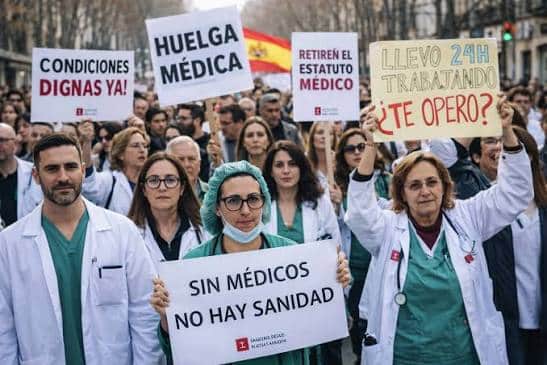
Doctors across Spain could begin an indefinite national strike in mid-October as their dispute with the Ministry of Health over proposed employment reforms intensifies.
The strike committee, which represents six major medical unions, has unanimously agreed to escalate industrial action against the Government’s proposed new Framework Statute for public healthcare workers. The decision must still be formally approved by the governing bodies of the participating organisations.
Union representatives were due to meet on Thursday, September 10, to finalise the structure, starting date and timetable of the action. Further details are expected to be announced before the weekend.
The committee includes the Spanish Confederation of Medical Unions (CESM), the Andalusian Medical Union, Metges de Catalunya, Madrid’s AMYTS association, the Basque Medical Union and Galicia’s independent doctors’ union O’MEGA.
Doctors argue that the proposed legislation fails to recognise the particular training, responsibilities and working conditions of medical professionals. They are demanding a separate statute and negotiating framework specifically for doctors, alongside a maximum 35-hour working week and significant changes to compulsory on-call duties.
The unions also want on-call hours to be better paid, properly reflected in pension calculations and made progressively voluntary. They claim doctors have been excluded from meaningful negotiations over conditions that directly affect them.
The Government’s draft legislation would replace regulations dating from 2003 and affect almost one million public healthcare employees. It includes measures intended to reduce temporary employment, strengthen work-life balance, establish a right to disconnect from work communications and bring professional classifications into line with European standards.
It would also reduce doctors’ standard maximum working week from 48 to 45 hours and generally limit continuous shifts to 17 hours, although longer voluntary duties could remain possible at weekends and on public holidays.
Medical unions insist those changes do not go far enough. They have described the reform as an imposition developed without adequate representation from the medical profession.
The legislation has been approved by the Council of Ministers and sent to Congress, where it faces a difficult passage. Although supported by several general healthcare unions, it has encountered political opposition and resistance from medical organisations.
Doctors staged five separate weeks of nationwide strikes during the first half of 2026. Further prolonged action could result in the cancellation of appointments, diagnostic tests and non-urgent operations, placing additional pressure on already lengthy waiting lists.
The unions say an indefinite strike could still be avoided if the Government resumes direct negotiations and offers substantial changes to the legislation.