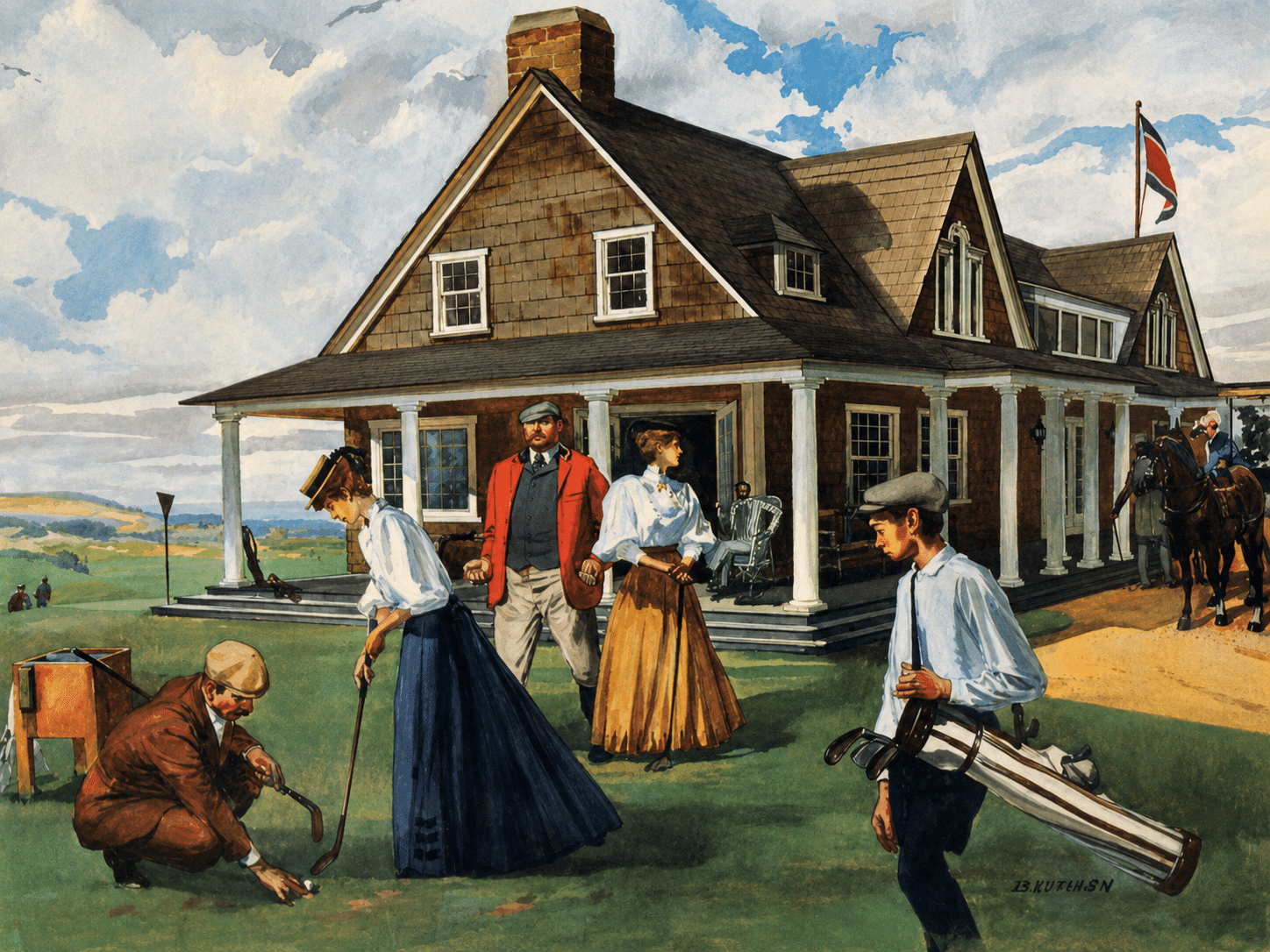

SHINNECOCK HILLS Golf Club, hosting the U.S. Open June 18-21st was constructed in 1891 on Long Island, N.Y. with the help of the local Shinnecock Indians. The course soon grew from 12 to 18 holes and in 1896 hosted the 2nd U.S. Open. Clubhouses were usually farm buildings, but the clubhouse at Shinnecock Hills was possibly the first designed for comfort, and faced the ocean to catch the breezes.
It was the first golf club in America to admit ladies; they had their own 9 hole course. With constantly changing wind direction, the course requires every club in the bag.
Unfortunately, despite an agreement reached before the last U.S. Open held there in 2018 ownership of the land is still hotly contested by the Shinnecock Indians, so players this year should get ready to duck, as the spectators coming over the hill could be waving bows and arrows.
ARNOLD PALMER’s only U.S. Open victory came in 1960 at Cherry Hills Country Club, Colorado. He was thought to be out of contention, commencing the final round 7 strokes behind the leader, but he drove the green on the 346 yd first hole setting up an opening birdie. Arnie shot 65, at that time the lowest round in U.S. Open history, and scored a 2-shot victory over an amateur named Jack Nicklaus. His driver is still on view at the club.
HAVING MISSED the CJ Cup Byron Nelson and the Charles Schwab Challenge Rory McIlroy is taking a break before the Memorial (June 4th.) After winning The Masters in April, McIlroy played in only the Truist before the PGA. He also skipped the Valspar, Houston Open and Valero Texas Open. Perhaps they can’t get a babysitter.
THE LATEST climate report suggests that Britain’s historical links courses could be washed away by 2100. Rising sea levels and coastal erosion will see them tumbling into the sea. Oh well, by 2100 they will probably have found a way to solve the problem, and anyway us oldies will be playing on a perfect course by then. Heavenly, in fact.
IN 2025 New Zealand’s Ryan Fox won the RBC Canadian Open in a playoff and 130,000 fans celebrated at the ‘Rink’ hole, complete with ice hockey boards and a penalty box. Fans dress up as referees and sing “O Canada” and golfers wear their favourite team jerseys. What started as a nod to Canada’s love of ice hockey and golf has grown into an exuberant fan experience that brings national pride to every Canadian Open. Held this year at Osprey Valley on June 8-14th. Donald Trump will not be invited.
LEE TREVINO has been called one of the finest shot-makers of all time, his signature shot being a very pronounced controlled fade. Tom Watson said “Trevino could turn a wedge right round a corner.” Leaving school aged 14 to earn money he became a caddie at the local golf club, playing after hours with discarded golfballs.
He served four years in the Marine Corps before returning to golf, and rose from playing money matches to entering the PGA Tour, where he shocked the world by winning the 1968 U.S. Open. Over 4 weeks in 1971 he won the Open, Canadian Open and the U.S. Open (defeating Nicklaus in a playoff) and he is one of only four players to twice win the U.S. Open, Open Championship and PGA.
Being struck by lightning on a golf course in 1975 should have ended his career, but nine years later aged 44 he won his sixth major. The kid from the cotton fields still joked his way round the course. Tony Jacklin once told him he didn’t want to talk during the round; Trevino retorted: “Tony you don’t have to talk, just listen.”
Now 86, he is still playing. “If it wasn’t for golf I don’t know what I’d be doing, if my IQ was 2 points lower I’d have been a plant somewhere.” As an antidote to the po-faced Dechambeaus of golf Lee Trevino will always be a tonic.
Until next time: Happy Golfing.