A decade after Britain voted to leave the European Union, polling suggests that more voters now view Brexit negatively than positively. Yet public dissatisfaction with its consequences has not produced an unequivocal mandate to reverse it.
Ten years after the referendum that transformed Britain’s political and economic direction, public opinion appears to have shifted decisively against the way Brexit has turned out.
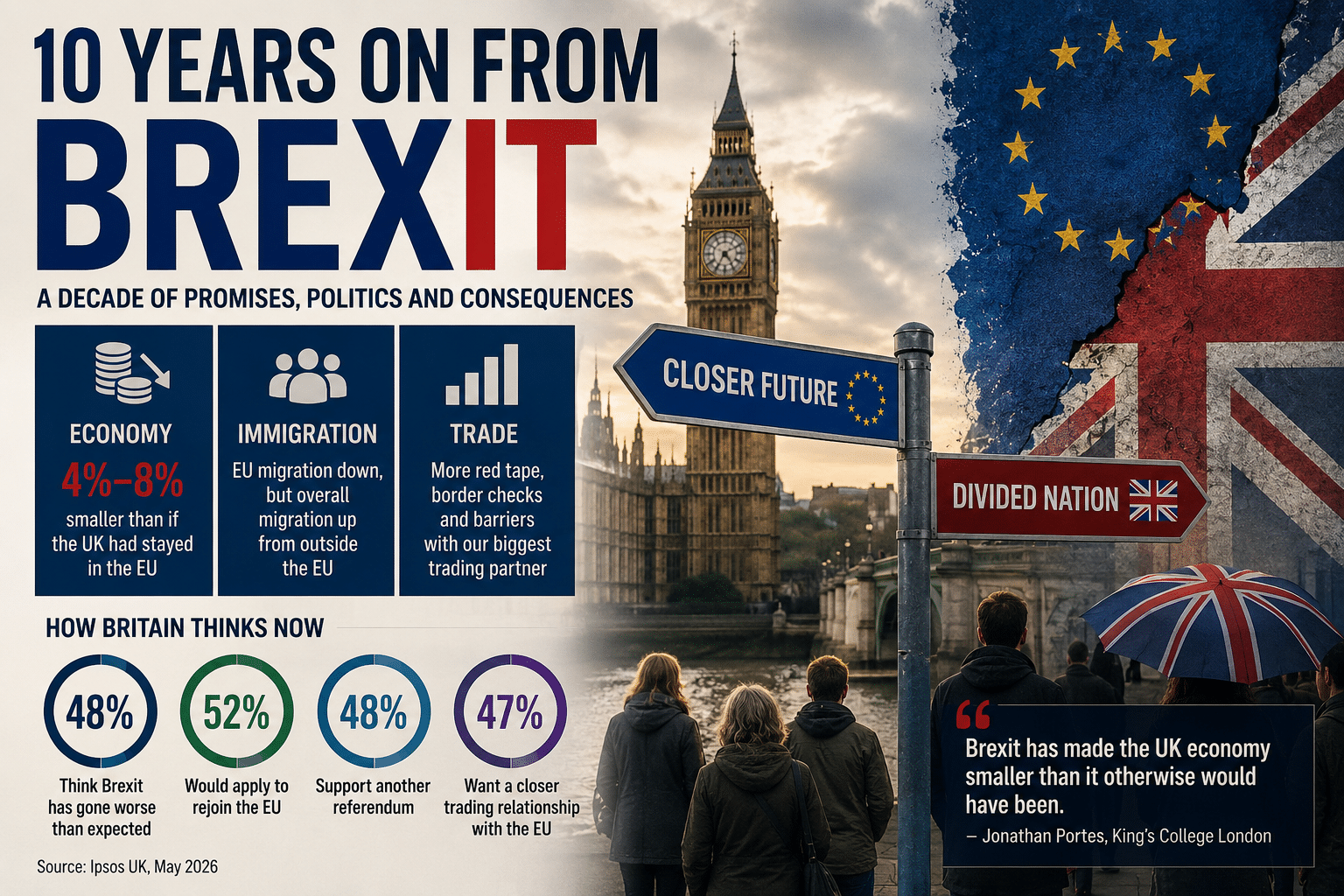
Polling by Ipsos in May 2026 found that 52% of people believe Britain should apply to rejoin the European Union, while 33% favour remaining outside. Among respondents who said they would be likely to vote in a future referendum, rejoining led by 58% to 37%. Excluding those who were undecided, that would translate into a result of approximately 61% to 39% in favour of seeking renewed membership.
The findings also reveal widespread disappointment with Brexit’s record. Some 48% said it had gone worse than they expected, while only 9% believed it had gone better. Between 48% and 49% supported holding another referendum, depending on whether it took place before or after the next general election.
The change in opinion is particularly pronounced among younger adults. Ipsos found that 68% of people aged between 18 and 34 supported applying to rejoin the EU. Older voters, particularly those aged 55 and above, remained more inclined to favour staying outside.
Political loyalties continue to shape attitudes. Large majorities of Labour, Liberal Democrat and Green supporters favour rejoining, while most Conservative and Reform UK voters prefer Britain to remain outside the bloc.
The figures point to growing Brexit regret, but the public mood is more complicated than a simple reversal of the 2016 referendum result.
Much depends on how voters are asked about Britain’s future relationship with Europe. There is strong support for greater practical cooperation with the EU, particularly in trade, security and defence.
Ipsos found that 47% wanted a closer trading relationship with the EU, compared with 16% who preferred a more distant one. Around 60% supported closer security and defence cooperation. A further 53% said they would accept EU citizens having the right to live and work in Britain in exchange for UK access to the European Single Market.
However, when closer European relations are presented as a trade-off against national control of immigration, attitudes become more restrictive. Some 52% said Britain should prioritise complete control over immigration, even if that resulted in a more limited relationship with the EU.
That finding suggests that many voters are dissatisfied with the results of Brexit without necessarily abandoning the concerns that helped produce the Leave victory in 2016. Questions of sovereignty, border control and democratic authority continue to resonate, even as support grows for reducing the economic barriers created by Britain’s departure.
Other surveys conducted around the tenth anniversary have produced similarly negative assessments. Respondents have blamed Brexit for worsening the cost of living, weakening the economy, reducing opportunities for younger people and making trade more difficult. Some have also concluded that Brexit failed to resolve concerns about illegal immigration.
Three-quarters of respondents in one survey said they wanted closer relations with the EU. But closer relations do not necessarily mean returning to full membership. For many voters, the preferred outcome may be a more cooperative and less confrontational relationship rather than the complete reversal of Brexit.
A GRADUAL ECONOMIC DRAG
The change in public opinion is closely connected to Brexit’s economic record.
Economic estimates cited around the anniversary suggest that the UK economy may be between 4% and 8% smaller than it would have been had Britain remained in the EU. Such estimates compare the economy’s actual performance with models of how it might have developed without Brexit, meaning the precise figure remains open to debate.
The broad conclusion, however, is that Brexit has acted as a gradual and cumulative constraint rather than causing an immediate economic collapse.
Trade, business investment and productivity have all been affected. British companies can continue exporting many goods to the EU without tariffs under the post-Brexit trade agreement, but tariff-free trade does not mean frictionless trade.
Businesses now face customs declarations, regulatory checks, product certifications, border procedures and restrictions on the movement of workers. These obstacles are particularly burdensome for smaller companies, which may lack the staff or financial resources required to navigate additional bureaucracy.
The European Union remains Britain’s largest trading partner, making the additional barriers economically significant. New trade agreements with countries outside Europe have provided opportunities in some sectors, but they have not compensated for the increased friction affecting commerce with neighbouring EU countries.
Supporters of Brexit argue that the project should be judged over a longer period and that the ability to set independent policies is valuable in its own right. They say short-term disruption was an expected price for regaining control over trade, regulation, migration and other areas previously influenced by EU institutions.
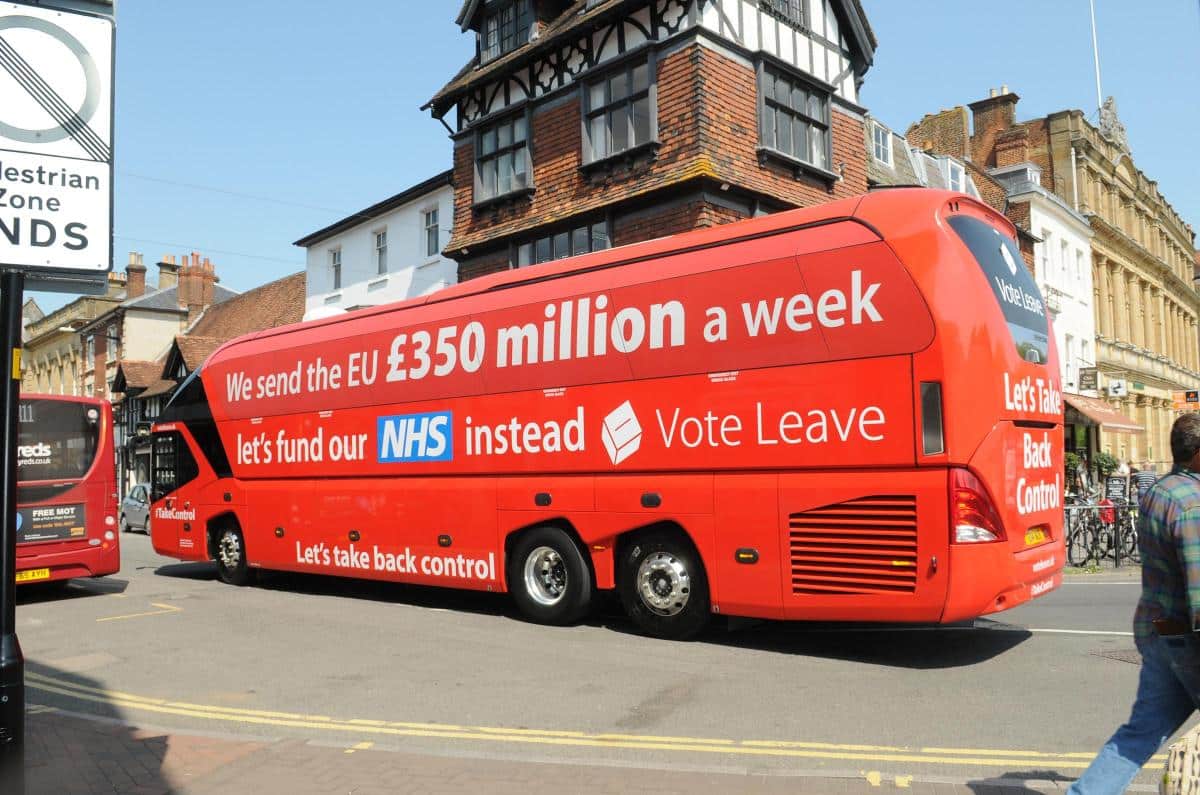
Critics respond that the promised economic benefits have not materialised at the scale presented during the referendum campaign. Instead, they say, Britain has experienced weaker trade growth, lower investment and continuing administrative costs.
Brexit therefore did not produce the dramatic overnight crash predicted by some of its opponents. Its economic effects have been slower and less visible: forgone investment, reduced productivity, lost export opportunities and additional costs accumulating over time.
IMMIGRATION AFTER FREE MOVEMENT
Immigration was one of the defining issues of the 2016 referendum campaign. Leave supporters argued that Brexit would allow Britain to regain control of its borders by ending the automatic right of EU citizens to live and work in the country.
Free movement between Britain and the EU subsequently ended, and migration from European countries declined. But overall immigration did not fall in the way many voters expected.
Instead, migration from outside the EU increased as employers, universities and public services recruited people through the post-Brexit visa system. Sectors including health care, social care, hospitality and agriculture continued to depend heavily on overseas workers.
Brexit therefore changed the composition and legal basis of immigration more clearly than it reduced the overall number of people coming to Britain.
The government gained greater formal control over who could enter through work and study routes, but the resulting policy choices often produced migration levels higher than those recorded before Brexit.
At the same time, public attention increasingly shifted towards asylum seekers arriving in small boats across the English Channel. Although these arrivals represent a relatively small share of overall immigration, they have become one of the country’s most politically contentious issues.
For voters who supported Brexit primarily to reduce migration, the distinction between greater legal control and lower overall numbers has proved significant. Britain may now possess more independent authority over immigration policy, but many people do not believe that this authority has delivered the results they were promised.
A LASTING POLITICAL DIVIDE
Brexit continues to shape British political identities long after the formal process of leaving the EU was completed.
The referendum divided voters by age, education, geography and social outlook. Those divisions subsequently cut across traditional party loyalties and contributed to years of political instability.
Brexit dominated successive Conservative governments, triggered repeated leadership crises and consumed parliamentary time. It also weakened long-standing attachments to the Conservative and Labour parties as voters increasingly organised themselves around Leave and Remain identities.
Reform UK has benefited from continuing dissatisfaction. Some of its supporters believe Brexit itself was a mistake, while others argue that it was never implemented fully or competently enough to succeed.
This distinction remains central to the political debate. Critics of Brexit regard its economic and diplomatic difficulties as evidence that leaving the EU was inherently damaging. Many committed Brexit supporters instead blame governments for failing to take sufficient advantage of the freedoms available outside the bloc.
As a result, the political argument is no longer simply between Leave and Remain. It is also a dispute over whether Brexit failed because of its underlying design or because of the way it was carried out.
REJOINING WOULD NOT BE SIMPLE
Growing support for closer EU relations does not mean that Britain can simply return to the position it occupied before the referendum.
Any application to rejoin would require the agreement of existing EU member states and would involve negotiations over the terms of membership. Questions would arise over freedom of movement, budget contributions, regulatory obligations, agricultural and fisheries policies, and Britain’s relationship with the euro and the Schengen travel area.
The opt-outs and special arrangements Britain previously enjoyed could not be assumed to remain available.
Public support for rejoining may therefore weaken or fragment when voters are presented with the practical conditions involved. A person who supports rejoining in principle may not support accepting freedom of movement, making substantial budget contributions or adopting a wider range of EU rules.
This helps explain why support for closer cooperation is broader and more stable than support for immediate full membership.
Measures to reduce trade barriers, improve mobility for younger people, strengthen defence cooperation and coordinate policies on energy, climate and security may command wider backing than a new membership application.
For any British government, the political challenge is to improve relations with the EU without reopening every aspect of the referendum debate.
REGRET, BUT NOT YET CONSENSUS
A decade after the vote, the balance of British public opinion has moved against Brexit.
More people now believe it has damaged the country than helped it. A modest majority supports applying to rejoin the EU when the question is asked in general terms, while even larger numbers favour closer economic, diplomatic and security ties.
The economic evidence helps explain that change. Brexit did not produce an instantaneous collapse, but the accumulated effects of weaker trade, lower investment, labour-market disruption and administrative friction have made it increasingly difficult to argue that leaving delivered the material benefits promised in 2016.
Nevertheless, Britain has not reached a settled consensus in favour of returning to full EU membership.
Immigration and sovereignty remain powerful concerns. Support for rejoining is sensitive to the obligations and compromises that renewed membership would involve. Many voters appear to want the economic advantages of closer integration while retaining the political control associated with remaining outside.
The most accurate conclusion, therefore, is not that Britain has become decisively pro-EU again. Rather, it has developed a broad majority against a distant or confrontational relationship with Europe.
Ten years after the referendum, Brexit regret is substantial. But the strongest public consensus is for a softer, closer and more pragmatic relationship with the European Union—not necessarily an immediate or unconditional reversal of the decision taken in 2016.