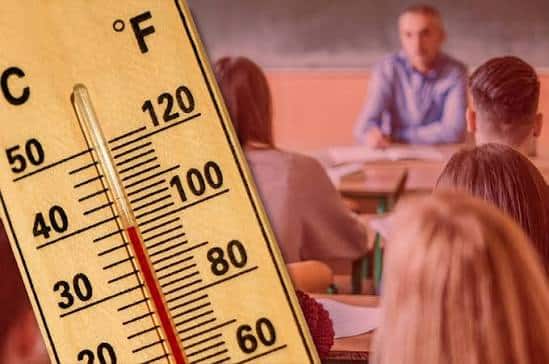
Thousands of pupils across Alicante province are set to return to classrooms in August-like heat, with most schools still lacking adequate air conditioning despite emergency funding announced by the Valencian Government.
The State Meteorological Agency, Aemet, predicts that the first 12 days of September could be the hottest recorded in Alicante since comparable records began. Classes resume on Wednesday amid temperatures expected to reach the mid-30s in several parts of the province.
The uncomfortable start follows an exceptionally hot end to the previous school year, when temperatures in some classrooms exceeded 30°C and cases of pupils fainting were reported.
Although the Generalitat allocated €6 million to improve thermal conditions at 587 educational centres in Alicante province, much of the equipment has yet to be installed. School representatives blame the delay on late instructions, complicated administrative procedures, shortages of equipment and a lack of available installation staff during August.
As a result, many pupils and teachers will return to classrooms offering little more protection from the heat than they had in June.
August conditions continue into September

The prolonged spell of high temperatures that began last Friday is expected to continue throughout the coming week.
Jorge Olcina, director of the University of Alicante’s Climatology Laboratory, said the start of the academic year would be affected by weather more typical of August.
“This period of high temperatures will affect the beginning of the school year,” he said. “It is not a heatwave, but a very prolonged period of high temperatures.”
Coastal areas are expected to record maximum temperatures of between 31°C and 34°C, while inland parts of the province could reach between 35°C and 37°C.
Conditions will remain uncomfortable after sunset, with overnight temperatures frequently staying between 23°C and 24°C. High humidity near the coast will add to the oppressive conditions, making temperatures feel even hotter.
Olcina attributed the weather to an area of high pressure accompanied by an influx of warm Saharan air. Although the African air mass is not considered particularly intense, it is helping to maintain conditions more commonly associated with the height of summer.
José Ángel Núñez, Aemet’s head of climatology in the Valencian Community, said temperatures would be far above the seasonal average.
“The coming days will be extremely warm, with temperatures considerably higher than is normal for this point in September,” he said. “They will even exceed those experienced on many hot days in the middle of summer.”
The highest temperatures are forecast inland, although coastal areas could reach 32°C to 34°C and may occasionally exceed 35°C. Warm nights and high humidity will also create particularly muggy conditions.
Another temperature record in sight
Aemet said that, while forecasts become less certain further ahead, current projections indicate that the opening 12 days of September could be the hottest ever recorded in Alicante city.
Temperatures are expected to exceed those registered during the same period in other exceptionally warm years, including 2004, 2014, 2022 and 2025.
On Wednesday, when pupils return to school, forecasts suggest temperatures could reach 36°C in Orihuela, 34°C in Elche and Villena, 33°C in Torrevieja and 32°C in Alicante city.
Benidorm is expected to reach 31°C, with highs of around 30°C forecast for Alcoy and Dénia.
The prediction follows an already record-breaking summer. Both July and August registered exceptional temperatures, continuing a pattern of summers beginning earlier and lasting longer.
Schools, however, remain largely unequipped to deal with the changing climate.
Funding came too late for many schools
Isabel Moreno, representing Alicante’s association of infant and primary school headteachers, said instructions governing the Generalitat’s cooling programme did not arrive until July 20.
Schools were consequently left with only a few working days to assess their requirements, obtain estimates, complete the necessary paperwork and order equipment before the August holiday period.
“It is impossible to manage everything required in ten days,” Moreno said.
Even relatively simple measures, such as buying fans or portable air-conditioning units, have been affected by shortages. Suppliers and installation companies were overwhelmed by a sudden surge in demand, while many businesses were operating with reduced staffing during August.
Moreno said most schools would therefore reopen in almost exactly the same condition as they finished the previous academic year.
“It is completely impossible to achieve adequate thermal comfort within this timeframe,” she said.
Although school leaders welcomed the additional funding, many believe it should have been used to finance permanent air-conditioning systems rather than short-term measures.
Installing fixed cooling systems is considerably more complicated because schools must obtain technical reports and ensure their electrical networks can cope with the additional demand.
“What we are asking for is not a temporary plan,” Moreno said. “We need a structural solution for climate control in educational centres.”
Electrical systems unable to cope
Joan Miquel Tomàs, head of occupational health at the STEPV teaching union, confirmed that the money had reached schools but said individual centres had been left to decide how best to spend it.
In many cases, the only realistic option was to purchase ordinary fans. Older school electrical installations may not have sufficient capacity to operate portable air-conditioning units safely, even though such equipment was among the measures recommended by the regional education authority.
Tomàs said centres had also struggled to find qualified staff to carry out installation work. The funding announcement triggered a rush of orders during the busiest part of the summer, when equipment was in short supply and many contractors were on holiday.
The result is that pupils and teachers face another term of improvised solutions, closed blinds and circulating fans while temperatures inside classrooms climb.
Education representatives insist that increasingly prolonged periods of extreme heat can no longer be treated as an occasional problem. They are calling for a long-term programme to modernise school electrical systems, improve insulation and install permanent cooling equipment.
Until that happens, Alicante’s schools will remain poorly prepared for summers that increasingly extend into the academic year.