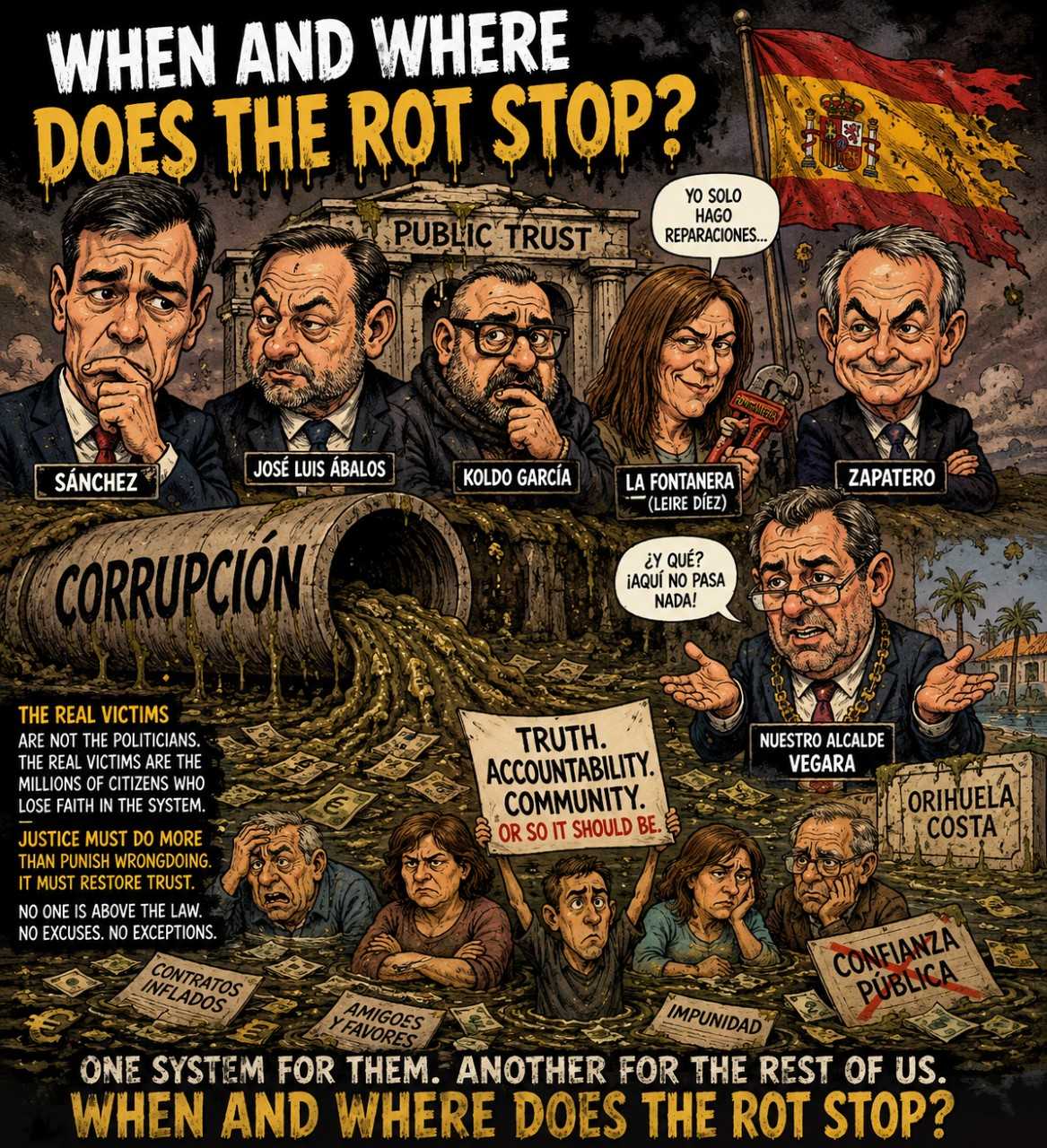

“Truth. Accountability. Community.”
Or so it should be.
Spain today faces two crises that are becoming increasingly difficult to separate: a corruption problem and a confidence problem.
Corruption itself is damaging enough. It drains public resources, distorts decision-making, and undermines the institutions that are supposed to serve the public interest. But the deeper and more lasting damage comes afterwards, when citizens lose faith in the very system that is meant to protect them.
The headlines seem endless.
Prime Minister Pedro Sánchez continues to face mounting political pressure as investigations and allegations swirl around individuals within his inner circle.
Former Transport Minister José Luis Ábalos has become embroiled in one of the most damaging political scandals in recent years.
His former adviser Koldo García has become a household name for all the wrong reasons, symbolising a growing perception that political connections often matter more than accountability.
Then came the revelations surrounding Leire Díez, quickly dubbed by many as “La Fontanera” (“The Plumber”), accused of operating in the shadows of political power.
And now we have the latest allegations involving Zapatero, a figure who once occupied the highest office in the land. Whether proven or disproven, every new accusation adds another layer of suspicion and public cynicism.
Closer to home, residents of Orihuela Costa cannot ignore the fact that our own Mayor, Pepe Vegara, continues to face legal proceedings relating to allegations dating back many years. Regardless of the eventual outcome, the simple reality is that such cases cast long shadows over public life.
This is no longer about one party.
It is not about the PSOE.
It is not about the PP.
It is not about the left or the right.
It is about a growing belief that there is one system for ordinary citizens and another for those who possess influence, connections, or political power.
That perception is corrosive.
Every scandal chips away at public confidence. Every delayed court case raises fresh questions. Every allegation, every investigation, every headline reinforces the feeling that accountability arrives slowly—if it arrives at all.
Meanwhile, ordinary Spaniards continue to pay their taxes, obey the law, and play by the rules. They watch as politicians promise transparency, integrity, and reform, only to see yet another scandal emerge months later.
The true victims are not only those directly harmed by corruption.
The real victims are the millions of citizens who begin to lose faith in democracy itself.
When trust disappears, cynicism takes its place.
When cynicism grows, participation falls.
When participation falls, democracy weakens.
Justice must do more than punish wrongdoing. It must be seen to act fairly, consistently, and without fear or favour. It must demonstrate that no individual, regardless of office or status, is above the law.
Spain cannot afford to normalise scandal.
It cannot continue lurching from one controversy to the next while public confidence erodes further.
The question many citizens are now asking is simple:
When and where does the rot stop?
Because until Spain restores trust, transparency, and genuine accountability, it will continue to suffer from both crises—the corruption problem and the confidence problem.
And in the long run, the second may prove even more damaging than the first.