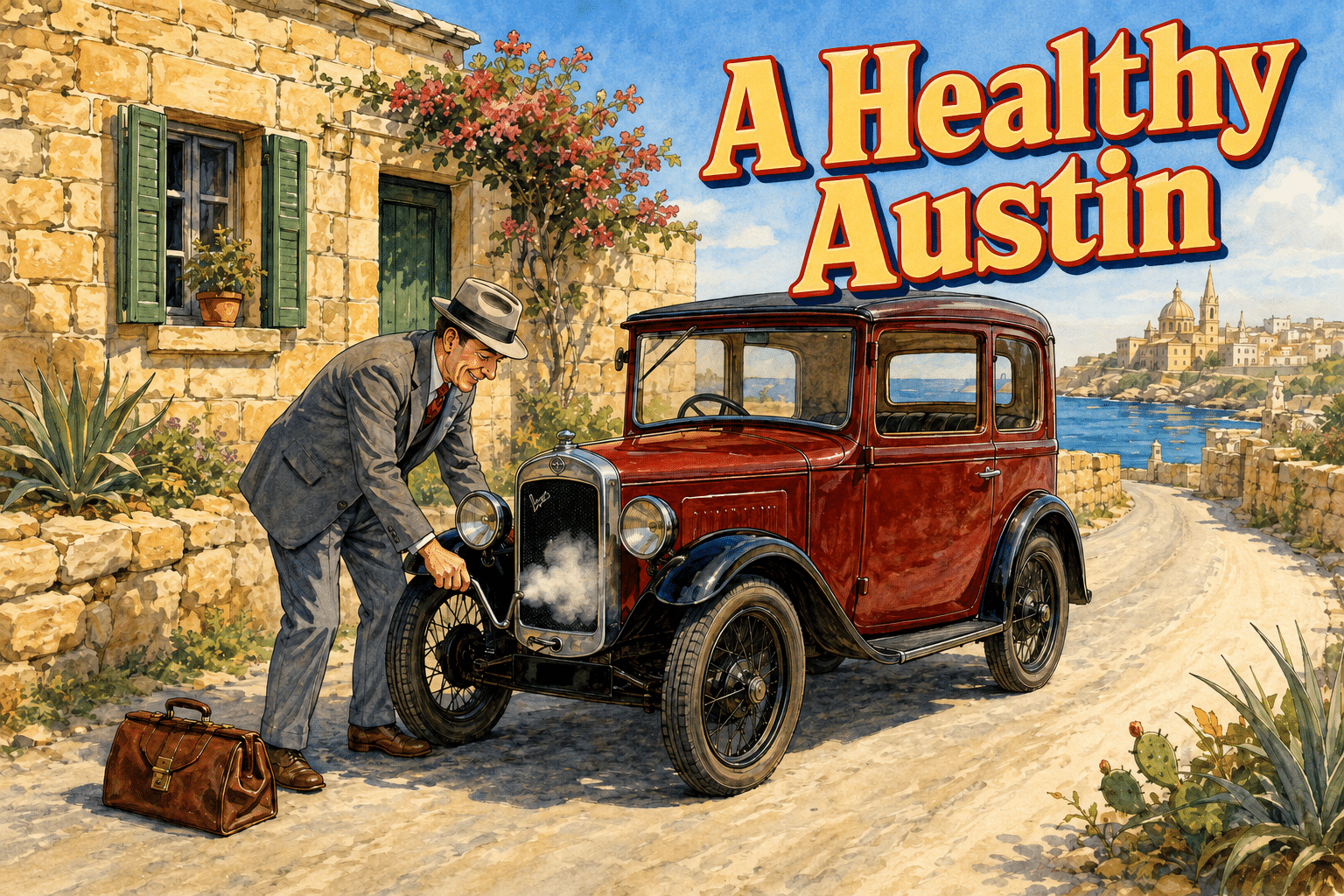

It was a bright, sunny day, and we were in Malta, that charming little island in the Mediterranean. We were on a break there for a few days and, as one does, touring around and looking at the sights. It was more than twenty-five years after the Second World War, and there, parked on what was otherwise an empty road, was a two-door Austin Ruby of early-1930s vintage.
Near where it was standing was a small cottage. Its door opened, and a well-dressed man carrying a briefcase made his way down a path towards the car. He put the case inside and then moved to the front of the vehicle, where he inserted a handle just below the radiator. With one practised swing, the little car’s engine started. It was such a wonderful opportunity to witness an action from the past—and yet so magnificent.
My guess was that the man was a doctor undertaking his house calls. This would have been a familiar sight in the UK around the time the car was produced, and certainly up to the beginning of the 1950s. What changed? The National Health Service.
The Austin car brand was exported around the world, and the company built factories in other Commonwealth countries. To this day, these famous cars have motoring clubs celebrating their design and build quality.
Both the motor industry and the Health Service expanded in their own ways. The car company grew, especially after the Second World War, exporting vehicles and earning money for the country. The Health Service went in a different direction.
It is well known that British history goes back more than a thousand years. Its currency is as old as the state. It seems that none of that matters, however, as the country’s proud history is no longer taught in schools.
As already stated, the motor industry grew during the period following the war. In the late 1950s, there were two million registered vehicles; that figure had ballooned to thirty-one million two years ago. By then, however, the British motor industry had been swamped by imports, contributing to the decline of the Austin marque.
A shop steward, reacting to some small or large grievance and without discussion, would stand up, blow a whistle and shout, “All out!” The workshop would then come to a standstill. The industry suffered by falling behind with orders it could not fulfil. Instead of management running the company, the unions were in control.
The National Health Service also grew, from 18,000 doctors at its inauguration to thirty thousand at the latest tally—and that is still not enough to cope. It is free to anyone who calls upon it, including visitors from overseas who can fly in for treatment and then fly home. The cost of running the service is a drain on the United Kingdom’s finances, and keeping pace with the number of people requiring healthcare is almost impossible.
Watching the decline over the years is heartbreaking. Now there is also the invasion of others who have openly said that they wish to take over the country and change its religion. There is a war developing: one side knows it, but the British people, with their sense of honesty and kindness, do not. If they do recognise it, they have no leadership from a government that seems determined to make change happen.
We were once a proud people, taking pride in the UK, its history, its fairness and its honesty. Sadly, that pride has been completely taken away, and I could weep for my beautiful country of birth as I watch it disintegrate.
Wildfires and the burning of ancient churches are, in my opinion, the beginning—hopefully not the end.
Take care.
© Percy Chattey
Percy