
Another end-of-month pleno in Orihuela, another demonstration of how a municipality can talk endlessly while achieving absolutely nothing. The chamber fills, the cameras roll, hands go up — and residents brace themselves for the familiar spectacle: not governance, not leadership, but ritualised hostility masquerading as democracy.
Government benches vote as instructed, opposition benches howl on cue, and somewhere beneath the shouting lies a simple truth everyone in the room already knows — the outcomes were decided long before anyone opened their mouth. Debate is theatre. Votes are choreography. The public is the unpaid audience.
Critical issues — infrastructure decay, neglected parks, failing services, the long-standing grievances of Orihuela Costa — are treated less as problems to solve than as ammunition to fire across the chamber. Each intervention is crafted not to improve the municipality but to wound political opponents. Every speech is less a proposal than a performance for party headquarters and social media clips.
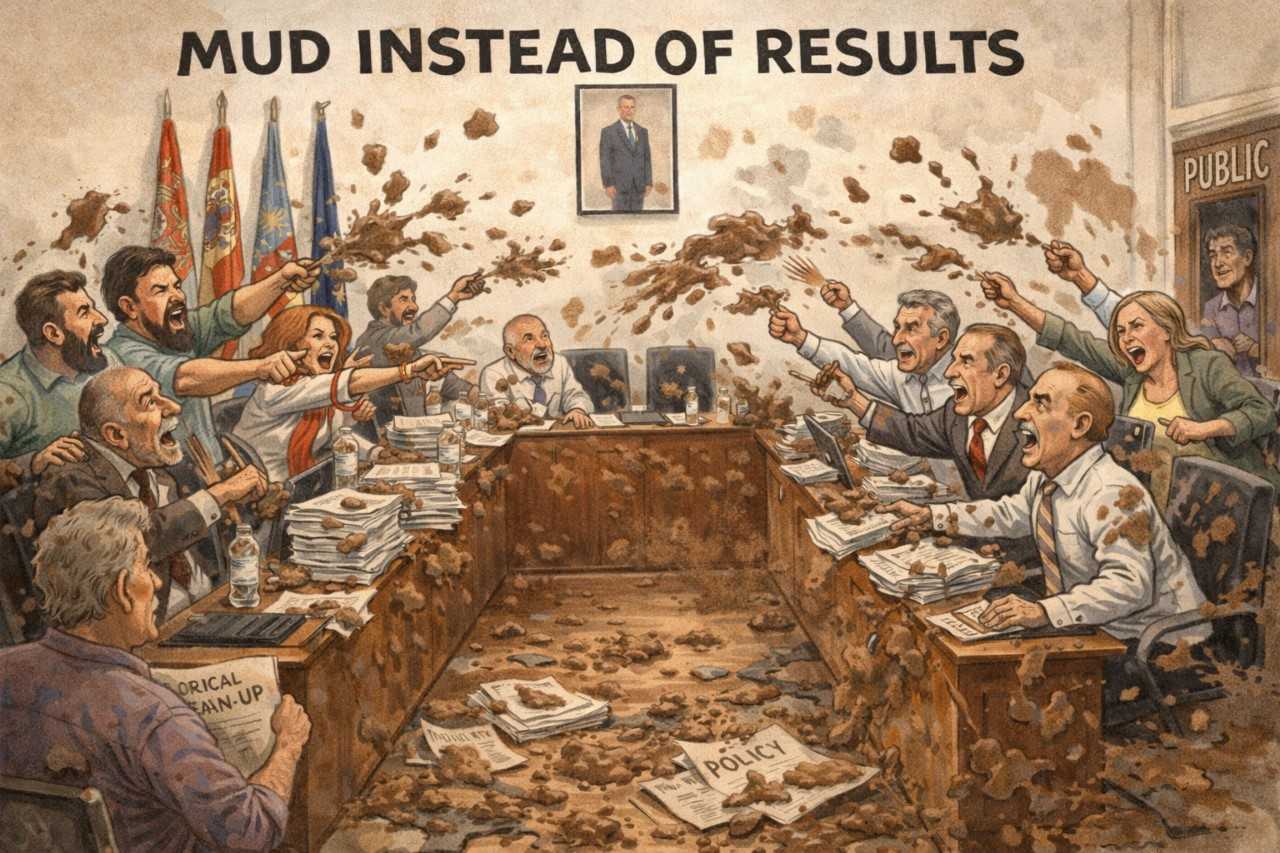
The result is a grotesque inversion of public service. Instead of governing, councillors compete to prove who can be the most outraged, the most accusatory, the most theatrically indignant. Mud flies — rhetorical, personal, sometimes barely disguised — until the chamber resembles less a seat of local government and more a playground fight conducted by adults who should know better.
Meanwhile, outside those wood-panelled walls, real life continues. Roads crumble. Public spaces deteriorate. Services falter. Residents wait. Businesses adapt. Families cope. The gap between political noise and lived reality widens month by month, pleno by pleno.
What makes the spectacle especially corrosive is its predictability. Everyone involved understands the script. Government will defend everything, opposition will condemn everything, and neither side will concede anything. Cooperation — the one ingredient that might produce actual results — is treated as weakness rather than responsibility.
This is not merely inefficiency; it is institutionalised paralysis. A system in which conflict is rewarded and solutions are optional. A municipality trapped in permanent campaign mode, where the next election matters more than the next improvement.
The real casualty is public trust. When citizens see their representatives behave like entrenched factions rather than problem-solvers, they disengage. Politics becomes background noise — loud, constant, and increasingly irrelevant. Cynicism takes root, and once it does, rebuilding confidence becomes infinitely harder than repairing a road or reopening a park.
Orihuela deserves better than governance by shouting match. It deserves leaders who understand that municipal politics is not supposed to be ideological warfare but practical administration. Streetlights, waste collection, planning decisions, safety, infrastructure — these are not abstract debates but daily realities.
Yet pleno after pleno delivers the same message: performance over progress, confrontation over competence, mud instead of results.
Until that changes, the chamber will remain exactly what it has become — not the engine of a functioning municipality, but a stage where nothing meaningful happens except the illusion that something did.
And the people of Orihuela will continue to pay for a government that talks constantly while the Town of Orihuela Costa itself waits for action, Orihuela Costa is A Town in All but Name