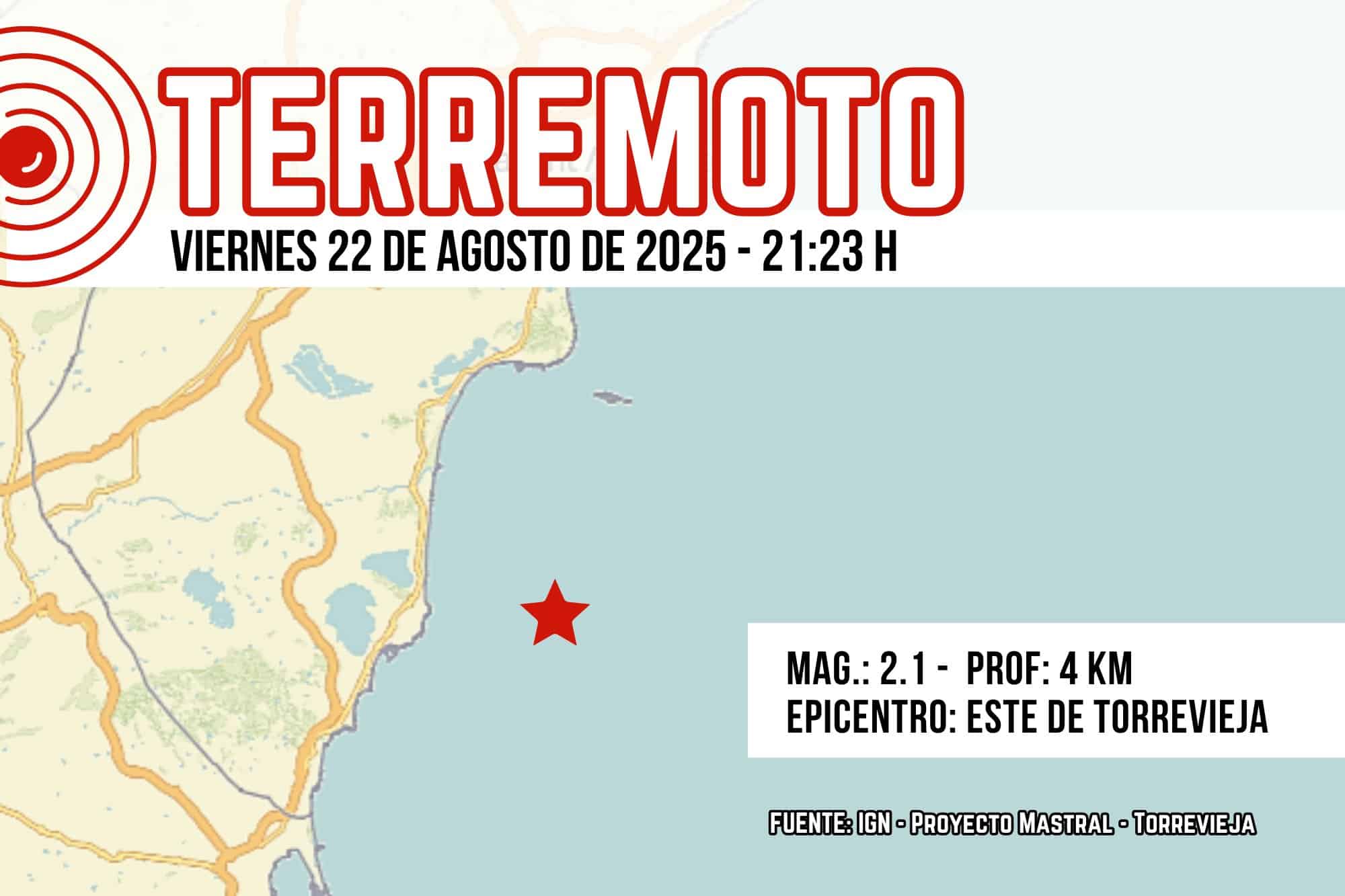
Torrevieja experienced a minor earthquake on Friday night at 9:23 p.m., registering a magnitude of 2.1 on the Richter scale. According to Spain’s National Geographic Institute (IGN), the tremor occurred offshore at a depth of 4 kilometers, with its epicenter located just off the town’s urban seafront.
Local weather and community platform Proyecto Mastral shared the information on its X (formerly Twitter) account, asking residents whether they had felt the tremor. So far, responses suggest that the quake went largely unnoticed.
A Region with a Seismic Past
While Monday night’s quake was minor and posed no danger, Torrevieja and the surrounding Vega Baja area are no strangers to seismic activity. The region sits near geological fault lines, and small earthquakes are relatively common.
The most devastating event in the town’s history was the earthquake of March 21, 1829, which struck the Vega Baja del Segura region with a magnitude estimated at 6.6. That disaster destroyed several towns, killed nearly 400 people, and prompted significant reconstruction efforts, including the redesign of Torrevieja’s urban layout to better withstand future seismic events.
Although modern tremors are usually weak and rarely felt, local authorities and safety experts continue to emphasize preparedness in a region with a long memory of seismic risk.
What to Do in Case of an Earthquake
Even in the case of mild tremors, residents are advised to follow basic safety guidelines:
- Stay calm and avoid running outside during shaking.
- If indoors, seek cover under sturdy furniture or stand in a doorway or against an interior wall.
- If outdoors, move away from buildings, trees, and power lines.
- After the quake, check for potential hazards such as gas leaks or structural damage.