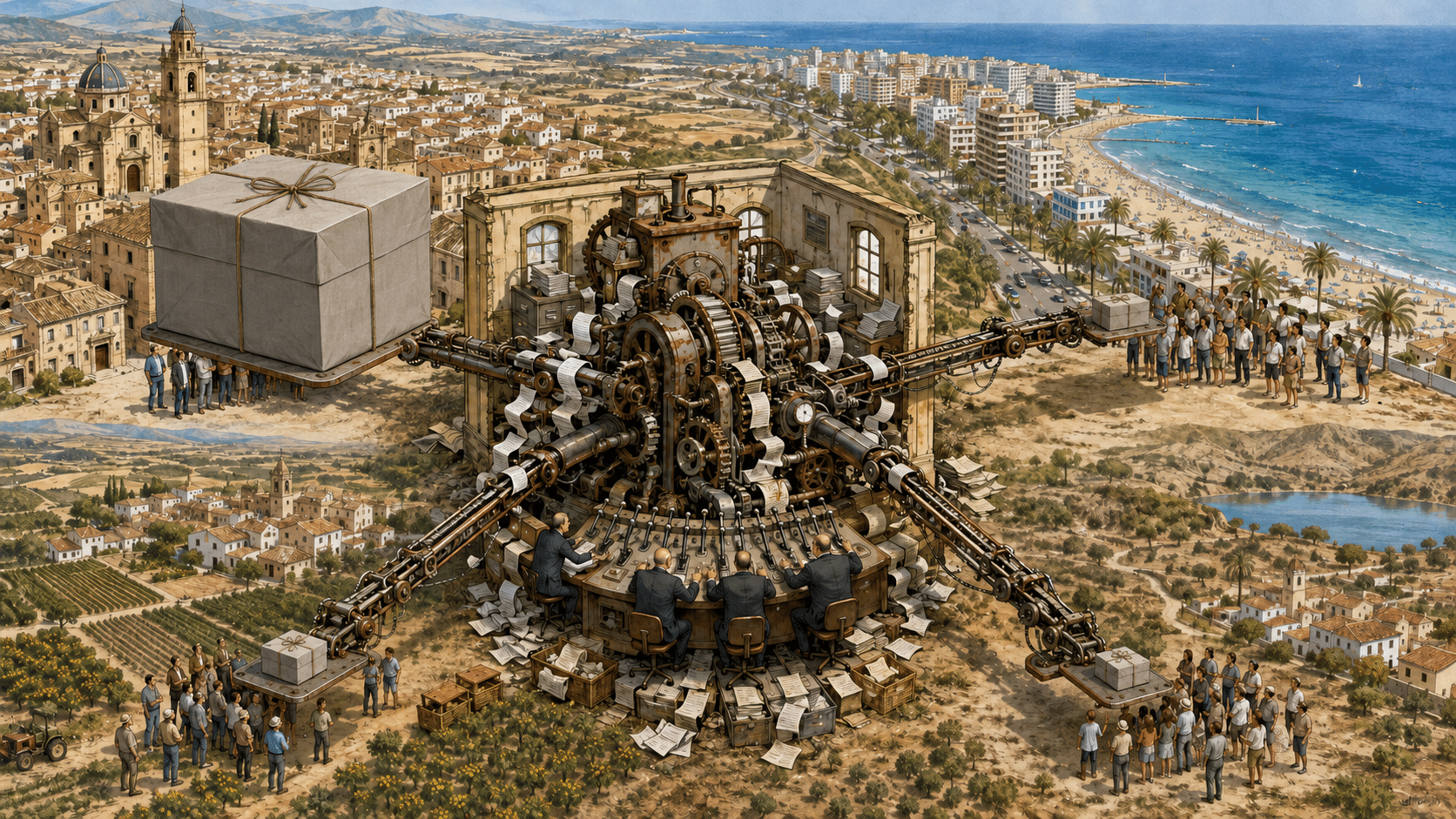
The Party for the Independence of Orihuela Costa (PIOC) has described Orihuela’s administrative model as completely outdated, arguing that it is one of the principal causes of the inefficiency that has affected the municipality for decades.
According to PIOC, the present system was designed for a reality that no longer exists. The party argues that decisions affecting an exceptionally large, diverse and geographically dispersed population remain concentrated among a relatively small group based in one part of the municipality.
Orihuela, it says, cannot be treated as a single, uniform community. La Murada, with approximately 3,500 residents, has very different needs from Torremendo, Orihuela city and Orihuela Costa. Attempting to govern these distinct areas through one centralised structure, applying the same priorities, procedures and criteria, inevitably produces poor results.
PIOC claims the consequences can be seen throughout the council’s financial and administrative record. It alleges that some municipal contracts have incurred additional costs of around 30 per cent.
The party also says that only six municipal budgets have been approved during the past 15 years, which it describes as an exceptionally poor record for a Spanish council. Even when budgets have been agreed, PIOC claims that no more than 40 per cent has been implemented.
In its view, these figures demonstrate that the existing structure cannot respond effectively to residents’ needs or convert available public money into completed projects.
Questions Over Investment Priorities
PIOC has also questioned the amount of public money invested in major facilities in Orihuela city and whether their use justifies their cost.
It cites the bullring, the former CAM building—which the party says is intended to become a third auditorium—and the Rubalcava Palace. Millions of euros have been spent on the palace, yet it remains closed.
Meanwhile, PIOC points out that Orihuela Costa, despite having tens of thousands of residents, still lacks a dedicated cultural centre.
The party has also raised questions about the number of museums maintained in Orihuela city. It argues that the scale of this cultural infrastructure would be more appropriate for a city of 500,000 people and claims that many of the museums receive no more than ten visitors a week.

PIOC insists that it is not opposed to culture or the protection of Orihuela’s heritage. Its concern, it says, is the apparent lack of proportion between the money invested, the population’s most pressing needs and the eventual use of the facilities.
Failure to Implement External Funding
The party considers Orihuela’s record of managing grants from other administrations even more troubling.
It says the municipality has previously returned—or failed to implement—funding provided by the Spanish Government and European Union, including money allocated through the EDUSI sustainable urban development programme.
For PIOC, securing funding but failing to complete the necessary projects within the established deadlines points to a structural weakness in municipal management.
The party also rejects the idea that the primary objective of administrative reform should be to create the cheapest possible council.
“A town hall’s function is not to be cheap, but to be effective,” it argues.
An administration may limit its spending while continuing to provide inadequate services. The true measure of success, according to PIOC, is whether residents’ taxes are transformed into reliable services, useful infrastructure and efficiently completed projects.
The party claims Orihuela Council is both inefficient and expensive, pointing to more than 20 political advisers who collectively cost the municipality over €1 million annually.
Dissatisfaction Across the Municipality
PIOC says widespread criticism on social media illustrates the depth of public dissatisfaction with the present system.
Complaints about street cleaning, maintenance, infrastructure, public services and council management are repeatedly raised by residents of Orihuela city, the rural districts and Orihuela Costa.
The party therefore acknowledges that dissatisfaction is not confined to the coast. Instead, it sees a municipality-wide perception that the current administrative structure is failing communities in every part of Orihuela.
PIOC argues that the answer is not to enlarge the existing bureaucracy but to decentralise it and bring decision-making closer to residents.
Proposed Territorial Reorganisation
The party proposes creating two distinct administrative areas. The first would comprise Orihuela city and the districts wishing to remain connected to it. The second would combine Orihuela Costa and Torremendo under an administrative structure designed specifically around their needs.
PIOC believes the discussion should extend further. It argues that La Murada should be allowed to become an independent municipality.
With approximately 3,500 residents, La Murada has a population comparable to—or larger than—many Spanish municipalities that already operate their own councils and provide more accessible local government.
PIOC also proposes that Torremendo should be permitted to become a smaller local administrative entity, giving it greater control over its affairs and improving the delivery of services to residents.
The party maintains that the issue involves far more than redrawing boundaries. It requires formal recognition that a municipality of Orihuela’s geographical size and demographic diversity can no longer be governed as though every area has identical priorities.
Smaller administrative units, it argues, would bring decisions closer to the public, improve accountability, reduce bureaucracy and allow resources to be directed more effectively.
For PIOC, the debate about Orihuela’s future must therefore consider more than which political party controls the council. It must also address whether the administrative model itself remains fit for purpose.
Its conclusion is unequivocal: Orihuela requires profound territorial and administrative reform—not simply to create smaller or cheaper councils, but to establish public administrations that are closer to residents, more accountable and considerably more effective.