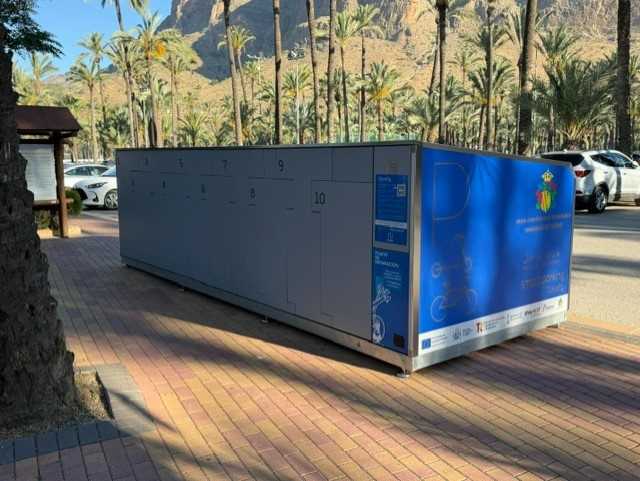
Orihuela City Council has launched four secure smart parking stations for electric bicycles, but none of the new facilities has been installed in Orihuela Costa.
The first phase of the scheme has focused entirely on Orihuela city and its surrounding districts, despite the council presenting the project as an initiative designed to support sustainable tourism, improve mobility and help visitors explore the municipality.
The four modular parking stations have been installed at Miguel Hernández Intermodal Station, El Palmeral Sports Centre and the Miguel Hernández University campuses in Desamparados and Las Salesas.
No facility has been provided in Orihuela Costa, one of the municipality’s busiest tourist areas and home to a large permanent population.
The project has been introduced by the Tourism Department as part of Orihuela’s Tourism Sustainability Plan and has been financed entirely through the European Union’s Next Generation EU funds.
Tourism Councillor Gonzalo Montoya said the main objective was to offer residents and visitors new ways to travel around and enjoy Orihuela’s heritage.
However, the decision to locate all four parking stations inland is likely to raise further questions over the distribution of municipal investment between Orihuela city and the coastal area.
Orihuela Costa includes numerous beaches, residential developments, commercial centres and tourist attractions spread across a wide geographical area. The lack of reliable public transport and safe cycling infrastructure has repeatedly been identified as a major concern for residents and visitors.
Despite this, the coast has been excluded from the opening phase of a scheme specifically intended to promote sustainable mobility, ecotourism and reduced carbon emissions.
Each parking module can accommodate up to ten bicycles in individual, enclosed and weatherproof lockers. The compartments are designed to protect bicycles against theft and vandalism while also providing space for helmets and personal belongings.
Every locker includes an electrical charging point, allowing electric bicycles to recharge while parked.
The units are powered by photovoltaic solar panels and include internal and external LED lighting for safe use at night.
Reservations are free and can be managed through a mobile application, which allows users to check the availability of lockers in real time. A physical numerical keypad is also incorporated into each unit, while technical support is available in the event of faults or access problems.
Although the council has described the scheme as the beginning of a wider network, it has not confirmed when, or whether, similar facilities will be installed in Orihuela Costa.
For coastal residents, the latest announcement is likely to be viewed as another municipal project from which Orihuela Costa has once again been left out.