
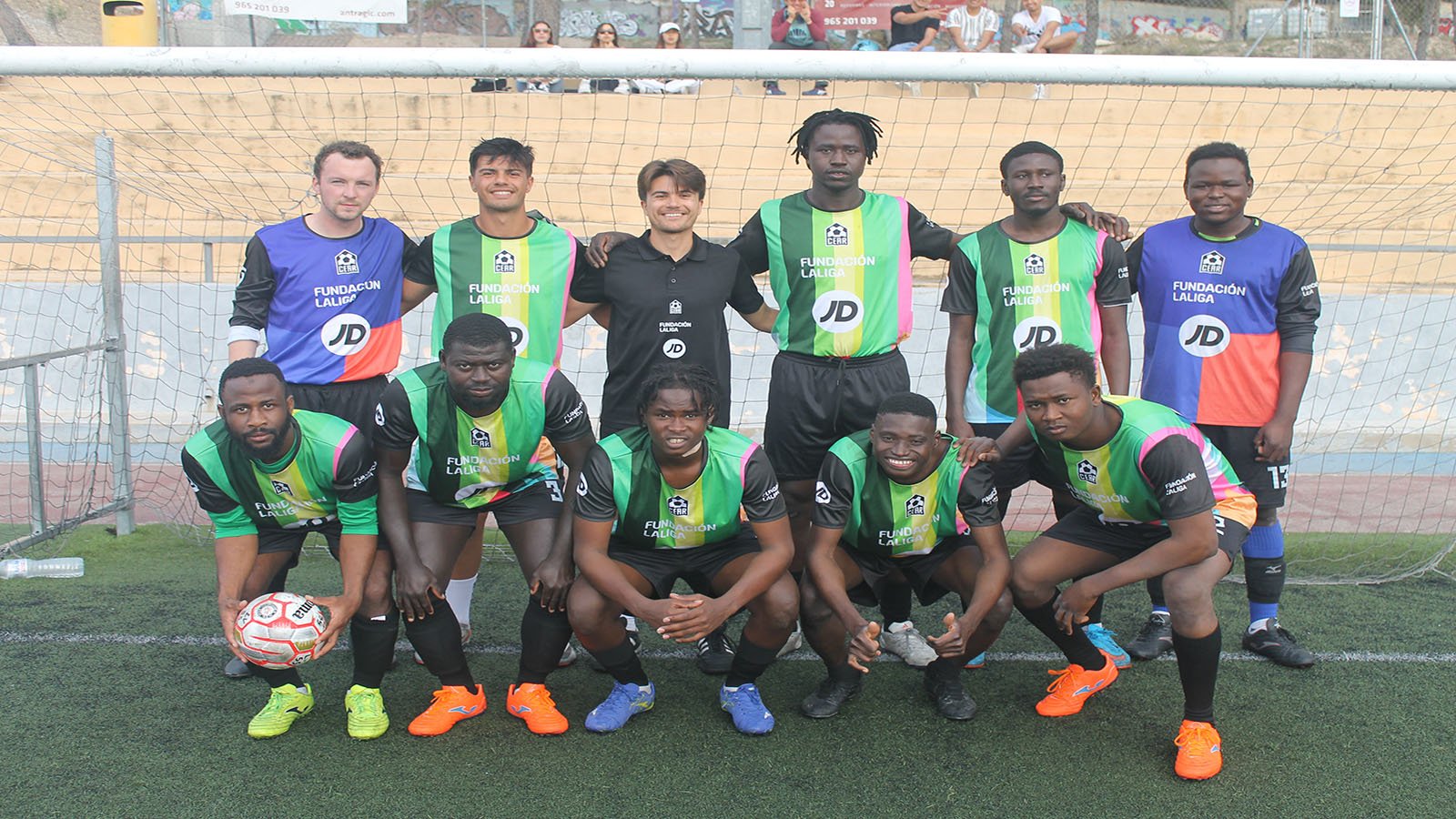
In Alicante, there is a 7-a-side football team that is doing much more than chasing goals—it’s creating a space where refugees from all over the world can feel at home.
CEAR CF, the football team of the Spanish Commission for Refugee Aid (CEAR), was founded in 2019 to provide migrants with a sense of belonging, social interaction, and emotional support. Since its inception, the project has expanded to cities including Madrid, Valencia, Gran Canaria, and Málaga, giving dozens of refugees a safe, structured space to connect each year.
For many players, football is more than a sport; it is a universal language that transcends borders and accents. Sergio Clemente, the team’s new coach this season, says: “Football is a magnificent platform for adapting to a new society.” Clemente, who also coordinates and plays for Hércules Paralympic, stepped in to lead the team after CEAR CF found itself without a coach.
The team competes in the Sixth Blue category of the Vistahermosa League, a private seven-a-side football competition in Alicante. Many of CEAR CF’s players cannot register with official federations due to incomplete documentation, so private leagues and the support of sponsors—including the LaLiga Foundation, JD Sports, and the Vistahermosa League itself—enable them to train and play. The league provides free field access and covers basic costs like equipment and player registration.
Sporting results have been mixed. This season, CEAR CF has won just one of seven matches. David Caracuel, the team’s social worker, explains that the high turnover of players is a major challenge. Refugees often relocate for work, housing, or immigration appointments, meaning the team must constantly adapt to new arrivals and departures.
For the players, football provides stability amidst uncertainty. Abdourahamane “Abdou” Bathily, a newcomer from Mali, describes his joy at finally playing: “I had never played football before; I watched it on TV since I was little, but there was no time to play.” For him, the team offers more than exercise—it gives him a community where he feels accepted and valued.
Veteran player Keoulin Keita, also from Mali, emphasizes similar benefits: “Football means a lot to me, it gives me health and joy and allows me to meet more people.” Keita has two full seasons with CEAR CF, having already obtained his legal documents and work in Alicante, and often helps guide new teammates who struggle with language or integration.
CEAR CF thrives on diversity. The squad includes players from Senegal, Mali, Ivory Coast, Morocco, Ukraine, and even the United States.
Volunteers from CEAR assist with integration, encouraging players to practice Spanish during training and fostering a supportive, inclusive environment. Despite limited resources the team trains with enthusiasm and joy.
Coach Clemente remains optimistic despite on-field challenges: “It’s always difficult to get going, especially in projects like this. But with the new signings and support from Hércules Paralympic players, I’m confident we’ll improve.” More than a team, CEAR CF functions as a microcosm of solidarity, bringing together young men navigating the hardships of migration while offering them a space to feel empowered, connected, and human.
For these footballers, CEAR CF is more than a seven-a-side team. It’s a lifeline—a place where skills, laughter, and camaraderie transcend nationality, language, and circumstance, proving that sport can be a true bridge for integration and belonging.


