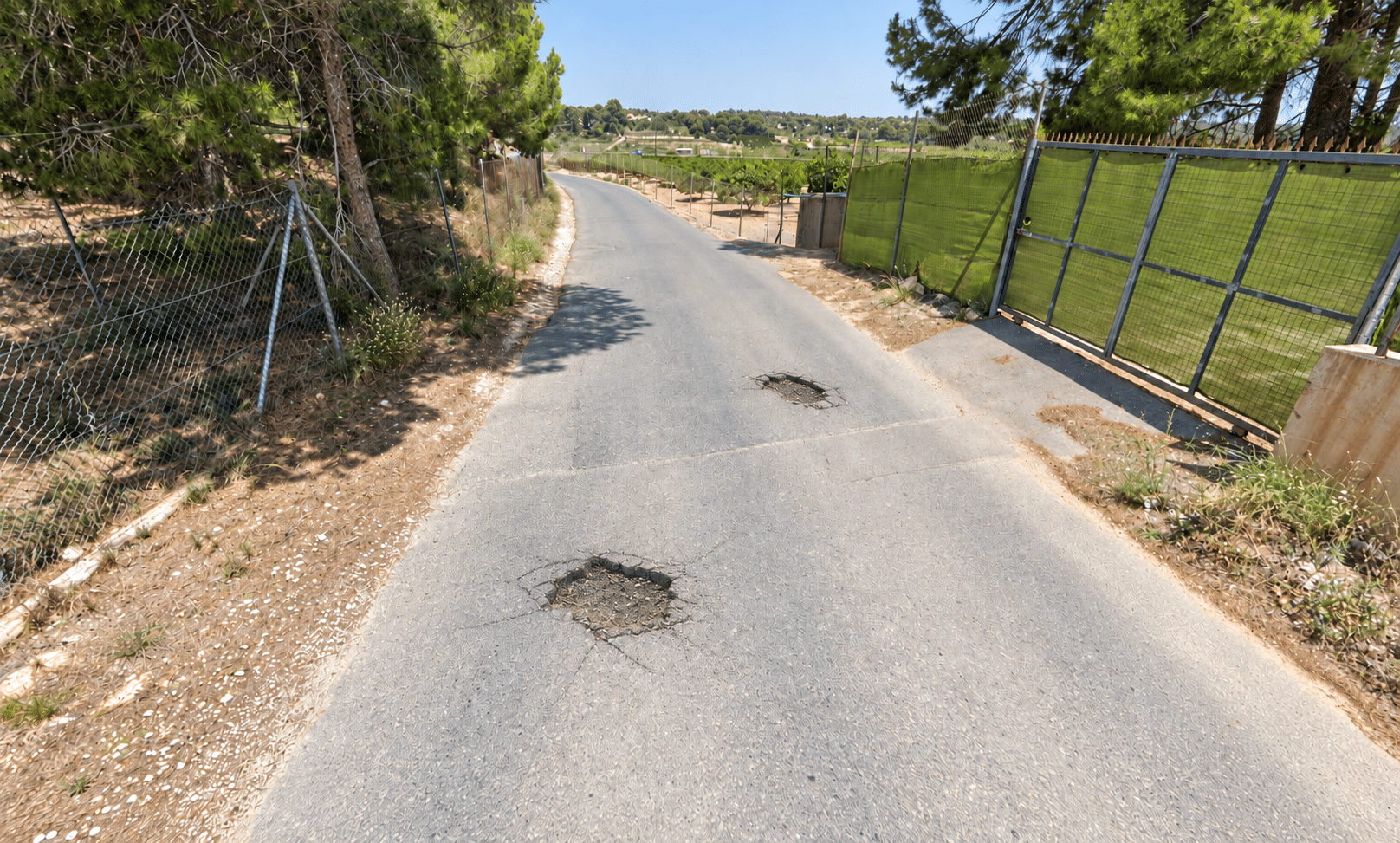
Pilar de la Horadada Town Council says it will use municipal funds to improve the deteriorating Lo Romero road after the Valencian Government rejected its application for financial assistance.
The road connects Pinar de Campoverde with the Region of Murcia and is regularly used by residents travelling to Los Arcos Hospital in San Javier, as well as nearby shopping centres, farms and agricultural businesses.
Residents have repeatedly called for the route to be repaired and widened, complaining of potholes, narrow sections and dangerous drops between the carriageway and its verges. Their frustration has increased during the summer as the council has undertaken an extensive resurfacing programme on streets in Pilar de la Horadada town centre.
The council submitted an estimated cost for the project to the Generalitat Valenciana last year and applied for funding through a regional rural-roads improvement programme. However, the application was unsuccessful.
Municipal sources said the council now intends to finance the entire project itself rather than continue waiting for assistance from other public authorities.
Vital Link for Campoverde Residents
Pinar de Campoverde has more than 5,000 residents, many of whom rely on services across the regional border in Murcia.
The Lo Romero road provides a shorter and faster route towards San Pedro del Pinatar and San Javier, avoiding the need to travel through Pilar de la Horadada to reach the AP-7 motorway or the N-332.
It is particularly important for journeys to Los Arcos Hospital, which is closer to Campoverde than Torrevieja University Hospital. Residents say the condition of the road is therefore more than a matter of convenience, particularly when urgent medical attention is required.
The route also provides access to the Dos Mares shopping centre and to farms, citrus plantations and greenhouses on both sides of the Valencian-Murcian border.
Beginning close to the CV-925 and the roundabouts at the entrance to Pinar de Campoverde, the Alicante section runs for approximately 2.5 kilometres and falls under municipal responsibility. Once it crosses into Murcia, it becomes the RM-F24, a road managed by the neighbouring regional administration.
Sharp Contrast at Regional Border
The difference between the two sections is immediately apparent.
On the Murcia side, the road is wider and generally well maintained. It has central and edge markings, a clean surface, level verges and few visible potholes. A prominent sign also welcomes motorists entering the region.
The Pilar de la Horadada section is narrower and affected by potholes and uneven edges. Residents say the sharp drops at the sides of the carriageway make it difficult for two vehicles to pass safely and have contributed to punctures and damaged tyres.
Part of the road also crosses the Cañada de las Siete Higueras ravine, where water can flow across the carriageway during episodes of torrential rain.
The deficiencies have been raised repeatedly with the council and are known to Mayor José María Pérez. Residents first formally demanded improvements and the widening of the route last year.
Funding Lost Through Priority System
The council’s application was submitted under a 2026 funding programme operated by the Valencian Department of Agriculture. The scheme was intended to help councils and smaller local authorities improve rural roads.
Pilar de la Horadada was not excluded because of an error or technical defect in its proposal. Its application was rejected because demand exceeded the available budget and other projects received higher priority scores.
Applications were assessed using several criteria, including population, municipal area, the risk of depopulation and whether the authority had received similar assistance during the previous four years.
Officials also considered whether the proposed work would improve access to agricultural, livestock or food-production facilities within a radius of 1,500 metres.
Where applications received equal scores, priority was given to municipalities belonging to the Valencian Network of Socially Responsible Territories. The authorities also considered a “rurality coefficient”, based partly on the proportion of cultivated land within each municipality.
The council said the route’s official classification had made it more difficult to attract outside investment. Although it provides an important cross-border connection, it remains classified as a municipal rural road that originally served the privately owned Lo Romero estate rather than as a secondary regional highway.
That status leaves Pilar de la Horadada responsible for the Alicante section, despite its daily use by residents travelling between two autonomous communities.
With no regional grant forthcoming, the council must now determine when the work can begin and how much will be allocated from municipal funds. Residents say they want a firm timetable and argue that the road should be treated as a priority because of its importance as the quickest route from Campoverde to essential medical and commercial services in Murcia.