An experimental artificial intelligence system introduced to ease congestion at one of Torrevieja’s busiest roundabouts is facing mounting criticism after drivers reported longer delays, greater confusion and increasingly angry scenes.
The Ministry of Transport activated the technology at the Rocío del Mar-Punta Prima roundabout in May. It is the first AI-controlled roundabout on Spain’s national road network and was intended to improve traffic flows at a junction used by almost 40,000 vehicles every day.
However, the system has faced its most demanding test during August, when the population of Torrevieja and Orihuela Costa increases dramatically. Residents and motorists say it has failed to solve the congestion and may simply have transferred much of the problem from the N-332 onto surrounding residential roads.
The roundabout connects the national highway with southern Torrevieja, Orihuela Costa and the residential areas of Punta Prima, Rocío del Mar and Señorío de Gomendio. It has been heavily congested for years, particularly during the summer.
Drivers believe the new system prioritises vehicles travelling along the N-332 while imposing longer waits on those attempting to enter from Avenida de Las Olas and Avenida de los Escorpiones.
The situation is particularly difficult on Avenida de Las Olas, which provides the only practical route to the N-332 for thousands of residents. Queues existed before the technology was installed, but motorists claim waiting times have increased since the system became fully operational.
Congestion is also spreading into nearby Calle Arrecife and Calle Pleamar, which many drivers previously used as shortcuts to the roundabout. Both roads can now become gridlocked during the busiest periods.
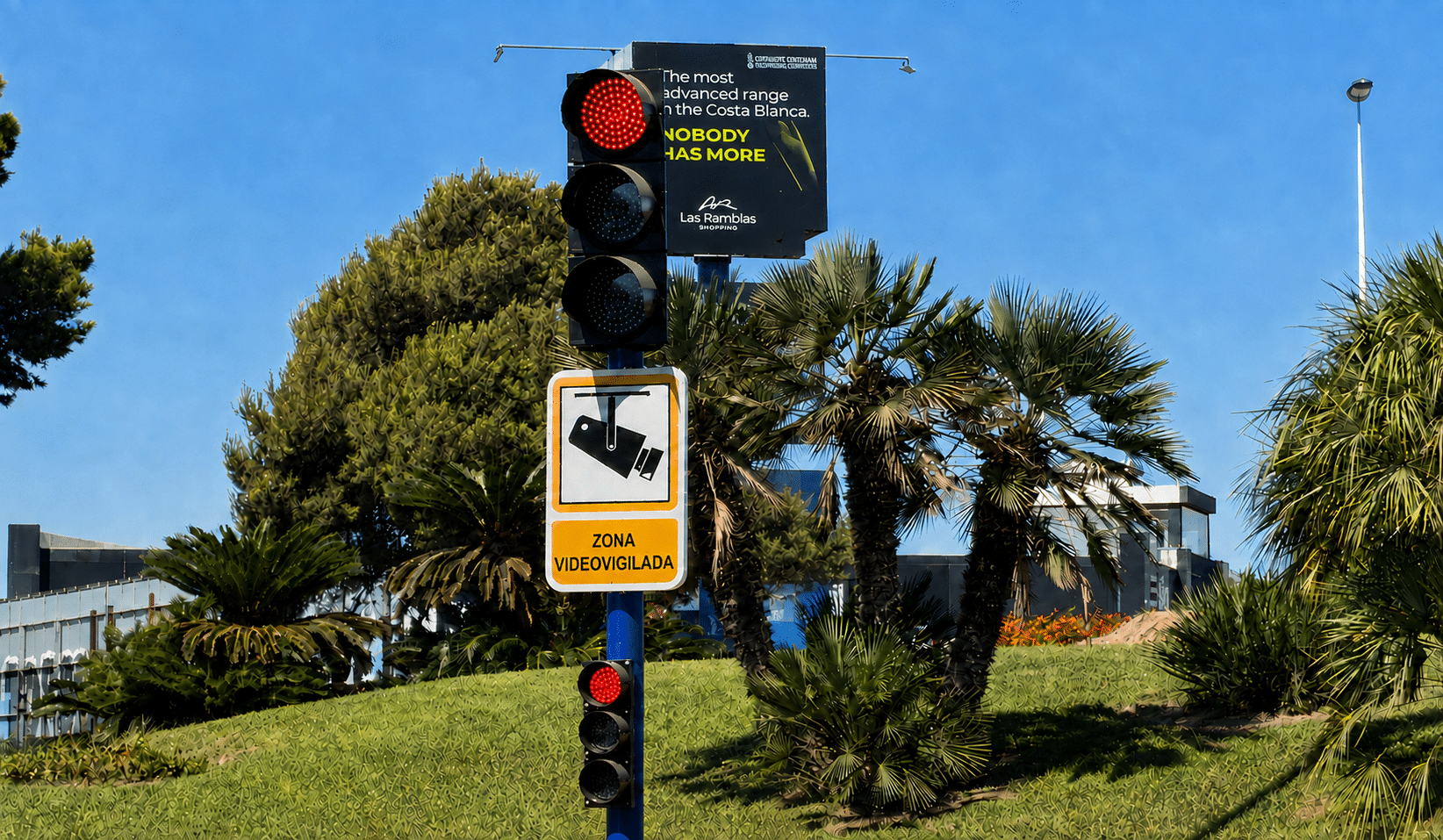
Unlike conventional signals operating through a predictable sequence, the roundabout’s lights respond to traffic volumes detected by cameras and monitoring equipment. Signals can flash amber or change to red according to decisions made by the control system.
The unpredictable changes have caused confusion among drivers. Some accelerate when they see a flashing amber light, while others become trapped at red signals for extended periods. Motorists who stop are frequently met with horns from frustrated drivers behind them, while an increasing number of vehicles have reportedly been seen ignoring red lights.
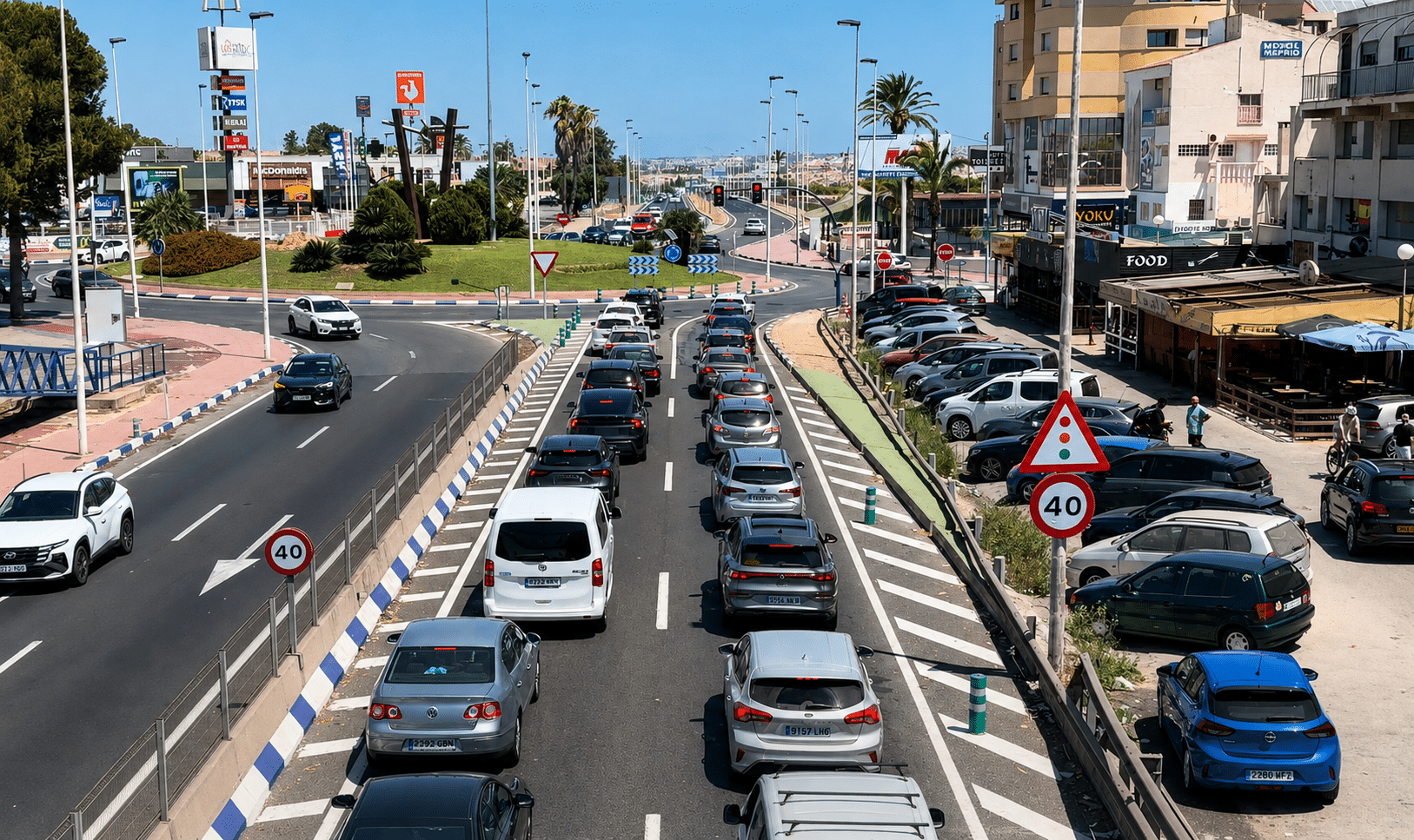
Residents living beside Avenida de Las Olas complain that the system has brought more noise, idling engines and pollution outside their homes.
The longest delays are generally reported on Avenida de Las Olas, followed by the northbound N-332 approaching Torrevieja. At busy times, queues on the national road have extended for more than a kilometre towards the Alameda del Mar roundabout.
Avenida de los Escorpiones also experiences substantial congestion, while traffic travelling south from Torrevieja towards Orihuela Costa and Pilar de la Horadada appears to be affected to a lesser extent.
The €409,369 project is financed through the European Union’s Recovery, Transformation and Resilience Plan. It combines cameras, vehicle-detection equipment and data-collection devices with machine learning, neural networks, traffic modelling and conventional road-engineering techniques.
Information gathered by the equipment is intended to allow the system to learn from changing traffic patterns and adjust signal timings automatically. Signs warning motorists about the surveillance cameras have now been erected, although the equipment reportedly does not include automatic number-plate recognition or enforcement technology.
Transport officials have acknowledged the experimental nature of the project. Similar systems exist elsewhere, but this technology is not yet routinely used to control roundabouts on Spain’s national road network because its performance can be affected by numerous variables.
For residents, that means Punta Prima has effectively become a testing ground. While the system gathers information and attempts to improve, local drivers continue to endure lengthy and unpredictable journeys simply to leave their neighbourhoods.
Artificial intelligence cannot overcome the roundabout’s fundamental problem: decades of residential and tourism development without sufficient investment in road capacity or alternative public transport.
Residents on both sides of the Torrevieja-Orihuela boundary continue to argue that only the long-promised widening of the N-332 through Torrevieja will provide a lasting solution. The project passed an important environmental stage, but there has been little visible progress for more than a year.
For motorists sitting in queues beneath the cameras, sophisticated algorithms are proving no substitute for additional lanes, better access roads and long-overdue infrastructure investment.