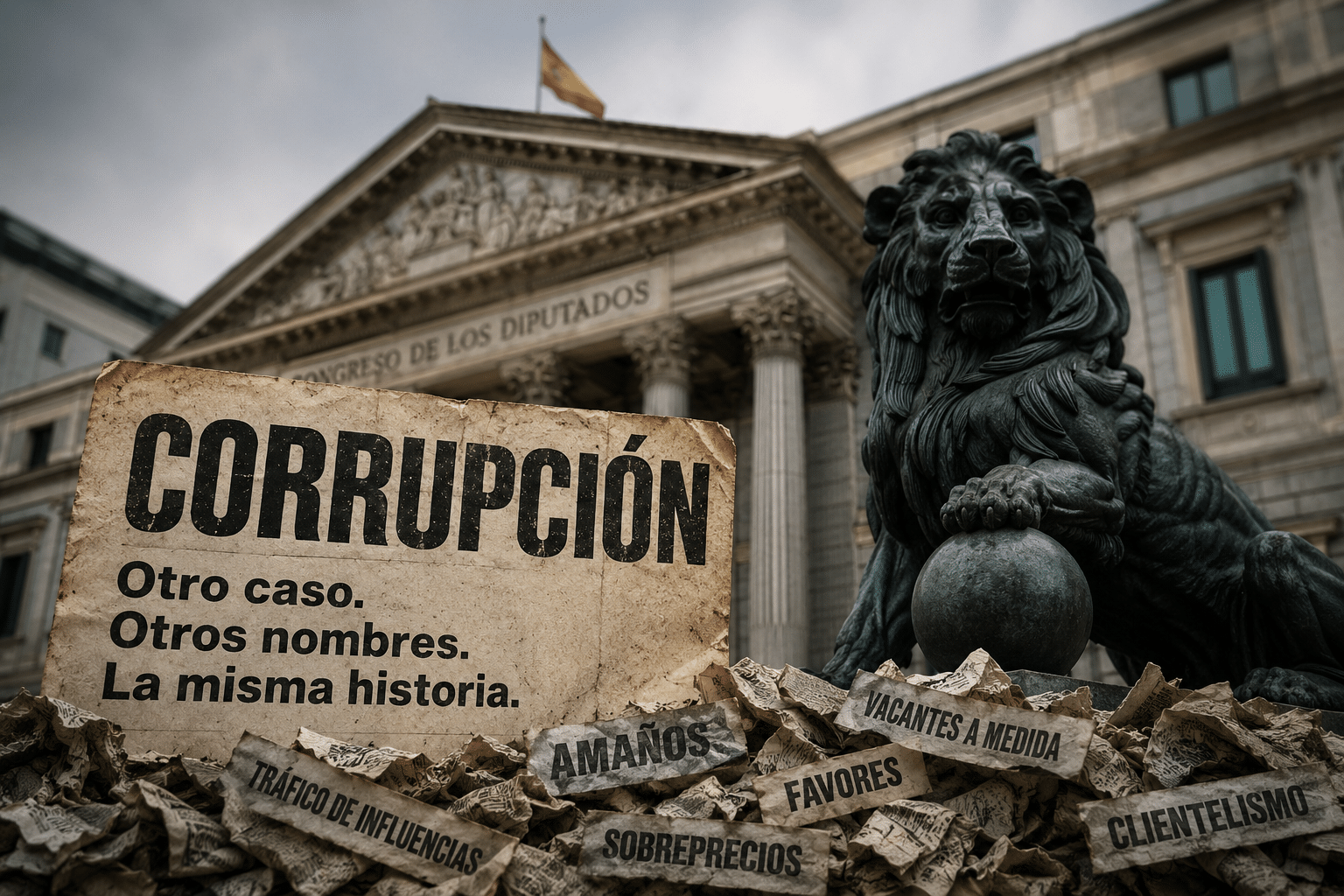
Spain is not a country oblivious to political corruption. Quite the opposite. The public sees it, talks about it, jokes about it, complains about it and, increasingly, expects it. That may be the most dangerous point of all.
After years of scandals involving parties across the political spectrum, many Spaniards appear to have moved beyond outrage into something more corrosive: resignation. Allegations of influence peddling, abuse of office, cronyism, opaque appointments and public money being used for private or party advantage no longer land with the force they once did. They are still noticed, but they are rarely shocking.
The mood is not ignorance. It is exhaustion.
For many voters, the reaction to a new corruption case is no longer “How could this happen?” but “Here we go again.” That phrase, repeated in bars, offices, homes and online forums, captures the state of political trust in modern Spain. The suspicion is not simply that one party is corrupt, but that the system itself protects those with access, contacts and power.
This is why corruption scandals do not always produce the political earthquakes that might once have followed. Parties survive. Ministers deny. Opponents rage. Investigations grind on. Supporters retreat into tribal defence. And the public, battered by the cost of living, housing pressures, strained public services and political polarisation, often files the latest scandal under the bleak heading of “normal politics”.
That does not mean Spaniards do not care. They do. But caring is not the same as believing anything will change.
This is the space where cynicism thrives. A voter may believe a politician is compromised and still vote for that party because they distrust the alternative even more. Another may dismiss allegations as politically motivated. Others may conclude that all sides are tainted, making corruption a moral stain but not necessarily a vote-switching issue.
That is the true damage: corruption becomes absorbed into the political landscape rather than treated as an emergency.
The danger for Spain’s democracy is not that citizens fail to recognise wrongdoing. It is that repeated wrongdoing, or even the repeated suspicion of it, weakens the public’s expectation of clean government. Once people assume politics is dirty by nature, the bar falls. Accountability becomes selective. Partisans demand resignations from opponents while excusing their own. Institutions are dragged into the fight and public confidence erodes further.
In that climate, every new case feeds a familiar narrative: connections matter more than merit, party loyalty opens doors, and ordinary citizens play by rules that the powerful can bend.
Spain has not become numb because corruption is minor. It has become numb because corruption feels permanent.
That is a bleak position for any democracy. The scandal is no longer only the allegation itself. The deeper scandal is that so many people now hear about another case involving politicians, relatives, advisers or public officials and barely raise an eyebrow.
They are not oblivious. They are tired. And tired electorates are far easier for broken systems to survive.
Corruption figures raise accountability questions across Vega Baja and Alicante Province
Vega Baja and the wider Alicante province have faced a persistent stream of corruption, fraud and misuse-of-office cases involving municipal politicians over the past decade, according to a review of publicly reported proceedings.
In Vega Baja alone, the conservative working figure stands at at least 12 corruption or fraud-related cases involving local politicians in the last ten years. Of those, at least six have resulted in reported convictions or judicial findings, while a broader count — including cases archived, pending, acquitted or still moving through the courts — rises to around 14 or 15.
Across Alicante province, the pattern is wider. A cautious province-wide count identifies at least 15 formal political corruption or fraud-related cases over the same period. When pending matters, acquittals, archived investigations and early-stage proceedings are included, the figure moves closer to 20 to 22.
The distinction matters. These figures do not mean that every politician named was convicted, nor that every allegation was upheld. Some cases ended in acquittal, others were shelved, and several remain unresolved. But the number of formal proceedings points to a deeper institutional concern: repeated allegations of prevarication, contract manipulation, tax fraud, and other offences linked to public office.
Vega Baja has been especially visible because of the judicial shadow over Orihuela, Bigastro, Catral, San Fulgencio and other municipalities. Orihuela, in particular, has seen a succession of former or serving mayors facing courts over corruption or fraud-related allegations, while the Brugal waste-contract proceedings remain one of the most recognisable examples of municipal scandal.
The Alicante-wide picture expands the issue beyond Vega Baja. Cases in Alicante city, Santa Pola, Calpe, Benidorm, Crevillent and other municipalities show that concerns over public contracts, appointments, tax matters and administrative decision-making are not confined to one town or one party.
For residents, the political message is simple: the issue is no longer only about individual scandals. It is about public confidence. When communities are asked to pay higher taxes while questioning the quality of local services, judicial history becomes part of the accountability debate.
The figures demand careful language, but they also demand attention. Alicante province does not merely have isolated controversies. It has a documented pattern of corruption and fraud-related proceedings that has repeatedly placed municipal politics under judicial scrutiny as residents demand transparent governance and public accountability.