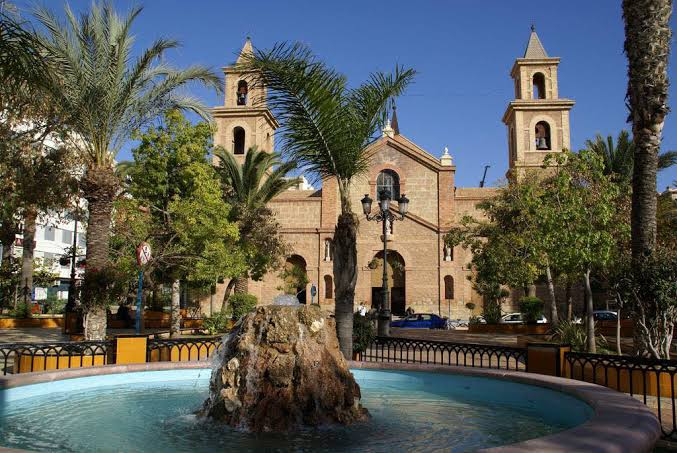
At the heart of Torrevieja, overlooking the Plaza de la Constitución, the Church of the Immaculate Conception tells the story of a town shaped by fishing, salt, disaster and recovery. Its twin bell towers are among the most familiar sights in the centre, but the parish’s history began long before the present building took shape.
In the late 18th century, Torrevieja was still a small coastal settlement. Its fishermen needed a place to worship close to home, and a chapel dedicated to the Purísima Concepción was blessed in 1789. It served as an outpost of the parish at La Mata. As the settlement grew, a larger church was built on the site beside what is now the town’s main square.
The transfer of the saltworks administration from La Mata to Torrevieja in 1803 helped establish the town as an increasingly important centre. The parish developed alongside it, becoming part of a community whose livelihoods depended on the sea and the surrounding salt lagoons.
Then came the earthquake of 21 March 1829. It devastated Torrevieja and other parts of the Vega Baja, damaging the church as well as the town around it. Rebuilding began in the following decades. According to the town’s tourism office, stone from the old watchtower that gave Torrevieja its name was used in the church’s reconstruction. The building seen today took shape in the late 19th century, with its bell towers completed in the early 20th.
The church faced another calamity in 1936, when a fire destroyed much of its interior and the original image of the Purísima. Restoration followed the Civil War. A new image of the town’s patron saint arrived by fishing boat in 1941, a moment that linked Torrevieja’s religious life once again with its maritime roots. Further work continued through the 1950s.
Today, the church’s restrained neoclassical façade opens onto a bright interior, with the image of the Purísima Concepción at its main altar. For residents and visitors, it is a place of worship and a reminder of how often Torrevieja has rebuilt itself. Its history follows the town’s own: a modest coastal beginning, rapid growth and a lasting ability to recover.