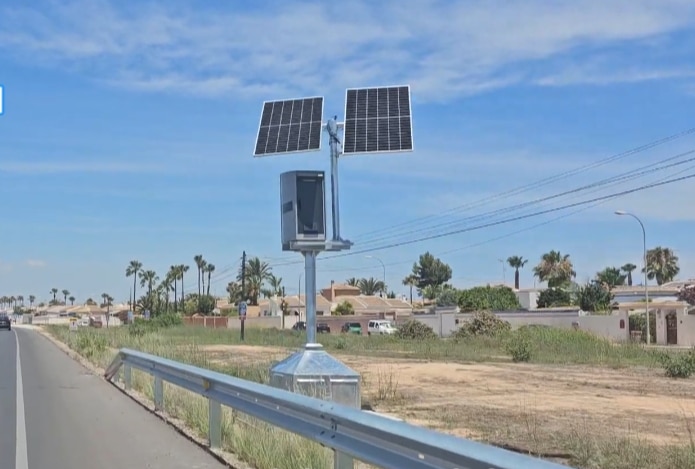
The Directorate General of Traffic (DGT) is finalizing the installation of six new fixed speed cameras across the province of Alicante, with the devices expected to go live between the end of 2025 and the beginning of 2026.
The civil works for the radar cabins have already been completed, and the Provincial Traffic Department anticipates that the devices will be fully installed this September. Before activation, they must be configured and certified by the Spanish Metrology Centre (CEM).
The new speed cameras will be located at:
- The A-7 near Elche
- The N-340, also at Elche
- The A-31 near Novelda
- The A-31 near Elda
- The CV-70 between Benidorm and La Nucía
- The CV-920 in Rojales
Government subdelegate in Alicante, Juan Antonio Nieves, emphasized the move as part of a broader modernization effort: “With the upcoming launch of six new fixed speed cameras on Alicante’s roads, the Government takes another step in upgrading traffic infrastructure, placing our province at the forefront of speed control and road safety.”
Four Cameras Already Added in 2025
The announcement follows the installation earlier this year of four other fixed cameras in the province, positioned on the N-332 in Santa Pola, the CV-96 in Elche, the CV-905 in Torrevieja, and the A-77a in San Vicente del Raspeig.
Stricter Controls with New Technology
The DGT has also tightened the tolerance levels of its new-generation devices, meaning they now trigger at lower speeds. Previously, fixed radars allowed a margin of 5 km/h below 100 km/h, or 7 km/h above that threshold. For mobile radars, a 7% margin applied.
Under the updated system, the margin for fixed devices has been reduced to 3 km/h. For example, they will now activate at 33 km/h in a 30 zone, or 53 km/h in a 50 zone. Mobile devices will apply a margin of 5 km/h or 5% of the limit on high-speed roads, such as motorways.
The DGT insists that the purpose of these measures is not punitive but to enhance road safety and reduce accidents on Alicante’s increasingly busy highways.