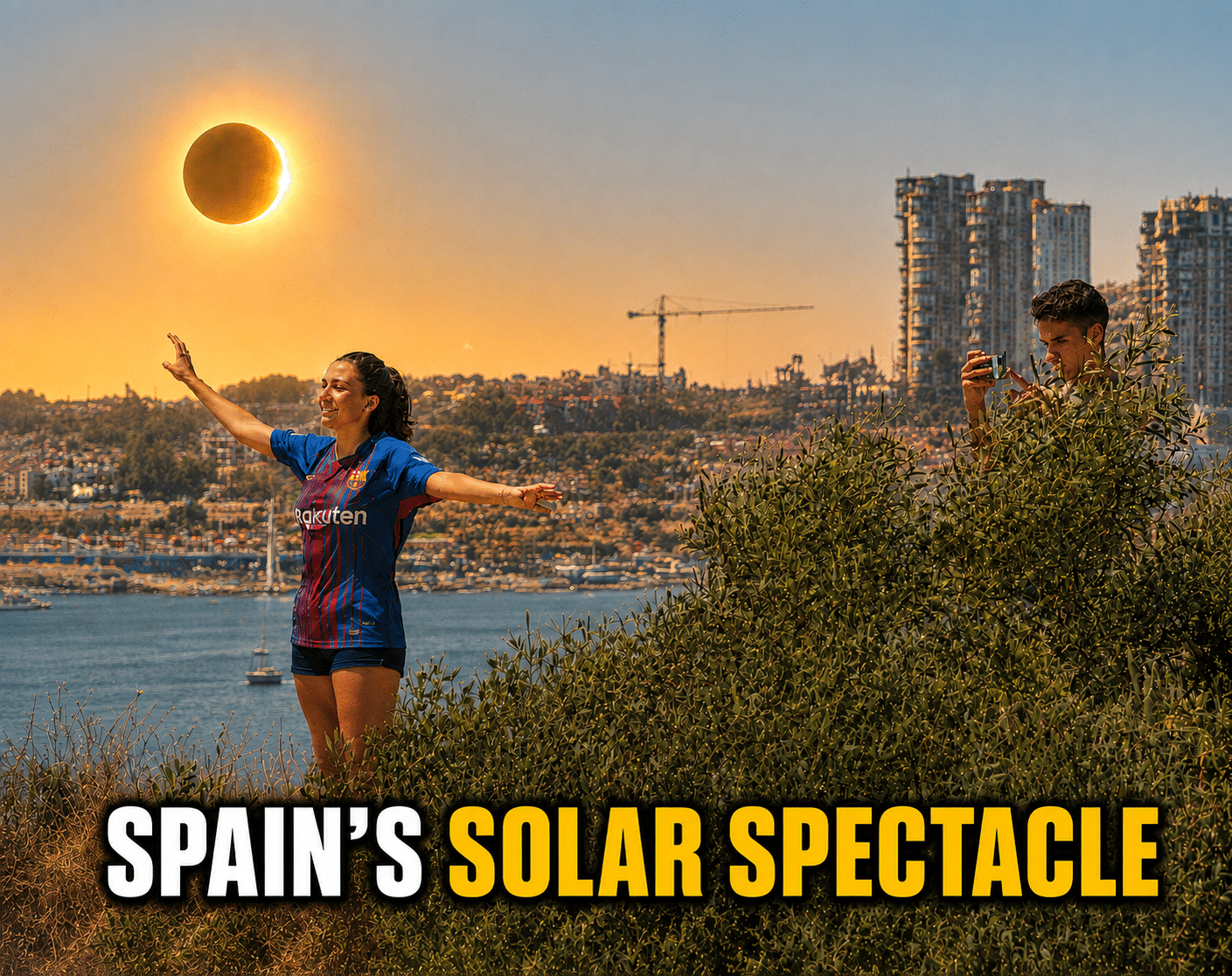
Residents and visitors across the Costa Blanca can look forward to an extraordinary series of astronomical events during August, including a dramatic solar eclipse, the Perseid meteor shower and a partial lunar eclipse.
The excitement begins on Wednesday, August 12, when the Moon passes between the Earth and the Sun. Although the eclipse will be total across parts of northern Spain, the Costa Blanca lies just outside the path of totality.
Nevertheless, observers in Alicante province will experience a spectacular partial eclipse, with almost the entire solar disc disappearing shortly before sunset.
In Torrevieja, the eclipse is expected to begin at approximately 7.40pm. Maximum coverage will occur at around 8.35pm, when an estimated 98.4% of the Sun will be obscured. The Sun will then disappear below the horizon shortly before 9pm. Timings elsewhere along the Costa Blanca will differ by only a few minutes.
As the Sun will be extremely low at maximum eclipse, observers will require a clear and unobstructed view towards the west-northwest. Elevated viewpoints and open countryside may provide better conditions than east-facing beaches, where buildings, trees or mountains could block the final stages.
Eye protection is essential. Despite the scale of the eclipse, the Costa Blanca will not experience totality, meaning it will never be safe to look directly at the Sun without certified solar filters. Eclipse glasses should comply with the ISO 12312-2 safety standard. Ordinary sunglasses, smoked glass and homemade filters offer no protection.
Eclipse glasses are available free from ONCE sellers and kiosks across the southern Costa Blanca while stocks last.
They can also be purchased from many local opticians and pharmacies, although availability varies.
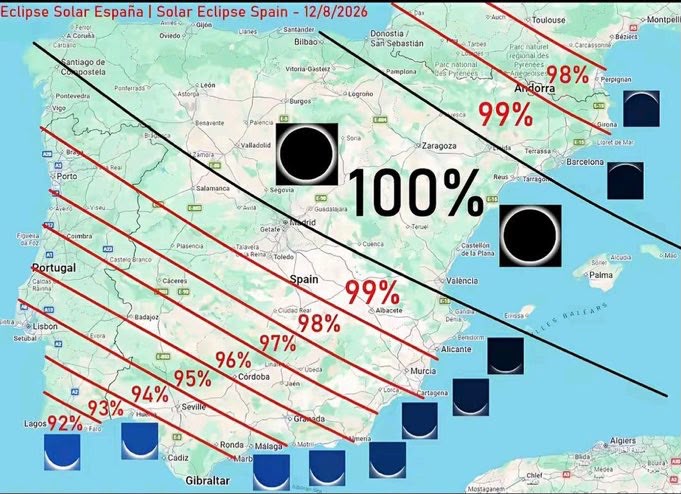
Only accept glasses marked ISO 12312-2 with the CE symbol and manufacturer details. Ordinary sunglasses, welding glass, CDs and homemade filters are unsafe. In Torrevieja and Orihuela Costa the eclipse remains partial—even at approximately 98.5%—so the glasses must stay on whenever looking towards the Sun.
Cameras, binoculars and telescopes must also be fitted with purpose-designed solar filters over their front lenses. Looking through optical equipment while wearing eclipse glasses can cause permanent eye damage.
Just hours after the eclipse, attention will turn to the Perseid meteor shower, which reaches its peak during the night of August 12–13.
The Perseids occur when Earth passes through debris left by Comet Swift-Tuttle. The particles enter the atmosphere at around 59 kilometres per second, creating the bright streaks commonly known as shooting stars.
Viewing conditions should be excellent because the peak coincides with a new Moon, leaving the night sky free from disruptive moonlight. The strongest activity is expected between 4am and 6am on August 13, although meteors should be visible from approximately 11pm.
Under dark rural skies, observers could see dozens of meteors every hour. No telescope is necessary. The best approach is to move away from streetlights, allow the eyes at least 20 minutes to adjust and watch as much of the sky as possible.
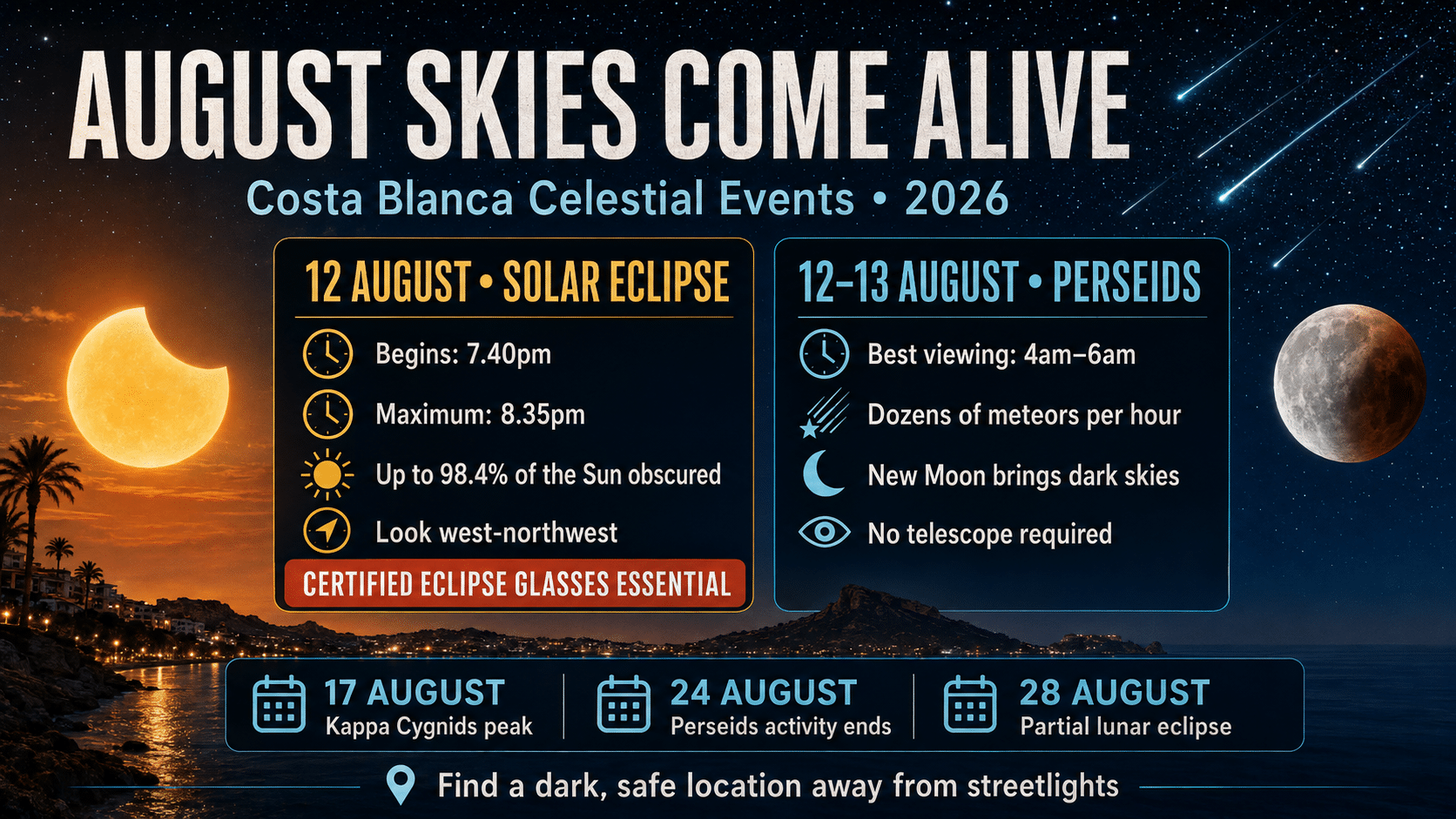
The Perseids remain active until August 24, while the less intense Kappa Cygnid shower is expected to peak around August 17. Although it produces fewer meteors, it can occasionally deliver impressive slow-moving fireballs.
Another major event follows during the early hours of August 28, when a partial lunar eclipse will be visible from the Costa Blanca. Part of the Moon will enter Earth’s shadow, although it will set before the eclipse has completely finished.
Unlike the solar eclipse, the lunar eclipse can be watched safely without specialist equipment. Together, these events promise to make August 2026 an exceptional month for Costa Blanca skywatchers.