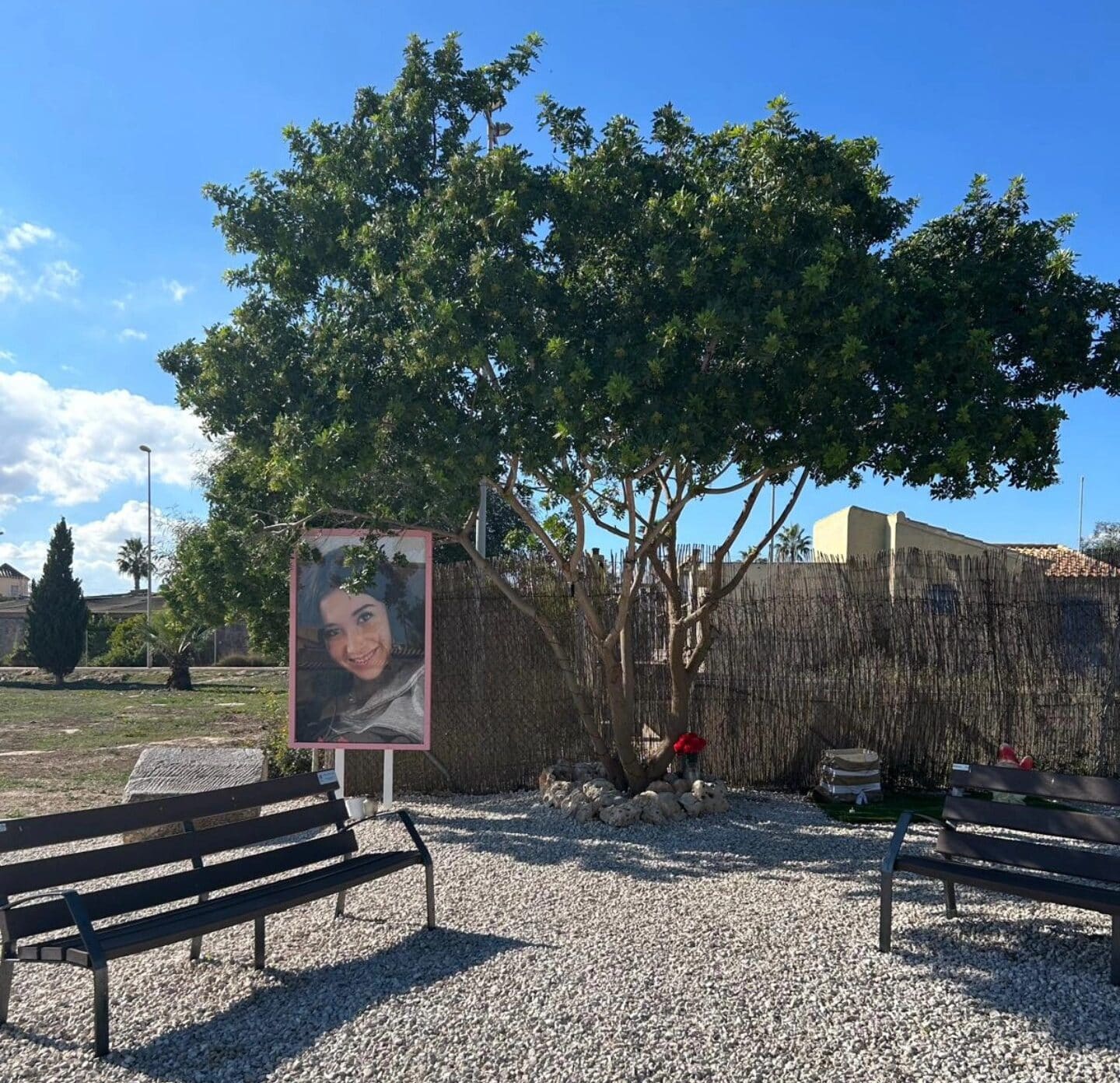
They will also face five years of supervised release; a judge will decide at age 21 whether they complete their sentences in adult prison for the gender-based killing in Orihuela Costa.
A Juvenile Court in Alicante has sentenced the two young men convicted of the murder of 15-year-old Cloe in Orihuela Costa to eight years in a juvenile detention centre, the maximum sentence permitted under Spain’s juvenile justice system. The ruling, confirmed by sources close to the case, also imposes an additional five years of supervised release on both defendants.
The convicted youths are Cloe’s former boyfriend and a friend who assisted him in carrying out the crime. The court applied the sentences sought by both the Public Prosecutor’s Office and the private prosecution, represented by lawyer Juan Carlos Fuentes on behalf of the victim’s family.
Both were found guilty of murder with intent and received identical sentences. As they were minors at the time of the crime, they must serve their custodial sentences in a closed juvenile facility until the age of 21, which is the legal maximum. For particularly serious offences, the law allows for the remainder of the sentence to be served in an adult prison, a possibility that will be assessed by the court when that time comes.
SEE ALSO: Public Tributes Paid to Cloe on the Anniversary of Her Death
At present, Cloe’s former boyfriend has already turned 18 while in pretrial detention, while the second defendant is still 17. If they are required to serve the full sentence, they could remain in custody until the age of 25, followed by a further five years under a court-mandated supervision programme.
The ruling also orders the defendants and their parents to compensate Cloe’s family for moral damages. In addition, the former boyfriend still faces separate proceedings related to alleged domestic abuse during his relationship with the victim.
The judgment is not yet final and may be appealed before the Alicante Provincial Court. Although both defendants pleaded guilty during the trial and admitted responsibility for the killing, no plea agreement was reached. Defence lawyers argued that their clients’ cooperation and confessions should have led to reduced sentences, a position rejected by the prosecution given the gravity of the crime.
The defence of the second defendant maintained that the crime was gender-based violence and argued that his client should not receive the same sentence as the ex-boyfriend, whom they described as the mastermind. According to the defence, the former partner planned the murder, convinced his friend to participate, carried out the killing and later attempted to deflect blame by falsely linking the crime to a drug-related dispute.
Evidence and investigation
Cloe was murdered on the afternoon of 24 November last year, on the eve of the International Day for the Elimination of Violence against Women. Prosecutors argued that the killing was a case of gender-based violence after the teenager decided to end her relationship.
Investigators determined that the crime had been planned for weeks. According to the prosecution, both defendants showed psychopathic traits and even searched online for real-life crime videos to rehearse how to carry out the murder. The victim was lured to a dark alley, where she was attacked without suspecting what would happen.
Analysis of the defendants’ mobile phones proved crucial. Messages exchanged on the night of the murder showed them boasting about what they had done, even sharing photos of themselves at home playing video games while Cloe was dying. When they later realised, through a tracking app on the victim’s phone, that she had been taken to Torrevieja Hospital, they became anxious about the possibility that she might survive.
Despite attempts to erase the messages, the Guardia Civil recovered them, along with location data placing both suspects at the scene of the crime. Investigators also recovered biological evidence and remnants of the murder weapon, a knife purchased at a discount store and later burned along with bloodstained clothing in an abandoned building nearby.
Faced with the overwhelming evidence, both defendants confessed. However, the court ruled that their admissions did not warrant any reduction in sentence.