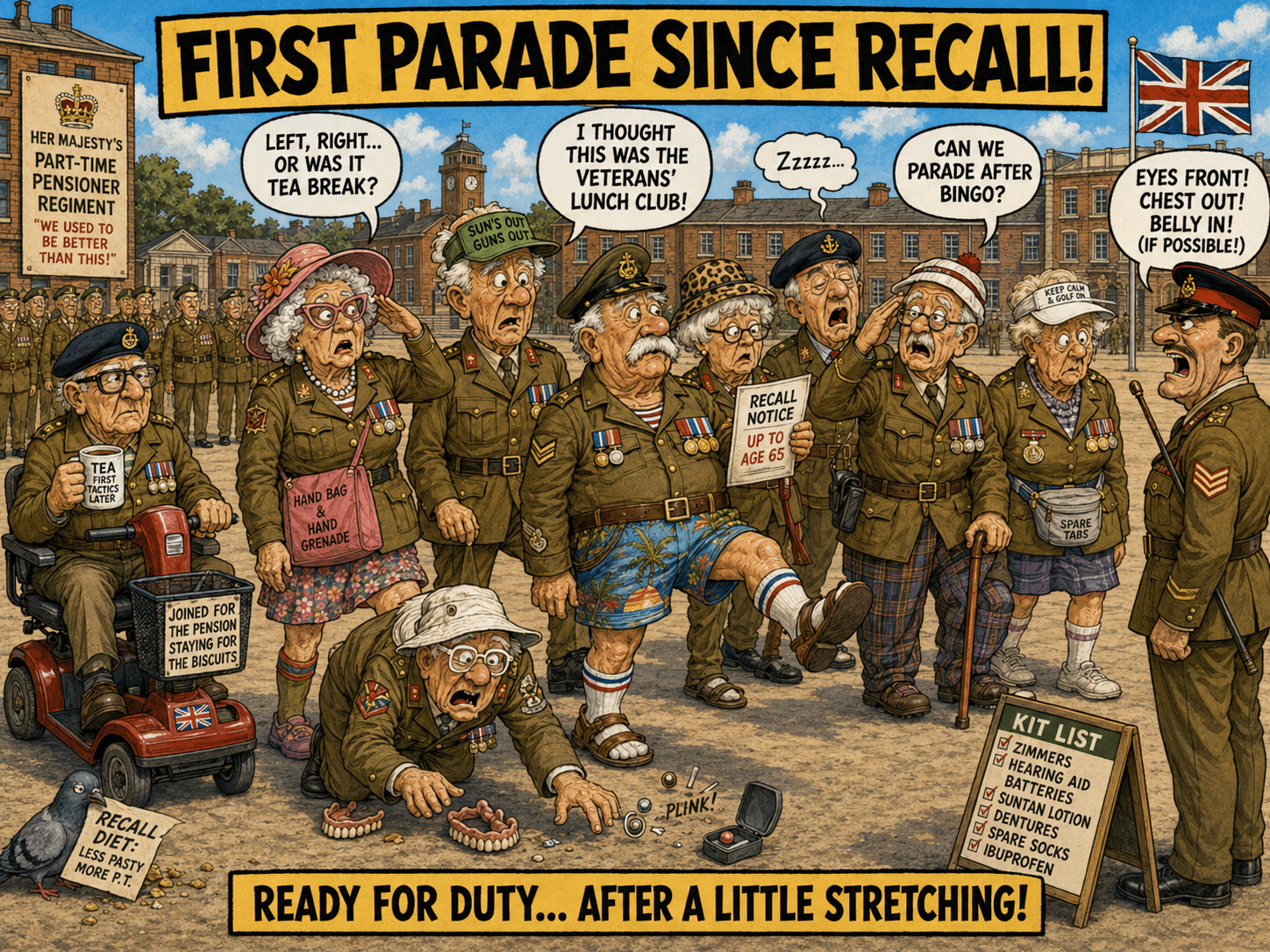
The Return of the Zimmer Commandos
Britain’s former service personnel may soon discover that retirement is less about golf clubs, garden centres and half-price cruises, and more about polishing boots, finding the old beret and wondering whether the knees still bend on command.
Under new legislation being brought forward through the Armed Forces Bill, former members of the British armed forces could remain liable for recall until the age of 65.
The proposal forms part of the government’s latest Defence Investment Plan, which aims to strengthen what is known as the Strategic Reserve. In plain English, that means former regular service personnel who may have left the forces, built a new life, bought a barbecue, moved to Spain or finally learned how to relax — but who still carry a recall liability.
Under the proposed changes, the upper age limit for recall would rise to 65. The government also wants to lower the threshold for calling people back into service.
At present, recall powers are mainly linked to serious situations such as national danger, a major emergency, or an attack on the UK. The new wording would widen that to include “warlike preparations”, a phrase that sounds alarmingly like the moment someone says, “Don’t worry, it’s probably nothing,” shortly before everyone is told to pack a bag.
The Defence Investment Plan says the change would allow the armed forces to “mobilise talent rapidly when it matters most”. For many veterans, that talent may include logistics, engineering, leadership, communications, tactical planning and, quite possibly, the ability to make a decent brew under pressure.
The government is also keen to stress the value of reserve personnel and former service members, particularly the specialist skills they have picked up in civilian life. This could mean anything from cyber security and medical expertise to construction, transport, mechanics and the rare but valuable ability to fix a printer without swearing at it.
Ministers say new technology and better engagement systems will be used to keep in touch with the Strategic Reserve. This presumably means fewer dusty letters arriving unexpectedly and more modern ways of informing a 64-year-old former corporal that his quiet Tuesday has taken a sharp turn.
The plan also promises to protect time, funding and equipment for reservists during training. That will be welcome news to anyone worried that the reactivated pensioner platoon might be expected to share one helmet, three maps and a packet of biscuits left over from 1998.
The government insists the wider picture is positive, saying regular force numbers are now beginning to grow again. According to the plan, intake has exceeded outflow in the Royal Navy and Royal Marines since January 2025, in the RAF since October 2025, and in the Army since April 2026.

The Army recorded 980 more recruits than departures in the 12 months to March 31, 2026, while longer-term plans include increasing the regular Army to 76,000 personnel between 2030 and 2035.
However, not every target is marching quite so smartly. A previous pledge to increase cadet numbers by 30 per cent by 2030 has now been pushed back to 2035. The government says this “difficult decision” will allow the armed forces to transform more quickly, which is official language for: something had to give.
A separate Defence Readiness Bill is expected later in this Parliament, with ministers promising further reforms.
For now, the message to former service personnel appears clear: keep the passport handy, enjoy the beach while you can, and maybe don’t throw away those old boots just yet.
Because in modern Britain, experience doesn’t retire.
It gets recalled.