“Every book I write begins with a question.”
An interview with The Leader Newspaper
Many people know you from your community work on Orihuela Costa and as a Co founder of PIOC, but over the last few years you’ve also established yourself as an author. How did that journey begin?
Peter Houghton: It actually began with concern rather than ambition. I never woke up one morning and decided I wanted to become an author. I simply felt there were stories that weren’t being told properly.
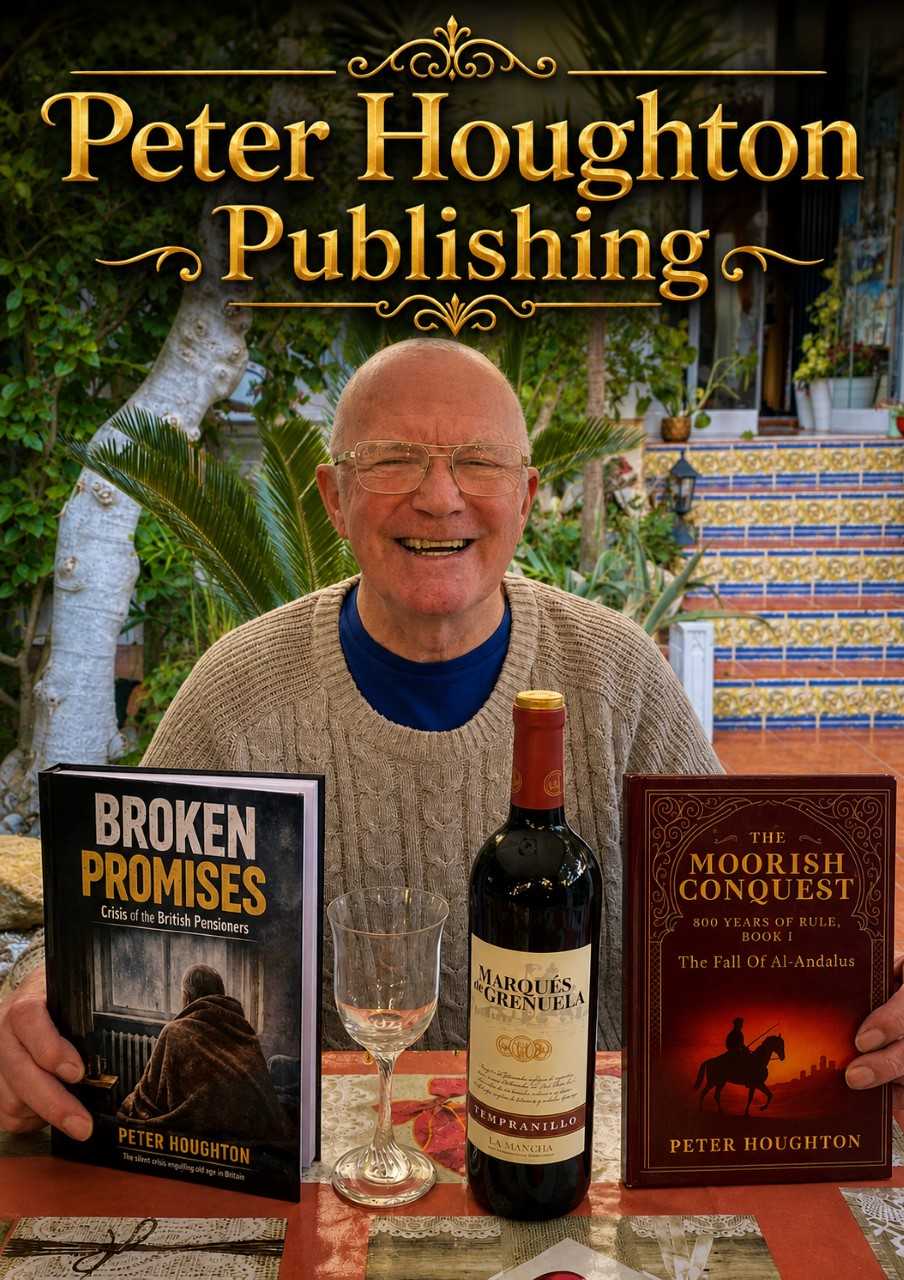
My first non-fiction book was Broken Promises: Betrayed and Forgotten – The Silent Crisis Facing Britain’s Pensioners. It examined the challenges facing older people in Britain—loneliness, social care, dignity, financial hardship and the feeling of becoming invisible in later life.
It was a difficult book to write because it wasn’t just about statistics. It was about real people. The response from readers convinced me that books can start conversations that sometimes politics and the media overlook.
That encouraged me to continue writing.
Your books cover very different subjects. Was that always the plan?
Peter: Not at all, although there is a common thread running through everything I write.
Whether it’s The Moorish Conquest, Broken Promises, Living and Growing Old in Silence, Shadows Over Spain, or my forthcoming book Beyond the Costa, they’re all about people.
They’re about history.
They’re about communities.
They’re about decisions.
They’re about asking why some things succeed while others fail.
I’m fascinated by how societies work and, equally, why sometimes they don’t.
Your latest work, Beyond the Costa, seems quite different from your previous books. What inspired it?
Peter: One sentence.
For years, while working alongside residents and community groups on Orihuela Costa, I kept hearing people say:
“Orihuela Costa isn’t Spain.”
Every time I heard it from a regular attended to one of our PIOC meetings , I couldn’t understand what he meant.
How could Orihuela Costa not be Spain?
It’s part of Spain.
It follows Spanish law.
It pays Spanish taxes.
At first, I assumed he was simply expressing frustration.
It wasn’t until I began travelling extensively throughout Spain that I realised he wasn’t talking about geography at all.
he was talking about from his own experiences,
That completely changed my thinking.
So the book is really about changing your own mind?
Peter: Exactly.
For years I was looking at Spain through a very small window.
My world revolved around Orihuela Costa—roads, beaches, planning issues, healthcare, policing and local politics.
Those issues mattered, and many still do.
But I gradually realised that I had started judging the whole country by one small part of it.
Then I travelled.
I visited towns and cities across Spain.
I spoke to residents.
I observed how different communities functioned.
What struck me wasn’t grand architecture or famous landmarks. It was the everyday details that most people rarely notice until they’re missing.
Roads were maintained.
Parks were cared for.
Public spaces were clean.
Street furniture was repaired before it deteriorated.
Even something as simple as advertising boards caught my attention.
On Orihuela Costa we have seen a proliferation of illegal advertising boards. Many have remained in place for years, while others advertise businesses that have long since disappeared. Some have been abandoned completely, left to rust by the roadside, creating an impression of neglect.
As I travelled throughout Spain, I found myself looking for similar examples.
Surprisingly, I rarely saw them.
It wasn’t that those municipalities were perfect—no place is—but there seemed to be a greater emphasis on maintaining the public realm and removing things that no longer served a purpose.
It was another small observation, but it reinforced a much larger lesson.
Communities are judged not only by the major projects politicians announce, but by the countless everyday details that residents experience.
That was when I began asking myself whether I had mistaken one part of Spain for the whole of Spain.
That question eventually became the foundation of Beyond the Costa.
Is this a political book?
Peter: Politics certainly appears because local government influences the places where we live.
But this isn’t a book about attacking political parties.
It’s about learning.
It’s about comparing communities and asking what successful places do differently.
Why are some towns clean, well maintained and thriving while others struggle?
Why do some councils consistently get the basics right?
Why do residents in some areas feel proud of where they live?
Those questions interested me far more than party politics.
Readers will know you’ve also written Shadows Over Spain. How does that fit into the picture?
Peter: Shadows Over Spain examines governance, accountability and transparency.
It’s a series that looks at how power affects everyday life.
Beyond the Costa complements it because instead of concentrating primarily on political systems, it concentrates on communities.
Together they tell two sides of the same story.
One examines power.
The other examines place.
You recently established Peter Houghton Publishing. What does that mean for you?
Peter: It’s probably one of the most exciting steps I’ve taken.
Rather than simply publishing individual books, I’m now building a catalogue under my own publishing imprint.
Every book becomes part of a larger collection.
Whether someone is reading history, social issues, politics or travel, I hope they’ll recognise a common purpose.
Peter Houghton Publishing will stand for books that inform, challenge accepted thinking, encourage discussion and, above all, make people curious enough to ask questions.
Finally, what would you like readers to take away from your work?
Peter: Curiosity.
If someone finishes one of my books seeing the world slightly differently than when they started, then I’ve achieved what I set out to do.
Books don’t always need to provide every answer.
Sometimes their greatest value lies in asking better questions.
I hope Beyond the Costa does exactly that.
It isn’t simply a book about Spain.
It’s a book about perspective.
Sometimes, to truly understand the place we call home, we first have to step beyond it.