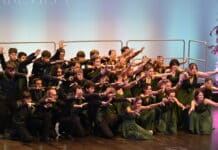
San Javier recently became a training ground for future astronauts as 35 young people took part in Spain’s “Astronaut for a Day” programme, organised by the Ministry of Science, Innovation and Universities. The initiative offered students aged 16 to 22 the chance to experience simulated lunar, Martian and zero gravity aboard the Spanish Space Agency’s Airbus A310 ZERO-G.
After preparatory sessions at the General Air Academy with Spanish astronauts Sara García and Pablo Álvarez, the group boarded the aircraft at Santiago de la Ribera. The participants included secondary-school students, university science students and cadets from the academy.
During the flight, the aircraft performed 16 parabolic manoeuvres at an altitude of between 5,000 and 6,000 metres. Each parabola created around 22 seconds of microgravity, allowing the students to float freely inside a padded area of the plane. In total, they spent almost six minutes experiencing the sensation of weightlessness.
For many, the experience was unforgettable. Sofía García López, a 19-year-old medical student from Zaragoza, described it as “the best experience” of her life and said it had strengthened her ambition to specialise in space medicine. Luis Gómez, a physics student from Madrid, said the flight began with laughter but soon became “an enormous feeling of relaxation” as participants floated from one side of the cabin to the other.

Fourth-year cadet Claudia Brugarolas said she could hardly believe she had “walked on the ceiling”. She explained that the instructors had encouraged them to let go and enjoy the sensation. Videos from the flight also showed Science Minister Diana Morant floating and laughing alongside the students.
Juan Carlos Cortés, director of the Spanish Space Agency, said the programme is essential for developing young talent and encouraging interest in space exploration. He stressed that Spain must prepare now for future missions and for a generational shift in the sector. “Space makes the impossible possible,” he told the participants, urging them to think critically and ambitiously.
General Francisco Braco, Chief of the Air Staff, highlighted the strategic importance of space for communications, positioning and security, describing it as an increasingly congested and competitive environment.
Minister Morant reaffirmed the Government’s commitment to space science and said Spain’s contribution to the European Space Agency now stands at €450 million a year. She also expressed support for Spanish astronauts Sara García and Pablo Álvarez to travel into space.
San Javier will also host Europe’s first incubator for dual-use space technologies at the former airport, offering entrepreneurs funding, mentoring, workspace and investor access.