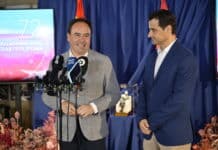
On July 9, Unidos por la Costa, led by President Tomás Moreno, met with Orihuela Mayor Pepe Vegara and Councillor for Contracting and Public Safety Mónica Pastor to express deep concern over worsening public services in Orihuela Costa. The meeting, which lasted over three hours, centred on what residents describe as a “crisis of neglect,” particularly urgent during the busy summer months.
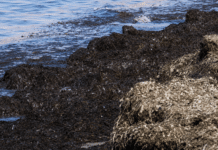
Moreno presented a detailed list of grievances: overflowing rubbish, broken bins, dirty streets, prolonged streetlight outages, unpruned palm trees, abandoned green zones, potholed roads, and neglected beaches. “We’re in the middle of summer, and essential services are still failing,” he warned.
Mayor Vegara acknowledged the concerns and, as he has done on man y previous occasions, he once again assured residents that long-term solutions are in progress, though Moreno stressed that visible improvements are urgently needed to retain public confidence.
The discussion also addressed several stalled or pending projects. These include delays in pedestrian access over the AP7 bridge and the continued closure of the Bellavista I promenade, now awaiting a court ruling following last week’s refusal by residents to accept the compensation payment awarded by the Alicante Provincial Jury.
The mayor revealed plans to sign a contract in Rome this August for five new waste collection trucks exclusively for the coast. Palm tree maintenance is ongoing, with date palms to be pruned in October, and two road resurfacing projects are scheduled for summer, with €200,000 earmarked for broader maintenance. However, much of the €13 million allocated for coastal improvements in the 2024 budget remains untouched due to procurement delays, particularly those involving EU-wide tenders.
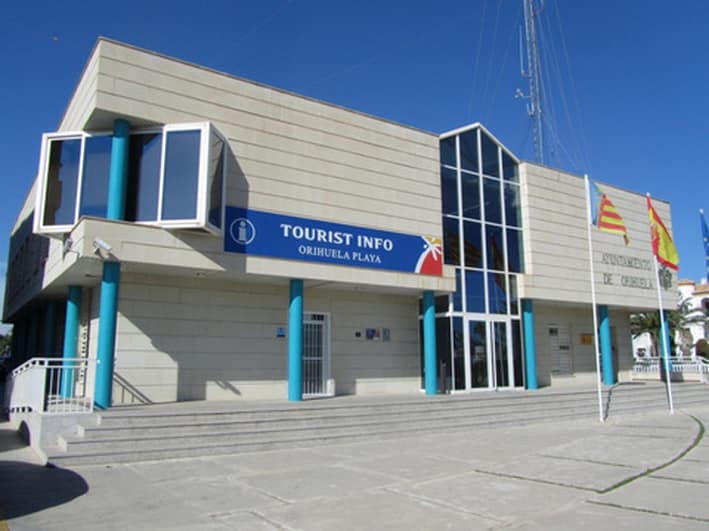
The Residents Association also called for fairer distribution of cultural funding, asking for more coastal involvement in public events like Christmas and Halloween. The group advocated for administrative decentralization to better manage local services from the Playa Flamenca town hall.
Other points raised included faster playground repairs, enhanced green space upkeep, and the delayed reopening of beach bars due to final paperwork issues.
Despite some positive announcements, Unidos por la Costa emphasised that residents remain frustrated by the lack of tangible progress. Moreno thanked the officials for their transparency but reaffirmed the community’s commitment to pushing for immediate and lasting improvements.
CELEBRATING TWO YEARS IN OFFICE
Remarkably, just two days after the Unidos por la Costa delegation raised serious concerns about the ongoing neglect of Orihuela Costa, Mayor Pepe Vegara gave a glowing interview to Información in which he praised the progress his administration has made—especially on coastal issues.
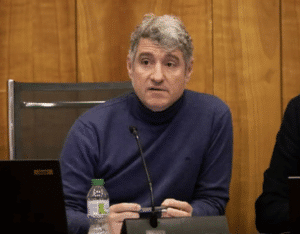
The mayor described the situation his government inherited as one of “abandonment,” particularly in the coastal zone, and claimed that his team had responded “swiftly and decisively” to correct it. However, much of the success he highlighted in the interview centred on Orihuela City rather than the coast.
He pointed to the near-complete renovation of the Rubalcava Palace, heritage restorations like the Caja de Ahorros de Monserrate, and multiple improvement projects planned in the historic centre, as well as to the new Sports City.
When addressing Orihuela Costa specifically, however, Vegara repeated familiar talking points: that his administration found no beach bar contracts, no road maintenance plans, and poor waste management.
He presented the re-launch of beach bar concessions, the transfer of green area maintenance to the municipal firm ILDO, and the assignment of road upkeep to the public company SGM, as signs of meaningful progress.
Yet he failed to acknowledge the delays in setting up the ILDO and SGM agreements, construction of the footbridge over the AP-7 that has now been outstanding for 13 years, or that one of the beach bar “lots” remains unresolved, omissions that suggests the reality on the ground is less complete than the mayor implies.
Despite the limited scope of concrete achievements in the coastal area, Vegara framed these developments as the beginning of a long-overdue institutional commitment to Orihuela Costa. He also emphasised that progress is being made “without political posturing,” citing his coalition with Vox as responsible and effective. According to him, it’s not about who signs the decrees, but about delivering results.
Still, for many residents, the mayor’s optimism rings hollow. The day-to-day reality in Orihuela Costa—marked by sporadic service delivery, delayed tenders, and uneven investment—stands in contrast to the polished narrative presented in his mid-term reflection. While the mayor insists that the coast is now receiving the “dignity” it deserves, locals are still waiting to see that dignity reflected in visible, lasting improvements.