Peter Houghton Saying It As It Is
I am not against independence for Orihuela Costa.
In fact, I support the principle of greater local control and I believe the case for a separate municipality deserves to be taken seriously.
But supporting independence should not mean avoiding difficult questions.
Quite the opposite.
If Orihuela Costa is ever to become an independent municipality, then those who support that objective should be the first to ask the hardest questions about how it would actually work.
For years, the case for independence has often been expressed in simple terms.
Orihuela Costa has a large population.
It contributes substantial revenue.
Residents regularly complain about inadequate services, poor maintenance, weak infrastructure and a lack of political influence.
Those arguments are powerful.
But they are not, by themselves, enough to create a municipality.
The legal route exists, but it is complex.
There are requirements involving population, territory, financial sustainability, public services, technical reports and administrative procedure.
Winning councillors would matter.
Winning elections would matter.
But neither, by itself, would automatically create an independent Orihuela Costa.
Then there is the financial question.
Figures of €40 million or €50 million are frequently mentioned when discussing how much the coast may generate.
Those numbers could ultimately prove highly significant.
But a headline figure is not a municipal budget.
A serious viability study must identify recurring income and compare it against the full cost of running a municipality.
That means policing, waste collection, street cleaning, road maintenance, beaches, parks, administration, staffing, IT systems, planning, insurance, buildings, contracts, social services and infrastructure.
It also means dealing with the accumulated cost of years of underinvestment.
Then comes the territorial question.
Where exactly would the new municipality begin and end?
Which commercial areas would be included?
Which golf courses?
Which undeveloped land?
Which public assets?
Moving a boundary can alter population, future development, assets and potentially millions of euros in revenue.
Then comes the division of assets and liabilities.
Who gets municipal buildings?
Public land?
Vehicles?
Contracts?
Staff?
Records?
Outstanding projects?
And what share of existing liabilities would transfer?
These are not arguments against independence.
They are the questions that must be answered if independence is to be credible.
The experience of Entre Dos Mares in La Manga is particularly instructive.
Their current campaign has already involved years of organisation, the creation of a formal association, legal advice, fundraising, territorial work, an economic viability study and the collection of formal public support.
That is what a serious municipal-separation project looks like.
It is not achieved through slogans alone.
There is a danger in political campaigns of believing that raising difficult questions weakens the cause.
I believe the opposite is true.
A movement becomes stronger when it can say:
This will not be easy. These are the obstacles. These are the costs. These are the legal requirements. And this is how we intend to deal with them.
Residents should not be sold certainty where certainty does not yet exist.
They should be given evidence.
They should see the numbers.
They should see the proposed boundaries.
They should understand who actually has the power to approve or reject the process.
They should know what services would cost and what assets or liabilities could transfer.
That is not negativity.
It is preparation.
I support independence for Orihuela Costa because I believe local decisions should be made closer to the people affected by them.
But support should never become blind faith.
If the project is strong enough, it should survive scrutiny.
If the finances work, prove it.
If the legal requirements are satisfied, demonstrate it.
If the territory is viable, map it.
If public support exists, measure it.
And if there are weaknesses, identify them before opponents do.
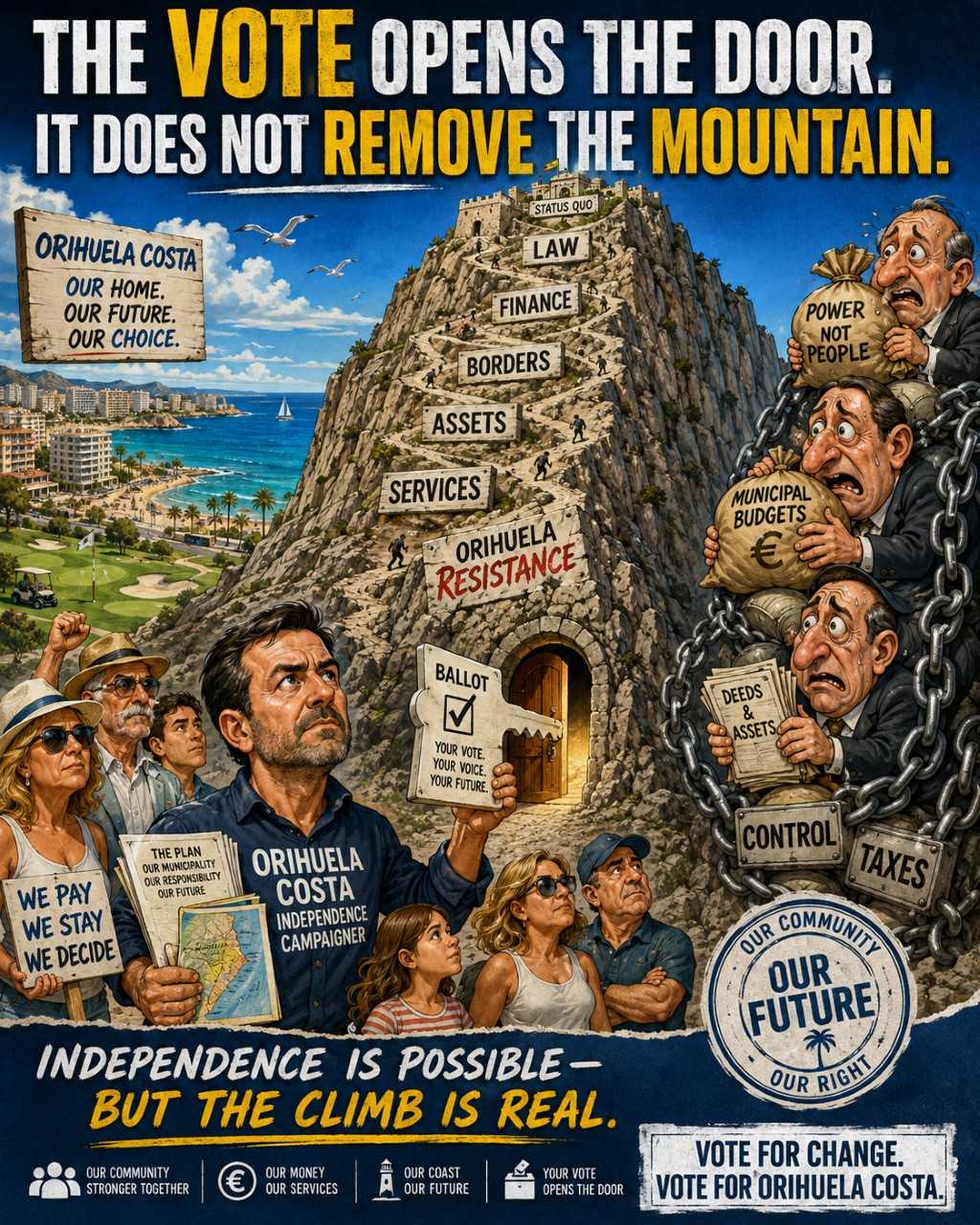
The strongest case for independence will not come from pretending the mountain is small.
It will come from showing residents the entire climb.
The vote may open the door.
But it does not remove the mountain.