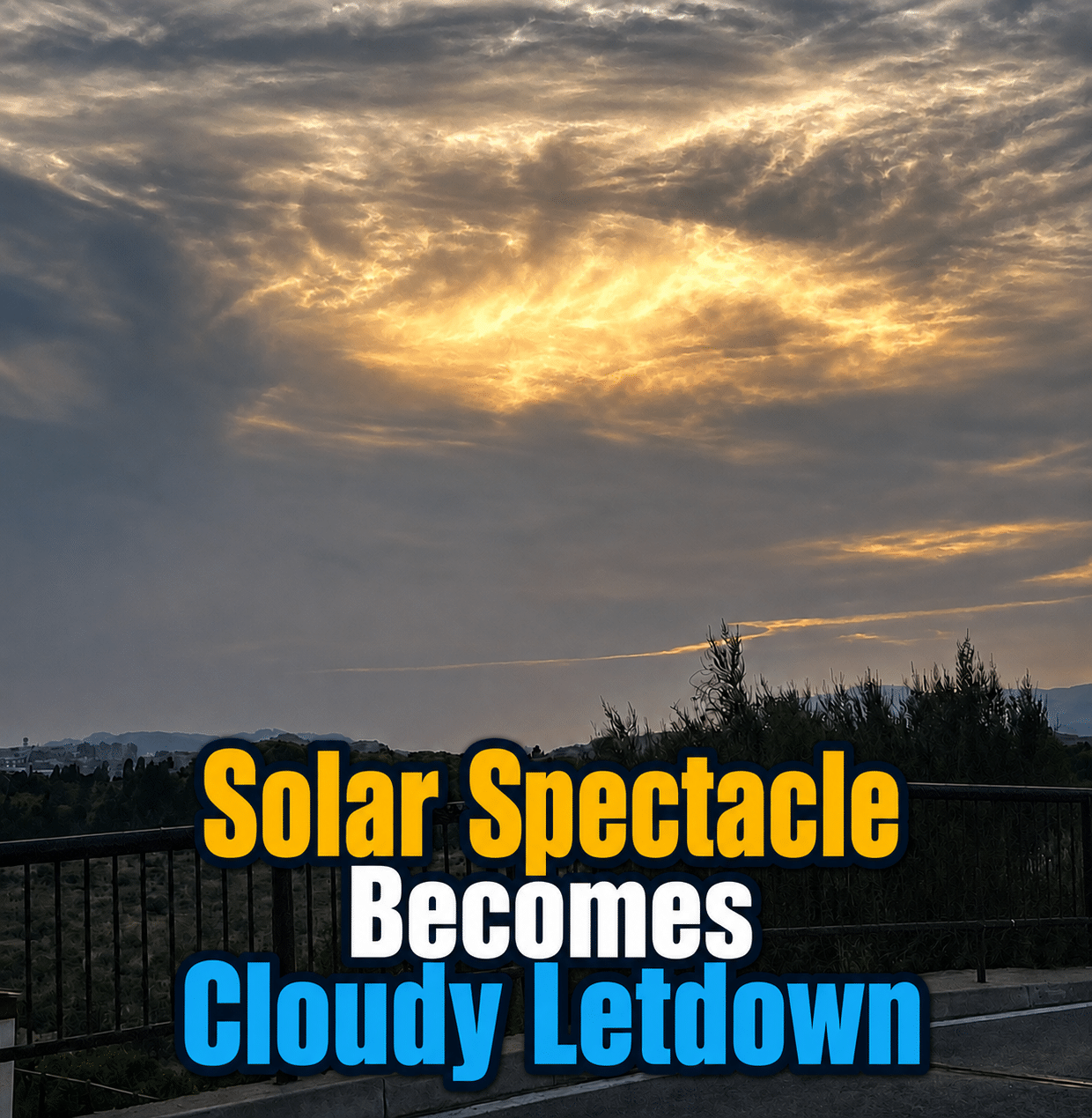
After months of anticipation, careful planning and endless warnings about eye safety, the Southern Costa Blanca’s much-hyped solar eclipse disappeared behind the one thing nobody had ordered: a thick blanket of cloud.
Thousands of residents had prepared for a memorable astronomical spectacle on Wednesday evening. Eclipse glasses had been purchased, telescopes positioned and chairs carried to castles, beaches, terraces, viewpoints and public squares across the province.
Children waited excitedly, phones were pointed towards the western horizon and groups of friends gathered to watch the Moon almost completely cover the Sun.
The University of Alicante had even organised a special observation event, allowing members of the public to follow the eclipse safely with expert guidance.
Everything was ready—apart from the weather.
In a province famous for enjoying more than 2,000 hours of sunshine every year, clouds arrived at precisely the wrong moment. Instead of witnessing one of the most eagerly awaited astronomical events in decades, many spectators found themselves staring through expensive glasses at a grey and stubbornly featureless sky.
The promised celestial spectacle had become a total flop.
The disappointment was keenly felt across Orihuela Costa, where residents and holidaymakers had hoped the beaches and elevated coastal viewpoints would offer ideal views towards the western horizon.
Families gathered around La Zenia, Cabo Roig, Campoamor and Playa Flamenca, while others watched from balconies, rooftop terraces and local bars. Visitors accustomed to almost guaranteed August sunshine could scarcely believe their luck.
After days of clear summer skies, the clouds arrived just in time to spoil the main event, leaving spectators repeatedly removing their eclipse glasses to check whether there was anything to see.
Social media eclipses the eclipse
Disappointment quickly gave way to typically Spanish humour as social media filled with photographs, jokes and memes about Alicante’s “non-eclipse”.
“More than 2,000 hours of sunshine a year—and of course it is cloudy today,” was among the most widely shared observations.
Another user wrote: “The Sun shines in Alicante 365 days a year, but on the day of the eclipse, clouds roll in and nobody can see anything.”
The cruel timing of the cloud cover proved irresistible. Alicante regularly promotes its blue skies and dependable sunshine, yet on the one afternoon when residents desperately wanted to look at the Sun, it vanished.
Some joked that clouds were so rare in Alicante that their appearance could apparently be predicted by studying the dates of solar eclipses.
Others turned their attention to the special glasses that had been in such high demand before the event.
“Apparently, people in Alicante are already queuing to get their money back for their eclipse glasses,” one social media user joked.
Another summed up the experience: “We all had the perfect glasses and were completely prepared. Then, just as the eclipse arrived, a cloud covered the Sun. We saw nothing—but at least our eyesight is still perfect.”
On Orihuela Costa, the jokes followed a similarly familiar theme: months without meaningful rain, weeks of relentless heat and then, at the precise moment the Sun became the star attraction, an uninvited bank of cloud.
Some joked that the most impressive sight of the evening was hundreds of people staring hopefully at exactly the same patch of grey sky.
Months of excitement end in grey skies

The August 12 eclipse had been promoted throughout Spain as a once-in-a-generation event. Castellón and large parts of Valencia were within the path of totality, while the southern Costa Blanca was expected to witness an impressive partial eclipse.
Residents had already accepted that Alicante province would miss out on complete darkness. Few imagined that clouds would rob them of almost the entire spectacle as well.
Even local politics found its way into the jokes, with some users mockingly blaming local politicians for failing to “clear the clouds”.
In the end, the eclipse became less of an astronomical event and more of a shared comedy. People may not have seen much through their special glasses, but they found plenty to enjoy on their phones.
The Moon was supposed to block out the Sun. Instead, Alicante’s clouds got there first.