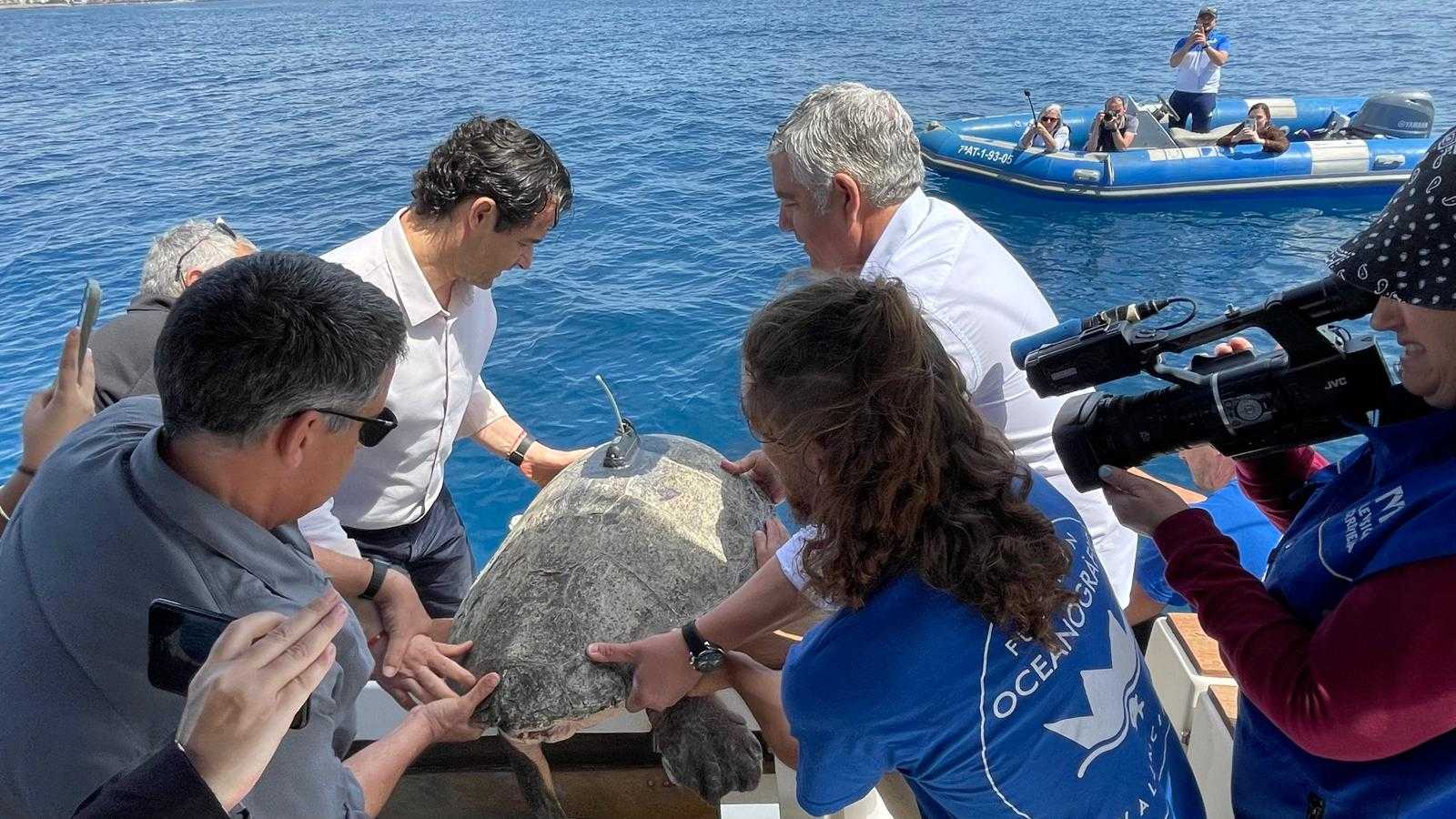
Torrevieja’s mayor, Eduardo Dolón, took part in the turtle’s release from a boat alongside veterinarians from the Oceanogràfic Foundation.
The turtle is now equipped with a satellite transmitter, allowing real-time tracking of its movements and contributing to greater understanding of the species’ biology.
After becoming trapped in Torrevieja’s port in February, Nuca was released back into the ocean on Thursday, following a full recovery at the Oceanogràfic’s ARCA del Mar rehabilitation centre in Valencia.
The release took place from a boat off the coast of Torrevieja and included participation from Mayor Eduardo Dolón, Environment and Beaches Councillor Antonio Vidal, municipal biologist Juan Antonio Pujol, President of the Royal Nautical Club of Torrevieja (RCNT) Carlos Carmona, and the veterinary team from the Oceanogràfic Foundation.
Mayor Dolón praised the Oceanogràfic team for their excellent work in rehabilitating Nuca, as well as the municipal biologist and RCNT, whose efforts made it possible for the turtle to return to the waters where it was rescued just a few months ago. He expressed hope that Nuca might return in the future to lay her eggs on one of Torrevieja’s beaches.

A delicate rescue and full recovery
The turtle, now named Nuca, was found swimming within Torrevieja’s port earlier this year, trapped and surviving on scraps from fishing activity.
Her rescue was carried out by specialized divers from the Oceanogràfic Foundation, with assistance from the municipal biologist and the RCNT. It was quickly evident that Nuca was in poor health—one of her flippers had been amputated due to an old injury, and a fishing hook was lodged in her oesophagus.
She was transported to the Oceanogràfic, where the veterinary team removed the hook via endoscopy and began treatment to aid her recovery. Her steady improvement over the following weeks confirmed she was fit to return to the wild.
Technology aiding conservation
Before re-entering the sea, veterinarians fitted Nuca with a satellite transmitter to monitor her movements in real time. The data gathered will help researchers understand her behaviour post-rehabilitation and improve conservation strategies for the species.
This conservation initiative is supported by the Fundación Biodiversidad of the Ministry for the Ecological Transition and the Demographic Challenge, as part of the PRTR program funded by the European Union’s NextGenerationEU initiative.