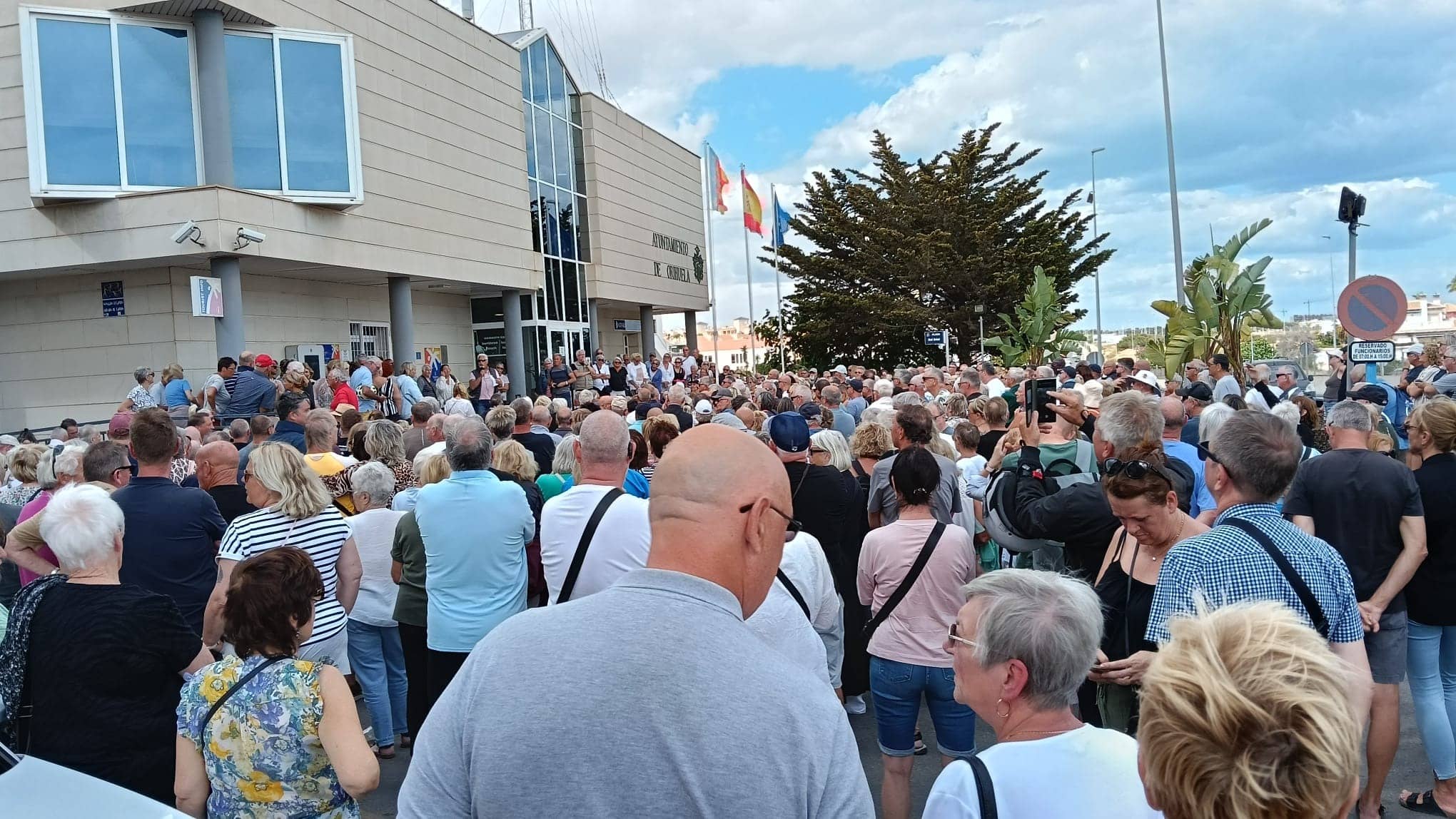
Outcry over democratic deficit and failing municipal services sparks mass protest outside Playa Flamenca town hall
Playa Flamenca, Orihuela Costa – May 5, 2025
Frustration and political tension exploded once again in Orihuela Costa this Monday as more than 300 residents took to the streets in protest, answering the call of local political groups and residents associations. Their message was loud and clear: “Enough is enough.”
The protest, held in front of the Playa Flamenca municipal offices, coincided with the long-delayed meetings of District Boards X and XI—the local bodies meant to represent over 30,000 registered residents and more than 60,000 full-time inhabitants of the coastal area.
These citizen forums had not been convened in five months, in violation of their monthly mandate, triggering accusations of democratic neglect and administrative incompetence.
Among the symbols of the protest: a symbolic empty chair, placed to mark the absent mayor, Pepe Vegara, whose continued silence and lack of accountability have fuelled growing resentment in the area.
Residents decried the failure of the Orihuela Council to provide even the most basic municipal services—services they say they are taxed for but never receive. “We are invisible to this government,” said Román Jiménez, president of the PIOC, who denounced the council for turning the district meetings into a “mockery of democratic representation.”
The roots of the crisis date back to late 2024, when the secretaries of both district boards resigned. No replacements were appointed, and meetings ceased. A scheduled session for April 28 was cancelled without explanation, only to be rescheduled for this Monday, amid allegations that the original postponement was to allow Councilman Manuel Mestre, president of the district, to attend a local religious procession.
The protest, fully authorized by the Subdelegation of the Government, was a boiling point for long-standing grievances. The Unidos por la Costa residents’ association supported the action, highlighting chronic failures in district governance and a broken system of participation that has led to no concrete results.
In a joint manifesto, residents condemned the council’s failure to draft a district needs report—a document required for budget planning—and the administration’s refusal to analyse and review its own municipal activity. Despite broad support from local political groups (excluding abstentions from PP and Vox), no action has been taken.

In a rare show of unity, opposition groups and board members have repeatedly called for Mayor Vegara’s direct appearance to explain budget decisions for 2024 and projections for 2025. Their request has gone unanswered for months, intensifying accusations that the mayor is “deliberately undermining” local representation.
Adding urgency to the demands, the PIOC and local groups also called for an emergency review of conditions at IES Playa Flamenca, the only high school on the coast, following rising concerns over violence, drugs, and weapons—highlighted by the recent murder of 15-year-old Cloe, allegedly by her 17-year-old ex-partner, both students at the school.
Forecasters predict that Orihuela Costa’s population will surpass 40,000 registered residents in under a decade with residents agreeing that it’s no longer sustainable for this many people to be governed from a city that refuses to even acknowledge them.
Recent population data confirm this shift: Orihuela’s population has grown by 1.9%, with the coastal area surging by 5%, compared to near-zero growth in the urban centre. Yet political representation remains grossly imbalanced. In the last elections, the local party outpolled both governing parties combined within Orihuela Costa—but failed to gain representation due to overall municipal thresholds.
With civic patience wearing thin and political resolve rising, Monday’s protest may well mark a turning point. Orihuela Costa is no longer asking for attention. It is now demanding it.
Image courtesy Unidos por la Costa