
Summer arrives on the same date every year, yet the local authority has once again been caught unprepared for the seasonal pressure that will be placed on basic services.
With the coastal population expected to increase to more than 100,000 people in the coming weeks, complaints are mounting over street cleaning, waste collection, beach maintenance, accessibility, road conditions and unfinished works. Critics argue that, after more than three years in office, the PP-Vox municipal government has had sufficient time to plan for the annual influx of residents and tourists.
Orihuela Costa remains one of the municipality’s greatest assets, offering an enviable climate and some of the most attractive coastline in the province. However, residents say that image is being undermined by poor maintenance and a lack of effective planning.
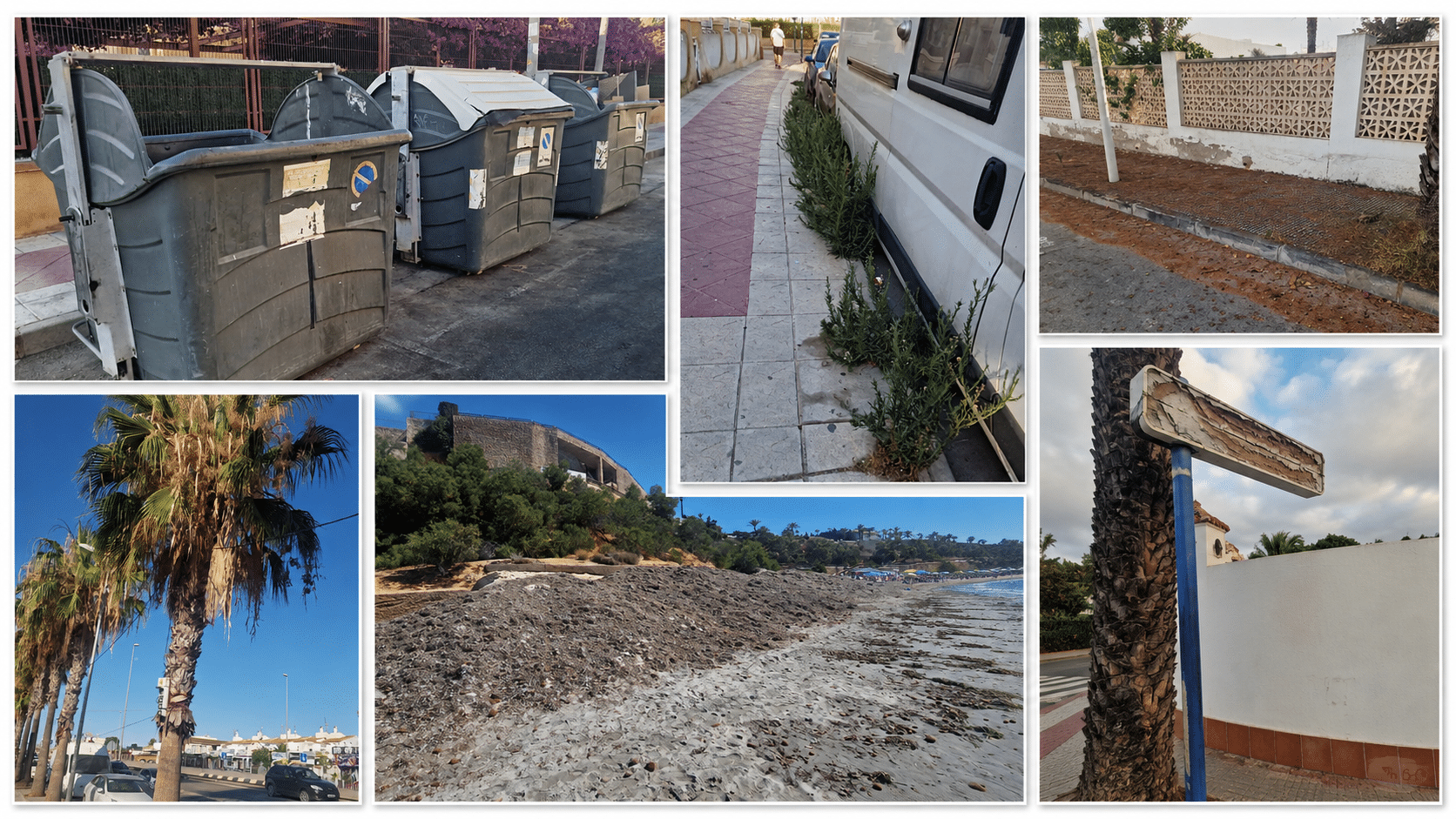
One of the main concerns is the condition of green areas and children’s playgrounds. The municipal company ILDO, which is responsible for the maintenance service, is said to be increasingly unable to meet the needs of the coast. Residents point in particular to unpruned palm trees, with dry branches and fallen fruit left scattered across pavements and streets.
Street cleaning is another recurring complaint. Local roads and pavements remain dirty, with residents claiming there is still no properly organised sweeping schedule or enough street-cleaning staff, vehicles and leaf blowers to maintain the area to an acceptable standard during the busiest months of the year.
Waste collection is also under scrutiny. Although new refuse trucks were added to the service last year, residents are waiting to see whether they will prevent the kind of summer chaos seen in previous years, when delays left streets lined with overflowing rubbish. The problem is worsened by old and damaged containers. Around a third of the 1,595 bins on the coast were replaced last year, but approximately 1,000 remain in poor condition, with no clear timetable for renewal.
Weeds and uncontrolled vegetation are also causing concern. In some highly visible areas, overgrowth has reached almost a metre in height, presenting what residents describe as a neglected and unacceptable image for both locals and visitors. Despite repeated complaints, no municipal department appears to have taken responsibility for keeping the problem under control.
The collection of pruning waste and bulky items also continues to fail. While some residents behave irresponsibly by dumping waste incorrectly, critics say the lack of police enforcement, the absence of a permanent ecopark and insufficient trucks and staff are all contributing to the problem.
Road conditions remain another major issue. Many streets continue to suffer from poor surfaces, potholes and inadequate horizontal and vertical signage. Residents argue that a full upgrade is needed, but question whether the municipal company Ecoplan has the resources required to carry it out effectively.
The beaches, already crowded, are also affected. Seaweed has still not been removed in some areas because the contract for its collection was put out to tender late, and has yet to be awarded. Maintenance of low walls, footbaths, flagpoles and beach walkways is also described as deficient, despite a €1 million allocation approved in the 2024 budget.
Accessibility remains especially serious at Barranco Rubio in Dehesa de Campoamor and at Punta Prima, where beach lifts are out of service. The Barranco Rubio lift has reportedly been closed for three years, while a €250,000 budget allocation approved two years ago for three new lifts has still not been implemented. A shuttle service for Barranco Rubio beach is also delayed and is not expected to begin until the final weeks of July.
Meanwhile, works on Avenida del Cabo in Cabo Roig, which began in March, remain unfinished, with recent resurfacing and road marking causing significant traffic congestion. The renovation of the expropriated section of the seafront promenade, carried out last summer, has also still not been completed, with only some lighting installed and accessibility improvements still pending.
Residents acknowledge that the current administration has launched important initiatives and that many councillors are approachable. However, they argue that the basics remain unresolved: clean streets, controlled weeds, safe roads, maintained parks, accessible beaches, working infrastructure, modern bins and a permanent recycling facility.
With more than €100 million reportedly held in municipal funds, critics say the problem is not money, but planning, resources and management. For many on Orihuela Costa, the frustration is simple: they live in a coastal paradise, but one that is being allowed to look increasingly neglected during the very period when it should be at its best.