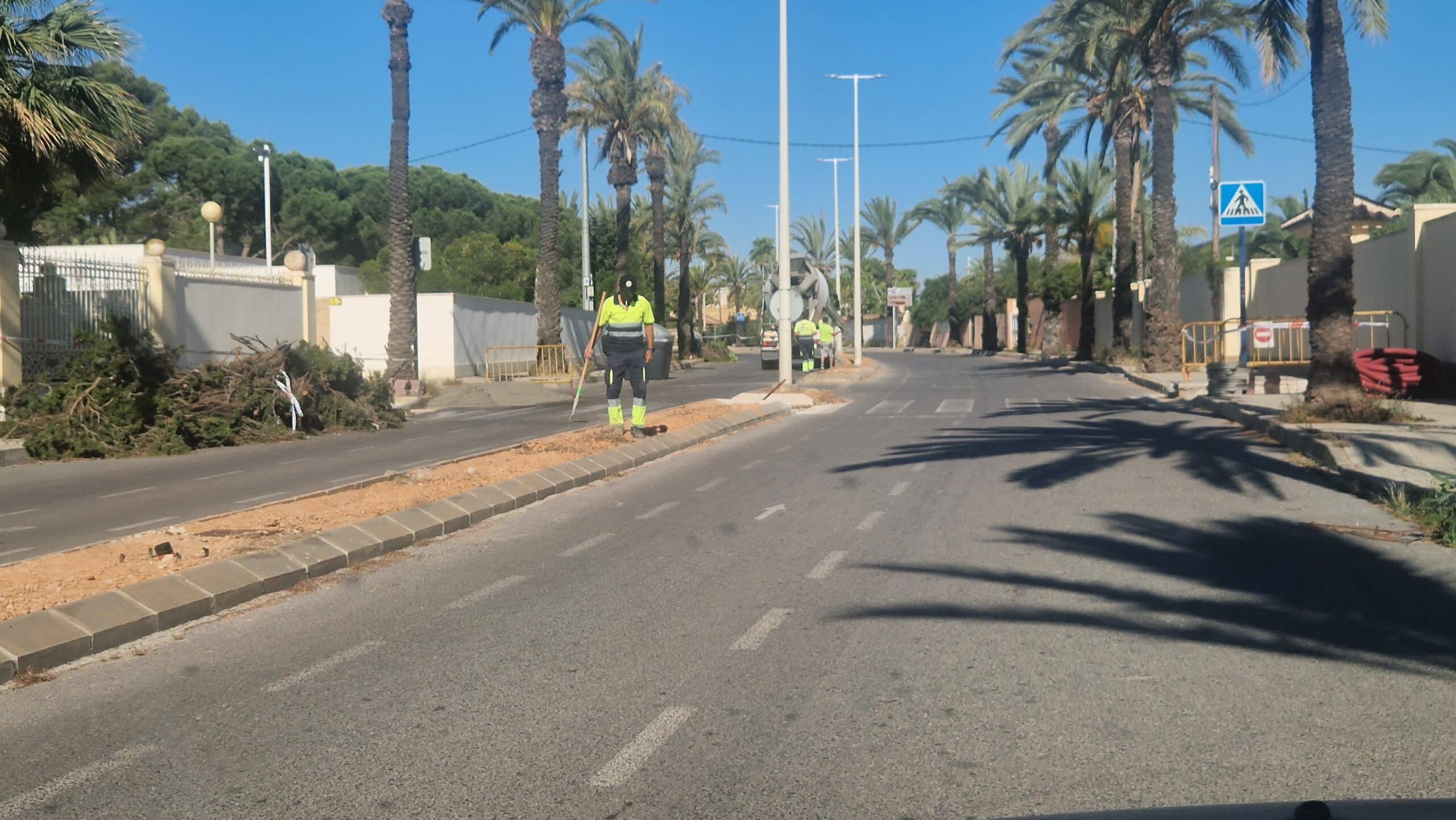
Cabo Roig Concrete Plan Axed After Public Outcry
Residents of Cabo Roig have forced Orihuela Council to abandon plans to concrete over the central reservation of Avenida del Cabo following widespread anger over the removal of mature trees and shrubs.
Although the campaign came too late to prevent much of the vegetation being cut down, residents have secured a redesign of the project. Instead of being paved, the median will now be replanted with low-growing, drought-resistant species suited to the local climate.
The dispute began after work started on the main avenue through Cabo Roig, a coastal development whose leafy surroundings are considered an important part of its identity.
Residents said many of the trees and shrubs removed were more than 50 years old and had contributed to shade, air quality, biodiversity and the area’s appearance.
Coastal councillor Manuel Mestre reportedly told campaigners that 300 signatures would be required before the council reconsidered the work. Residents collected 500, while an online petition later attracted more than 700 supporters.
The petition warned that excessive concreting would damage the character of Cabo Roig, reduce biodiversity, increase surface water run-off during torrential rain and contribute to higher local temperatures.
Campaigners also argued that the area’s natural environment was important not only to residents but also to tourism and the wider local economy.
Council sources said the original design had now been reviewed in response to public concerns.
Municipal officials maintained, however, that the removed vegetation had created road safety and infrastructure problems. A technical report said overgrown plants reduced visibility at junctions, bends and pedestrian crossings and interfered with street lighting.
Roots had also lifted sections of pavement and damaged public lighting ducts, according to the council.
Following the clearance and repair work, the authority has agreed not to pave the median. Instead, it plans to introduce low-level xerophytic planting requiring little or no irrigation.
The selected species will be adapted to the Mediterranean climate and suitable for the narrow central reservation, which is approximately 1.2 metres wide.
The council believes the revised scheme will preserve a planted median while improving visibility, reducing maintenance requirements and preventing further damage to paving and underground infrastructure.
The changes will not be introduced immediately, as the new design must first complete the necessary administrative procedures. Officials have asked residents for patience, with the work provisionally expected to be completed towards the end of the year.
The wider Avenida Cabo Roig improvement project began in March and was scheduled to take three months. Orihuela Council awarded the €209,344 contract last October to improve accessibility, road safety and deteriorated street infrastructure.
The original plans included rebuilding pavements and medians, installing accessibility ramps, replacing signs, repainting road markings and improving pedestrian crossings with solar-powered beacons, tactile paving and non-slip surfaces.
However, residents said they had not realised the scheme would remove so much greenery.
At the end of May, the Cabo Roig Residents’ Association and La Zenia Surf Association condemned the clearance, claiming between 2,500 and 3,000 square metres of vegetation had been removed.
They accused the council of replacing established Mediterranean planting with concrete at a time when cities across Europe were investing in trees and shade to combat rising temperatures.
The council defended the work as necessary for safety and accessibility, also noting that some of the removed plants were oleanders, which are toxic and require careful maintenance.
Despite those explanations, the strength of public opposition has now resulted in a significant change to the project.