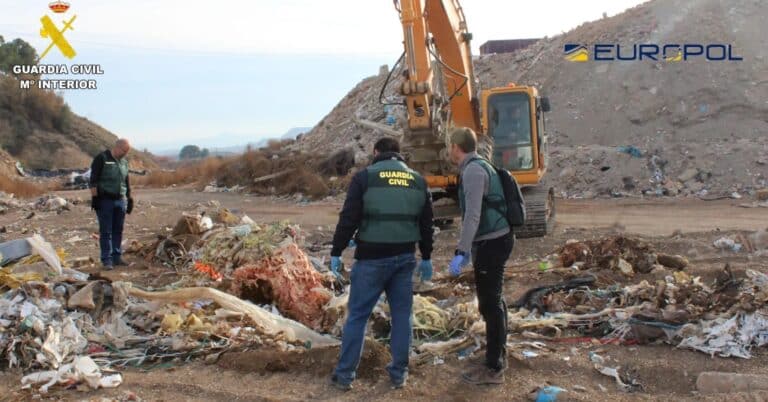
The Fenoll family allegedly established a fertilizer company to disguise the illegal burial of nearly one million tons of untreated waste on agricultural land in La Murada, a district in Orihuela.
This operation forms part of the wider Brugal corruption case, uncovered through extensive telephone wiretaps coordinated by the head of the National Police’s Money Laundering and Anti-Corruption Brigade.
That officer testified on Friday before the Provincial Court of Elche in one of the central trials arising from the investigation.
Prosecutors are seeking prison sentences of seven years for landowner Francisco Poveda and five years for Antonio Ángel Fenoll, Francisco Fenoll, and Ángel Fenoll Pastor—son, brother, and nephew respectively of businessman Ángel Fenoll Sr.—as well as for former Popular Party (PP) councillor Javier Bru and businessman José Vera.
The charges relate to the illegal disposal and concealment of waste on farmland in the areas known as Los Sigüenzas and Los Randeros.
According to the police testimony, wiretapped conversations recorded between May and July 2008 reveal that Ángel Fenoll Sr., who managed the Proambiente landfill at the time but is unfit to stand trial due to illness, directed the operation.
He allegedly instructed his son Antonio Ángel Fenoll, who maintained close contact with municipal officials in Orihuela, to “keep the institutional side under control.”
The officer outlined a structured division of roles among the defendants. Ángel Fenoll Pastor coordinated the burial and concealment of waste on agricultural terraces. Poveda supplied the land, while Francisco Fenoll occasionally operated the heavy machinery used in the burials.
Javier Bru’s role was described as key: he allegedly created a company specifically to provide a veneer of legality, presenting the dumping operation as a commercial transaction involving fertilizer. José Vera, owner of the machinery company involved, played a less clearly defined role.
One intercepted conversation, attributed to Poveda, was highlighted during the proceedings. When he learned that a local police patrol—acting independently of the Brugal investigation—had begun inspecting the burial sites, he warned: “This cannot come out, or they’ll put us all in jail.”
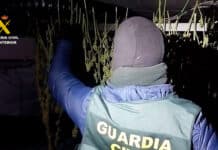
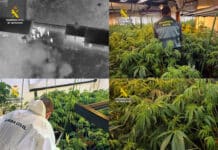
The police chief explained that by 2010, multiple strands of evidence converged: wiretap transcripts, local police inspections prompted by residents’ complaints, test pits dug by the Civil Guard, testimony from a former employee who identified burial locations, and technical reports commissioned by the Orihuela City Council between 2011 and 2015.
Together, these elements confirmed not only the illegal dumping but also a coordinated effort to conceal it.
Environmental damage was also addressed in court. Reports confirmed contamination of land near the Rambla Salada ravine, including plastics, solvents, pesticides, fuels, and leachate containing high concentrations of ammonium, nickel, and chromium. While most of the affected land is now used for citrus farming, only 11% has been officially barred from cultivation.
A former senior technician from the Segura River Basin Authority acknowledged the contamination but disputed its origin, attributing it to a leaking pond within the Proambiente facility rather than to the buried waste itself.