Seismic Swarm Shakes the Mediterranean:
IGN logs more than 12 tremors in under 12 hours, felt as far inland as Murcia
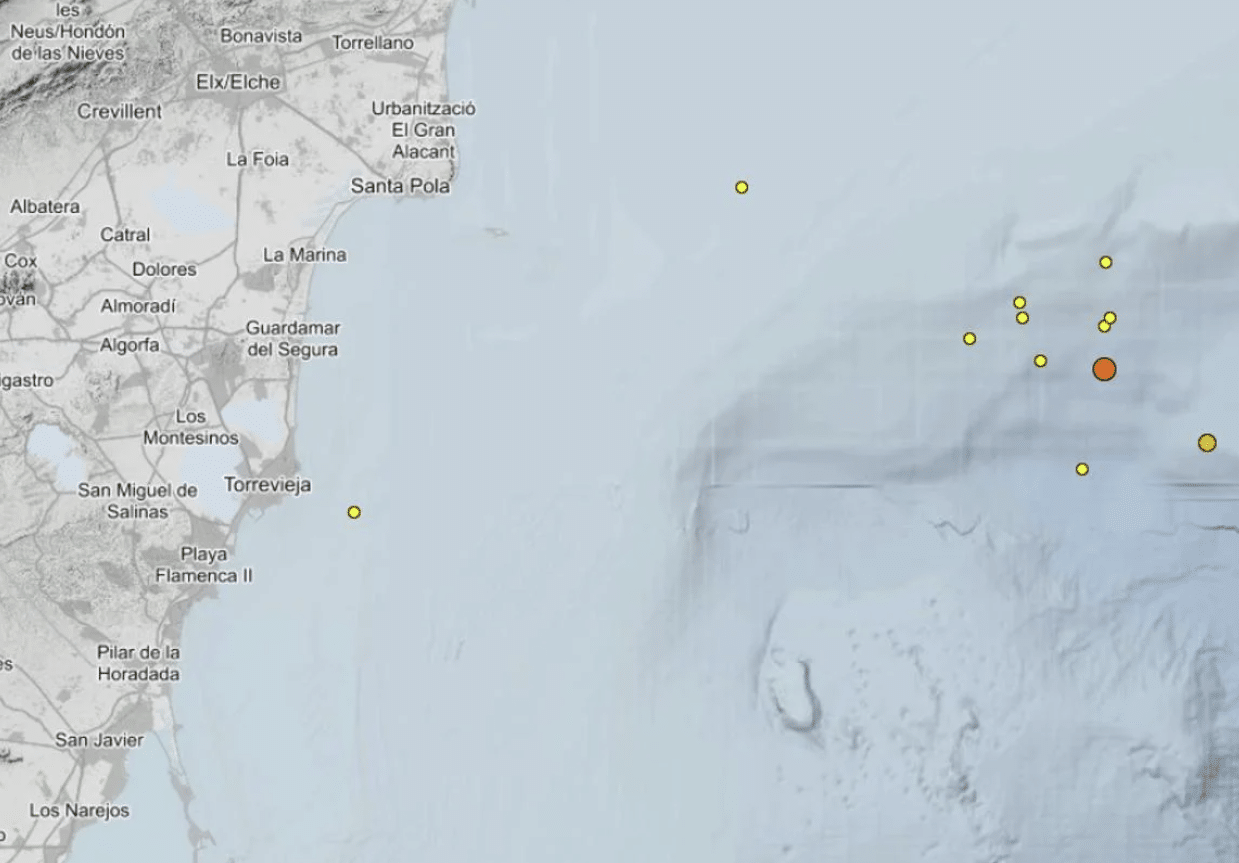
A series of earthquakes off the coast of Torrevieja shook the Mediterranean Sea late Monday night and into the early hours of Tuesday morning, in what experts are calling a seismic swarm. According to Spain’s National Geographic Institute (IGN), at least a dozen tremors were recorded in less than 12 hours, affecting areas along the Alicante coast—including Santa Pola and Guardamar del Segura.
The phenomenon, which involves a rapid succession of small earthquakes in the same area, is not unusual for this part of Spain. The Vega Baja and southern Costa Blanca regions lie in one of the country’s most seismically active zones, due to the ongoing collision between the Eurasian and African tectonic plates. Although large-scale earthquakes are rare, minor tremors are relatively frequent, and residents are occasionally reminded of the seismic nature of the region through mild but noticeable ground movement.
The meteorological and geophysical project MeteOrihuela reported on social media that most of the tremors occurred between 50 and 60 kilometers offshore, though a few were significantly closer to land. Despite their distance, several quakes were felt by residents in Torrevieja, Orihuela, and even parts of the Region of Murcia, as reported by users on social media platform X (formerly Twitter).
While most of the recorded earthquakes had magnitudes between 1.0 and 2.0, the strongest reached magnitude 3.6. The majority were located at depths ranging from 15 to 35 kilometers.
Although the cluster of quakes may seem alarming, experts stress that it is consistent with the region’s natural seismic activity. “You know we live in a zone of high seismic activity, constantly evolving, as a result of the collision between the Eurasian and African plates. These tremors are normal,” MeteOrihuela noted.
The IGN maintains a real-time alert system and seismic monitoring network across Spain, which allows authorities and researchers to track and assess seismic risks promptly. While no damage has been reported, the event serves as a timely reminder of the need for awareness and preparedness in areas with elevated seismic risk.