Electric scooter users across the Vega Baja will face tougher safety requirements from October 1, as revised national traffic regulations come into force.
The changes will affect riders in Torrevieja, Orihuela Costa, Guardamar, Rojales, Pilar de la Horadada and every other municipality in the region. Local police forces will be responsible for enforcing the rules on urban roads, although individual councils may also impose additional restrictions through their municipal traffic ordinances.
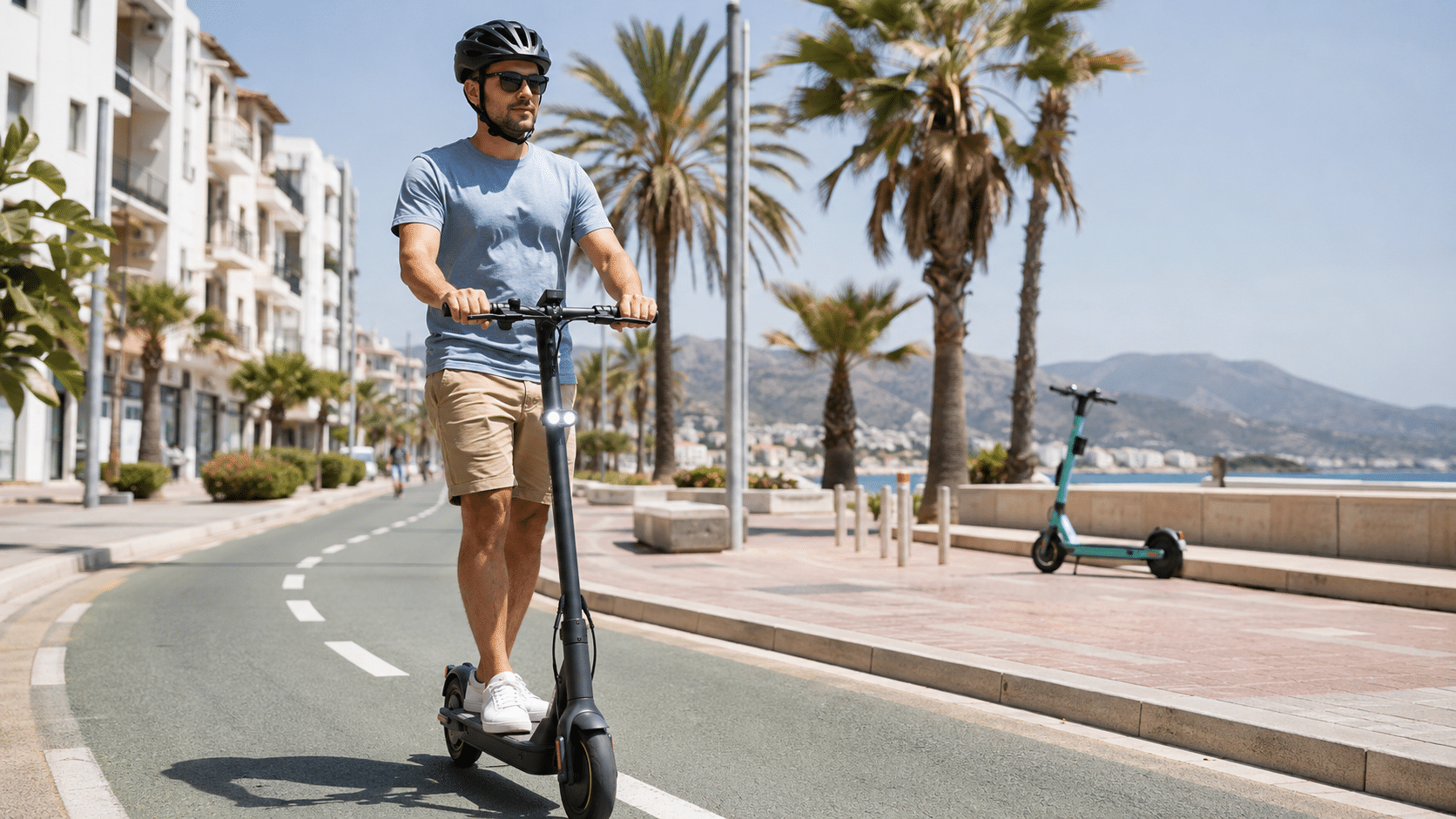
Among the most significant changes is the introduction of a national minimum riding age of 15. Riders will also be required to wear an approved protective helmet.
Failing to wear a helmet will be classified as a serious offence and may result in a €200 fine.
Reflective Clothing and Lights
Anyone using an electric scooter at night or in poor visibility will have to wear a reflective vest or another approved reflective garment.
People who use scooters professionally, including food-delivery riders, will be required to always wear reflective clothing while working.
The scooter’s lights must also remain switched on while it is being ridden. Police will be able to check that vehicles have functioning front and rear lighting and the required reflectors.
Failure to comply with the helmet or reflective-clothing requirements can attract a €200 penalty.
The new regulations also maintain the maximum permitted speed for personal mobility vehicles at 25 kilometres per hour. Modified scooters capable of travelling faster may no longer qualify as legal personal mobility vehicles and could be immobilised by police.
Registration and Insurance
Registration and insurance requirements are already in force and are not being introduced for the first time in October.
Owners must register their scooter in the DGT’s National Vehicle Register before arranging the compulsory liability insurance. Once registered, the scooter receives an identification number and must carry the corresponding label.
Scooters sold since January 22, 2024, should have a DGT-recognised certificate showing that the model complies with the required technical and safety standards.
Older scooters without certification may continue to circulate under transitional arrangements until January 22, 2027. However, they must still be registered and insured.
After that date, uncertified models will no longer be permitted on public roads.
Where Scooters Can Be Used
Electric scooters remain single-person vehicles. Carrying a passenger is prohibited, even when the scooter appears large enough for two people.
Riders may not use pavements, pedestrian-only areas, motorways, dual carriageways, urban tunnels or other roads from which personal mobility vehicles are excluded.
Outside built-up areas, their use will generally be restricted to specially segregated routes, such as authorised cycle lanes. Riders should therefore not assume that they can travel between Vega Baja towns on ordinary interurban roads.
Within towns, the routes available will depend partly on each council’s mobility ordinance and local signs. Rules may consequently differ between Torrevieja, Orihuela, Guardamar and neighbouring municipalities.
Phones, Headphones, Alcohol and Drugs
Using a handheld mobile telephone while riding is prohibited, as is wearing headphones or earphones that interfere with awareness of surrounding traffic.
Scooter users are also subject to alcohol and drug restrictions. Depending on the offence and the applicable legislation, penalties may run into hundreds of euros and the vehicle may be immobilised.
Refusing to undergo an alcohol or drug test can also result in serious consequences.
Other punishable behaviour includes reckless riding, ignoring traffic lights, travelling against the direction of traffic and using a scooter in an area where these vehicles are prohibited.
Although some municipal offences can result in fines of up to €500, the precise penalty will depend on the offence and the ordinance applied by the council concerned.
Increased Police Checks Expected
Local police forces across the Vega Baja are expected to place greater emphasis on scooter safety once the new national rules take effect.
Checks may cover the rider’s age, helmet, reflective clothing, speed, lights, insurance, registration and vehicle identification.
Riders hiring an electric scooter should ask whether a helmet is included. Although every rider must wear an approved or certified helmet from October 1, the national regulation does not explicitly require all rental companies to supply one. If a company does not provide a helmet, the customer will still be responsible for obtaining one before using the scooter. Failure to do so could result in a €200 fine.
The regulations reflect the rapid growth in scooter use throughout the region. Electric scooters offer a convenient and inexpensive means of travelling short distances, but their popularity has also led to complaints about pavement riding, excessive speed and dangerous behaviour in busy tourist areas.
From October 1, riders will need to ensure that both they and their scooters comply with the new requirements before taking to the road. DGT guidance on the October reforms and DGT registration information are available online.