Opinion piece by By Tomas Moreno
More than three years into the PP–Vox administration, residents are entitled to ask a simple question: why are waste collection and street cleaning services in Orihuela Costa still so appallingly poor?
The question is even more justified because, since last year, households have been paying approximately three times as much in waste collection charges. Residents are contributing considerably more, yet there has been no corresponding improvement in the service they receive.
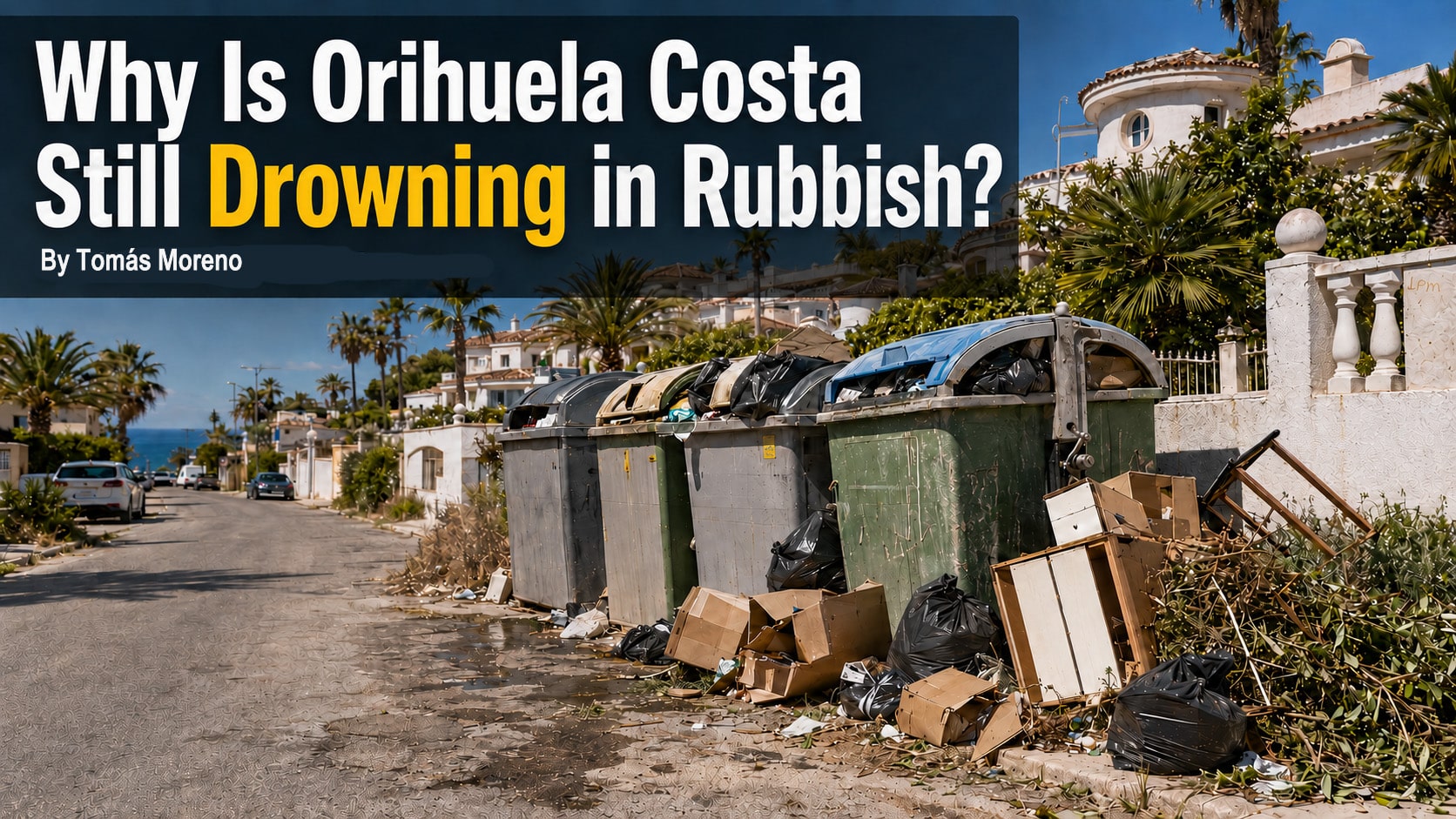
The condition of many streets is disheartening. Roads and pavements are covered with litter, weeds, palm fronds and discarded rubbish. Containers are dilapidated or overflowing, while the tarmac around them is stained black because neither the bins nor their surroundings are washed regularly.
Abandoned furniture, household items and garden waste can remain on the streets for days. In some neighbourhoods, the overall impression is one of neglect rather than that of a well-managed European coastal community.
Orihuela Costa’s residents should not have to live like this.
A service starved of resources
Waste collection and street cleaning have been managed directly by the municipal Department of Street Cleaning and Solid Urban Waste since 2012. The staff, vehicles, machinery, containers and other resources must therefore be provided and financed through the municipal budget.
Successive administrations, including the current government, have publicly acknowledged that the service is inadequate because it lacks sufficient resources. However, recognition of the problem is no substitute for solving it.
Daily collection routes are not always completed, particularly at weekends, causing containers to overflow. Commercial waste is not properly controlled, while more than 1,000 containers are reportedly required to replace the obsolete and deteriorating units currently in use along the coast.
The containers and their surroundings are rarely washed. Leachate spilled by collection vehicles is allowed to soak into the road surface, producing foul smells and unhygienic conditions.
Street sweeping, whether manual or mechanical, does not appear to follow an effective schedule. Neither does street washing. Weeds have been allowed to take over pavements and roadsides in numerous residential areas, while pressure-washing and pavement-scrubbing are almost non-existent, even in busy leisure and commercial zones.
Routes for collecting pruning waste, furniture and unwanted household items are equally unreliable. At the same time, inadequate enforcement against illegal dumping allows the problem to continue.
Even the permanent recycling centre has still not opened, despite the consortium reportedly having been ready to launch it for more than two years.
What does an effective service require?
Providing an acceptable waste and street-cleaning service is not an impossible task, but it does require several essential elements.
First, qualified professionals must be responsible for managing the operation. Second, there must be realistic planning adapted to the particular needs of Orihuela Costa, including its dispersed urbanisations and enormous seasonal population increase.
That planning must then be monitored and enforced.
The service also needs enough properly trained employees to carry out the work, together with a modern fleet of collection vehicles, replacement containers, mechanical sweepers, pressure washers, pavement scrubbers, blowers and other essential equipment.
Orihuela Costa currently suffers from deficiencies in all these areas. The result is visible on our streets every day.

What happened to the municipal company?
Since taking office in June 2023, the present administration has pursued the transfer of the service to a wholly council-owned municipal company.
The company created for this purpose, SGM, has reportedly received almost €2 million from Orihuela City Council. Yet it has still not begun to operate the service.
Creating a municipal company on paper is one thing. Providing it with qualified managers, technicians, employees, vehicles, machinery, containers and an effective operating structure is quite another.
The government has chosen an extremely ambitious model without demonstrating that the council possesses the professional expertise or organisational capacity required to make it work.
Meanwhile, residents continue paying for a service that remains grossly inadequate.
Other options were available
Direct management through a wholly municipal company was not the only possibility.
One alternative would have been a mixed-capital company in which a private partner could hold up to 49 per cent of the capital. That partner could have contributed not only funding but also the specialist knowledge required to organise and manage such a complex operation.
This was the model recommended in a report commissioned by the City Council from the consultancy firm Garrigues in April 2020.
In my opinion, a mixed company would have been a far more realistic solution. A suitably experienced private partner could provide precisely what Orihuela City Council appears to lack: additional resources, technical expertise and the ability to plan, organise and supervise the service efficiently.
Another option would have been to put the entire operation out to public tender.
Under this arrangement, a specialist private company would receive an annual payment to provide the vehicles, containers, machinery, technicians, employees and operational planning necessary to deliver the service.
This is hardly a revolutionary idea. It is the model used by most Spanish municipalities in our area, with Guardamar del Segura being a notable exception.
Why, then, did Orihuela’s government reject what appears to be the most practical and widely used solution?
Residents deserve an answer
More than three years after beginning the attempt to transfer the service to SGM, the government has still not succeeded. Waste collection and street cleaning therefore remain under the direct control of the municipal department, which continues to operate with inadequate resources and even worse planning.
The consequences are impossible to ignore: overflowing containers, filthy pavements, abandoned furniture, uncontrolled garden waste, unpleasant smells and streets that receive neither the cleaning nor the maintenance residents have every right to expect.
This failure is particularly unacceptable when households are being charged so much more for the service.
Orihuela Costa does not need additional promises, excuses or announcements about plans that never become operational. It needs clean streets, reliable collections, modern containers, effective supervision and proper enforcement against illegal dumping.
Residents are understandably losing patience. Discontent is growing, and increasing numbers now see the political and administrative separation of Orihuela Costa from Orihuela as the only long-term solution.
Whether one supports segregation or not, the municipal government should recognise what is driving that sentiment: years of neglect, repeated failures and the continuing impression that the coast pays more while receiving less.
The question is no longer whether the present system is failing. The evidence is piled up around the containers and scattered across our streets.
The real question is how much longer residents will be expected to tolerate it.