Orihuela City Council has included a collection of neglected archaeological remains at Punta Prima in its revised catalogue of protected heritage assets, seven years after plans were drawn up for their restoration and public display.
The historic site, which straddles the boundary between Orihuela and Torrevieja, contains the remains of a 19th-century Carabineros barracks, a Civil War air-raid shelter and an anti-aircraft battery. The southern section lies within Orihuela, while the northern part belongs to Torrevieja.
The remains have now been designated Assets of Local Relevance as part of Orihuela’s review of its protected heritage catalogue. The designation will regulate what activities and development may be permitted around the site.
The proposal was prepared by ARN Arquitectos, the company awarded the approximately €150,000 contract to update the catalogue. The firm also produced a preliminary restoration project in January 2019, following archaeological excavations carried out during June and July 2018.
Those investigations were commissioned by the developer planning the Posidonia residential complex. Torrevieja City Council granted permission for several apartment buildings on condition that the archaeological remains were preserved, restored and made accessible. One of the five buildings was designed directly above the shelter, leaving the underground structure enclosed within its foundations.
A joint commission involving Orihuela and Torrevieja councils was established, while the restoration proposal was submitted to the Valencian Regional Ministry of Culture and the Provincial Coastal Authority. The intention was for the heritage work to be completed alongside the residential development.
However, the restoration never materialised. Seven years later, the luxury complex comprising hundreds of homes and extensive landscaped areas was constructed. It has now been occupied since 2024, while the neighbouring archaeological site continues to deteriorate.
There is no information panel explaining its history. The only visible protection is fencing around one of the shelter’s two entrances. A proposed seafront promenade linking Torrevieja’s Rocío del Mar urbanisation with the Punta Prima beach promenade in Orihuela was also never constructed.
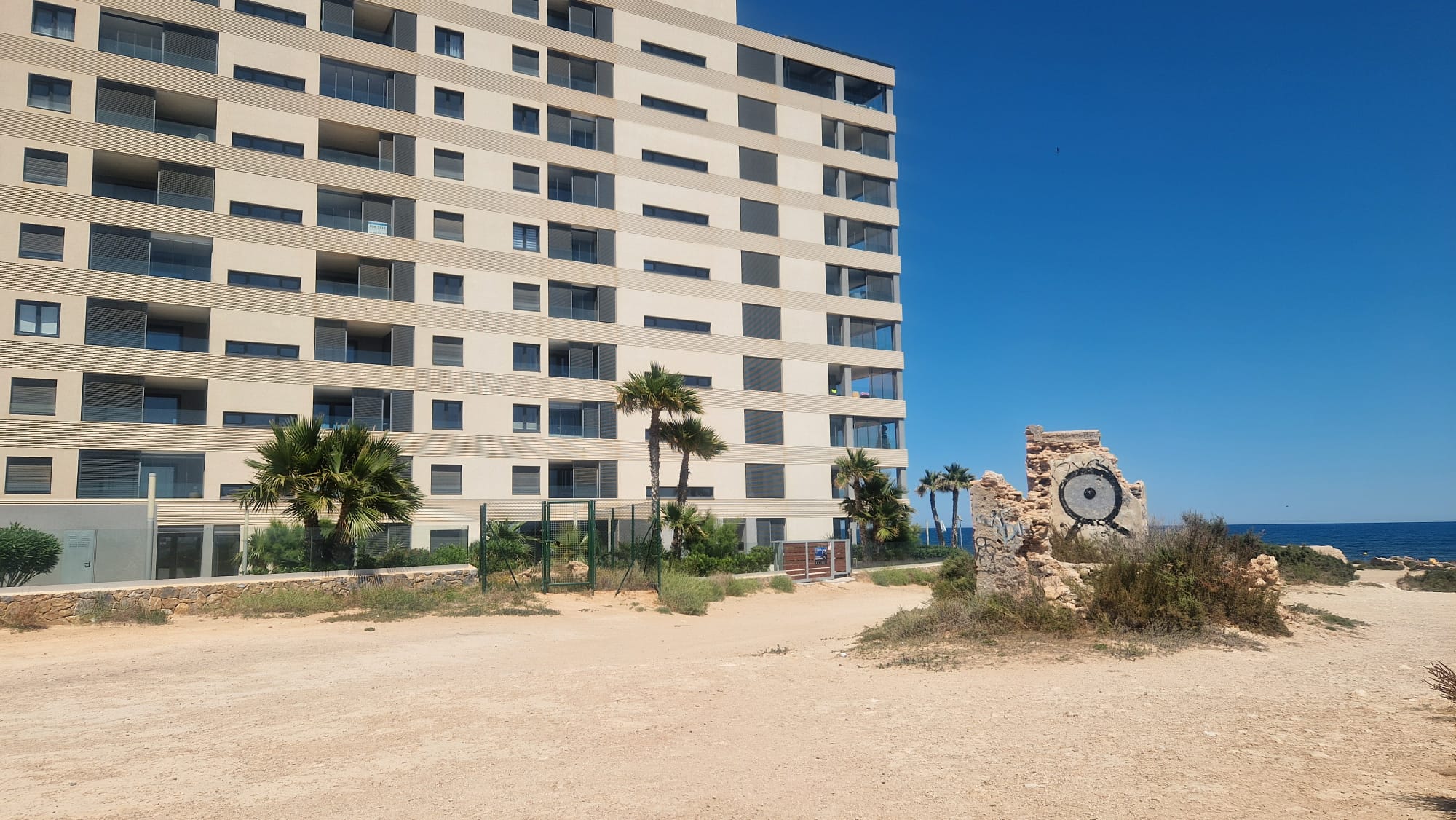
Before the development, the well-preserved shelter could be reached by descending more than 30 steps to a depth of six metres. It extended for 43 metres between its two entrances, with a central passage 1.95 metres high. Archaeologists also produced a three-dimensional model of the 30-square-metre structure.
Those reviewing Orihuela’s heritage catalogue believe any future intervention must be agreed jointly by both councils so the remains can be restored as a single historic site.
The barracks was built by at least 1881 to combat smuggling and provide security along an isolated stretch of coastline. It consisted of two rectangular buildings. The larger was demolished between the late 1950s and early 1960s, while much of its flooring was removed. The smaller building survived in better condition because it had remained buried.
The site also contains two cisterns connected to settling wells. Oral accounts suggest there were sandstone washing basins draining into the sea, where women from nearby hamlets washed clothes for the officers and cleaned the barracks. Horse stables may also have existed.
Research by historians Eduardo López and Juan Antonio Pujol documents the difficult and sometimes dangerous lives of the Carabineros stationed there. As well as confronting smugglers and maintaining order, officers conducted maritime rescues. In 1868, they assisted nine sailors and the captain of a Prussian brig that ran aground near Punta Prima.
Construction of the coastal battery began shortly after 1928 to help defend the Cartagena naval base. The surviving features include possible guard buildings and four circular emplacements believed to have housed Vickers guns.
Although apparently inactive during the Civil War, the battery commander warned Torrevieja’s mayor in 1937 that lights visible from the sea could reveal its position to enemy ships.
Despite this rich history, the remains are largely unknown and face continuing deterioration amid intensive coastal development. Their inclusion in Orihuela’s catalogue offers renewed hope that the long-promised preservation project may finally proceed.