
Every July, the streets of Orihuela become the setting for one of the most distinctive civic ceremonies in Spain as the Glorious Banner of the Oriol emerges from the Town Hall to lead the city’s historic celebrations.
Known in Spanish as the Gloriosa Enseña del Oriol, the banner is far more than a treasured relic. It is the living symbol of Orihuela—an emblem of municipal authority, Christian conquest, royal privilege and a civic identity shaped over many centuries.
Its annual appearance is closely associated with July 17, traditionally known as Reconquest Day or the Day of the Bird. The ceremony commemorates the incorporation of Orihuela into Christian rule during the 13th century and is also linked to Saints Justa and Rufina, the city’s co-patron saints.
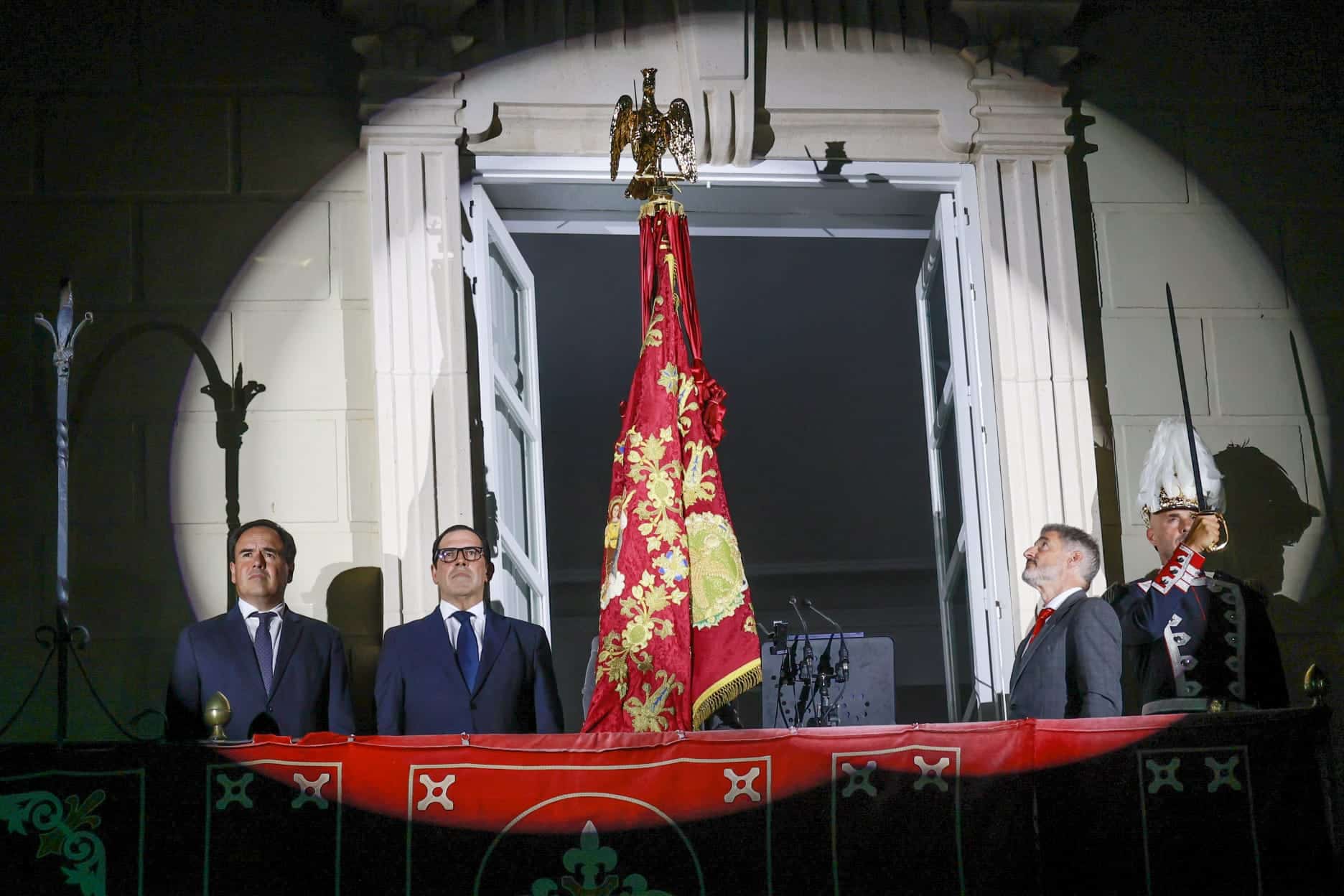
When the banner is displayed from the balcony of Orihuela Town Hall, it marks the continuation of a tradition rooted in the Middle Ages. Later, before being carried through the streets, it is lowered from the balcony using ribbons—a practice documented since at least 1609.
The unusual procedure reflects the exceptional status of the standard. The Oriol must always remain upright and, according to tradition, may be lowered only before God and the king.

A symbol older than the festival
Although Orihuela’s commemorative festival was formally established around 1400, the documented history of the city’s banner stretches even further back.
In 1357, Prince Ferdinand ordered Orihuela’s standard to accompany troops taking part in an expedition against Jumilla. The order demonstrates that the banner was already recognised as the official representation of the city and was carried on occasions of major military and political importance.
At the municipality’s request, the Bishop of Cartagena formally instituted the annual celebration in 1400. From that point, July 17 became associated with a civic and religious ceremony involving the municipal authorities, the cathedral and Saints Justa and Rufina.
The tradition developed gradually into the elaborate ritual observed today. The banner’s journey through the city, the participation of the municipal corporation and its association with the co-patron saints created a ceremonial sequence that survived dynastic changes, political upheaval and profound social transformation.
It remains one of the clearest examples of Orihuela’s determination to preserve its past as part of its modern identity.
Why is it called the Oriol?
The standard is popularly known as “The Bird” because of the magnificent silver-gilt oriole mounted at the top of its staff. The bird has become inseparable from the identity of Orihuela and appears prominently in the city’s heraldry.
The crowned oriole is depicted with its wings partly spread. One foot rests on a piece of wood, while the other holds a sword. The striking image represents vigilance, resistance and the defence of the city.
It is associated with the Latin motto Semper ensis vester prevaluit—“Your sword always prevailed”—granted to Orihuela by Peter IV of Aragon, known as Peter the Ceremonious, in recognition of the city’s loyalty and resistance during periods of siege and conflict.
The existing silver-gilt figure was created in 1732 by Orihuela goldsmith Miguel Ruvira, replacing an earlier version carved from wood.
Suspended beneath it is a crimson damask banner decorated with symbols representing Orihuela, the Crown of Aragon and Saints Justa and Rufina. It also bears the coat of arms of Philip V, reflecting the many different historical periods through which the emblem has passed.
The historic banner incorporates elements dating from between the 16th and 18th centuries and is preserved with exceptional care. A replica is now used for many ceremonial appearances, allowing the tradition to continue without exposing the original to unnecessary damage. Its textile section was produced in 2007, while the upper figure was added in 2020.

The Syndic Bearer
Carrying the Oriol is considered one of the highest civic honours that Orihuela can bestow.
Each year, a Syndic Bearer is entrusted with safeguarding and carrying the banner during the official procession. The appointment recognises an individual’s professional, cultural or personal contribution to Orihuela and their commitment to the city and its traditions.
The bearer does not simply carry a flag. For the duration of the ceremony, that person becomes the guardian of Orihuela’s principal historical emblem and a visible link between the city’s medieval past and its present-day community.
The procession is conducted according to strict protocol. The banner remains upright throughout its journey and occupies a position of honour among the municipal authorities, religious representatives and festival delegations.
Residents line the route as the Oriol moves through the historic centre, transforming what could otherwise be a museum object into a shared and emotional public experience.
The Armengola and the legend of Orihuela
The celebrations are also inseparable from the legendary figure of the Armengola.
According to local tradition, the Armengola played a decisive role in preventing an attack on Orihuela’s Christian population during the period of Muslim rule. Her story has been passed down through generations and remains one of the most powerful legends in the city’s cultural heritage.
Each year, a woman is chosen to represent the Armengola, the most senior distinction within the Moors and Christians festival organisation. Her presence provides another connection between history, legend and modern civic life.
Although the historical details surrounding the medieval story remain a matter of tradition, its cultural importance is unquestionable. The Armengola represents courage, loyalty and the defence of the city—values also embodied by the sword-bearing Oriol.

History brought alive in the streets
The annual procession of the banner forms the historical heart of Orihuela’s Moors and Christians celebrations, organised by the Association of Moors and Christians Festivals of Saints Justa and Rufina, known as AMYCO.
Eighteen festival groups make up the Christian and Moorish sides. Together, they coordinate the participation of hundreds of people and preserve a rich legacy of music, costume, pageantry and community involvement.
The principal events traditionally include a children’s parade, the lively Grand Festival Retreat and the solemn Christian and Moorish entry parades.
The children’s procession is particularly important to the festival’s future. Young participants learn the marches, costumes, symbols and customs of their respective groups, ensuring that the celebration is passed from one generation to the next.
The Christian Entry evokes the forces associated with the medieval reconquest, with groups such as the Knights of King Ferdinand, the Knights Templar, the Knights of Santiago and the Knights of the Oriol filling the streets with armour, heraldry and ceremonial music.
The Moorish Entry provides an equally spectacular display, distinguished by richly decorated costumes, powerful Moorish marches and carefully choreographed formations. Its participating groups celebrate the Islamic culture and history that also helped shape Orihuela and the wider Vega Baja.
Together, the two sides present a dramatic interpretation of the city’s past while recognising the different cultures that contributed to its development.
Orihuela’s living emblem
The Glorious Banner of the Oriol demonstrates that heritage does not belong exclusively in museums, archives or display cases.
Every July, it returns to the streets and becomes part of the city once more. Municipal representatives, festival groups, musicians, families and thousands of spectators gather around an emblem that has represented Orihuela for more than six centuries.
The banner has witnessed wars, dynastic struggles, political change and the transformation of Orihuela from a medieval frontier city into a modern municipality. Yet its ceremonial role has endured.
Raised above the crowds, the crowned bird and its sword continue to express Orihuela’s pride, resilience and loyalty to its history.
For residents, the Oriol is not simply a reminder of what the city once was. It is a declaration of what Orihuela remains: a community deeply conscious of its past and determined to carry that inheritance into the future.