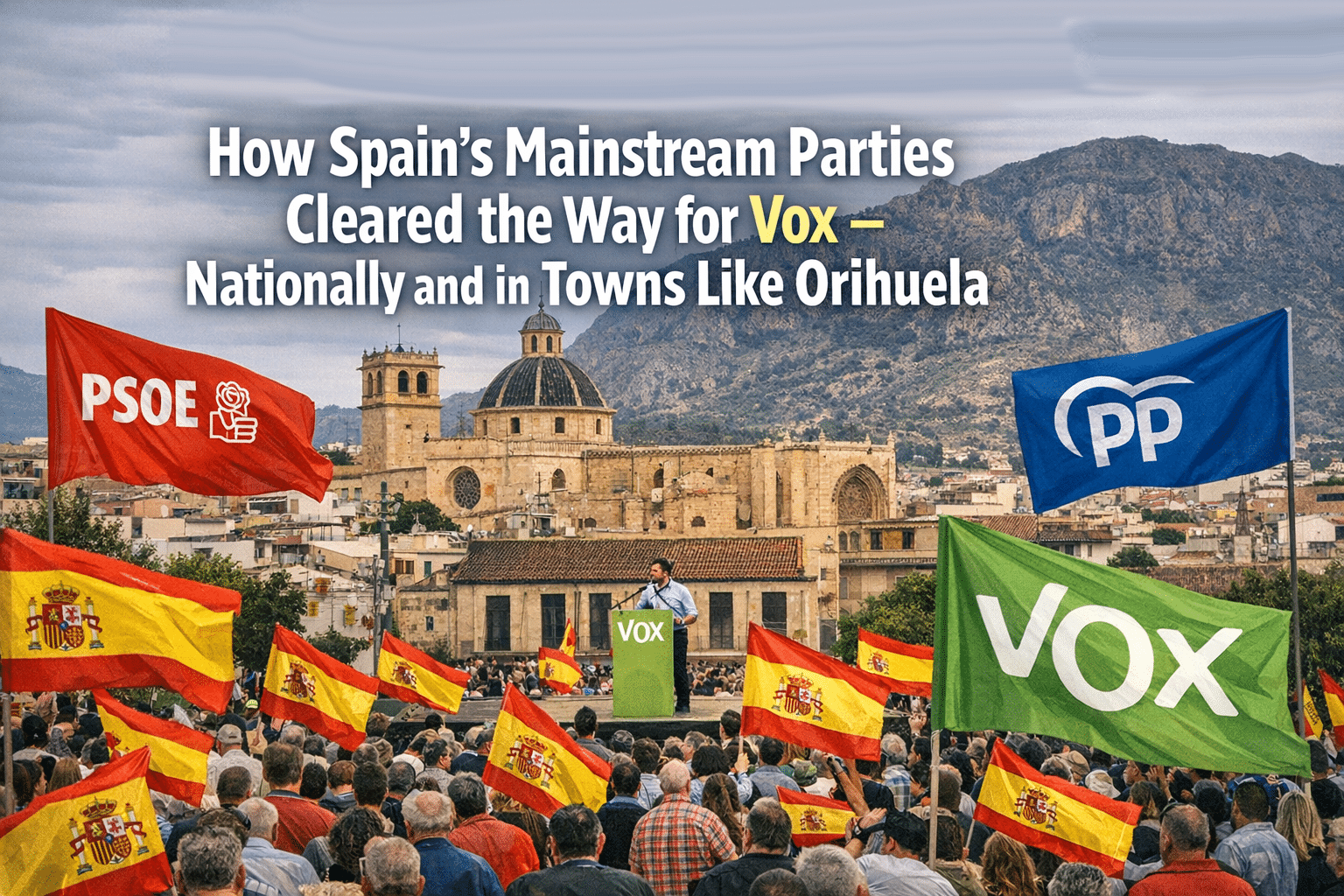

For decades, Spain’s political stability rested on a predictable rhythm: the Partido Popular (PP) and the Partido Socialista Obrero Español (PSOE) alternated in power, absorbing public frustration when the other faltered.
That rhythm has broken. The rise of Vox is not a sudden ideological earthquake but the cumulative result of institutional fatigue, corruption scandals, and strategic paralysis within the two parties that once defined Spanish democracy. And crucially, this shift is not confined to Madrid or national politics.
It is happening in municipalities across the country—including places like Orihuela, where local governance failures have mirrored the national pattern and accelerated the same voter realignment.
National polling captures the scale of the shift. Surveys place Vox at roughly 17–18 percent support—its strongest position since the 2023 general election.
PP has slipped to around 30 percent, its lowest level in more than a year, while PSOE has lost several points amid internal crises and corruption cases.
The gap between the two major parties has narrowed not because either has surged, but because both are losing credibility.
This erosion has been years in the making. PSOE has been repeatedly hit by corruption cases involving figures close to the party leadership. Each new revelation reinforces a narrative of institutional decay that Vox has weaponized with discipline.
PP, meanwhile, has never fully escaped the shadow of its own corruption scandals. Even when not directly implicated in current controversies, the party remains associated with past cases that continue to shape public perception.
Attempts to present itself as a clean, competent alternative have been undermined by strategic ambiguity and internal divisions.
But the national picture only tells half the story. The same dynamics are visible at the local level, where voters interact most directly with political institutions—and where frustration can be even more acute.
Orihuela is a case in point. Years of political instability, shifting coalitions, and governance failures have eroded trust in the traditional parties. Residents have watched repeated breakdowns in local administration, stalled projects, and public disputes between PP, PSOE, and other mainstream actors.
When local government appears dysfunctional, voters become more receptive to parties that promise a break with the status quo.
In municipalities like Orihuela, Vox has capitalized on this environment by presenting itself as the only force capable of imposing order and ending what it portrays as a cycle of incompetence.
The party’s national messaging—focused on corruption, institutional decay, and cultural grievance—translates easily into local politics, where dissatisfaction is often more personal and immediate.
When bins go uncollected, infrastructure projects stall, or councils collapse into infighting, the argument that “the old parties have failed” becomes more persuasive.
Demographically, the shift is even more striking. Vox’s strongest gains are among voters aged 18 to 44—a cohort that neither PP nor PSOE has managed to engage meaningfully.
For a party founded in 2013 to command nearly a fifth of the national vote among younger Spaniards is not a sign of ideological radicalization; it is a sign of generational disillusionment.
Many of these voters have grown up with economic precarity, political scandal, and institutional drift as the norm. They are not abandoning the mainstream—they are concluding that the mainstream abandoned them.
The consequences are already visible. In regional elections such as Extremadura, Vox doubled its representation despite running an unknown candidate. In local contexts like Orihuela, the party has become a decisive force in coalition negotiations and municipal governance.
Nationally, it consistently outperforms expectations whenever PSOE faces a scandal or PP appears divided. The pattern is unmistakable: Vox rises when the traditional parties falter, hesitate, or contradict themselves—whether in Madrid, Valencia, or a town hall in the Vega Baja.
Spain is not unique in this dynamic. Across Europe, parties that once anchored political life are struggling to adapt to an era defined by distrust, fragmentation, and cultural anxiety.
But Spain’s case is distinctive because the failures of PP and PSOE are so deeply intertwined with the country’s democratic story.
When the two pillars of the system appear compromised, the entire structure begins to wobble.
The rise of Vox is not a temporary protest vote or a passing storm. It is a symptom of a political system running on fumes. Unless PP and PSOE confront the credibility crisis they helped create—through transparency, renewal, and a willingness to break with old habits—the vacuum will only widen. And Vox will continue to fill it, nationally and in towns like Orihuela.