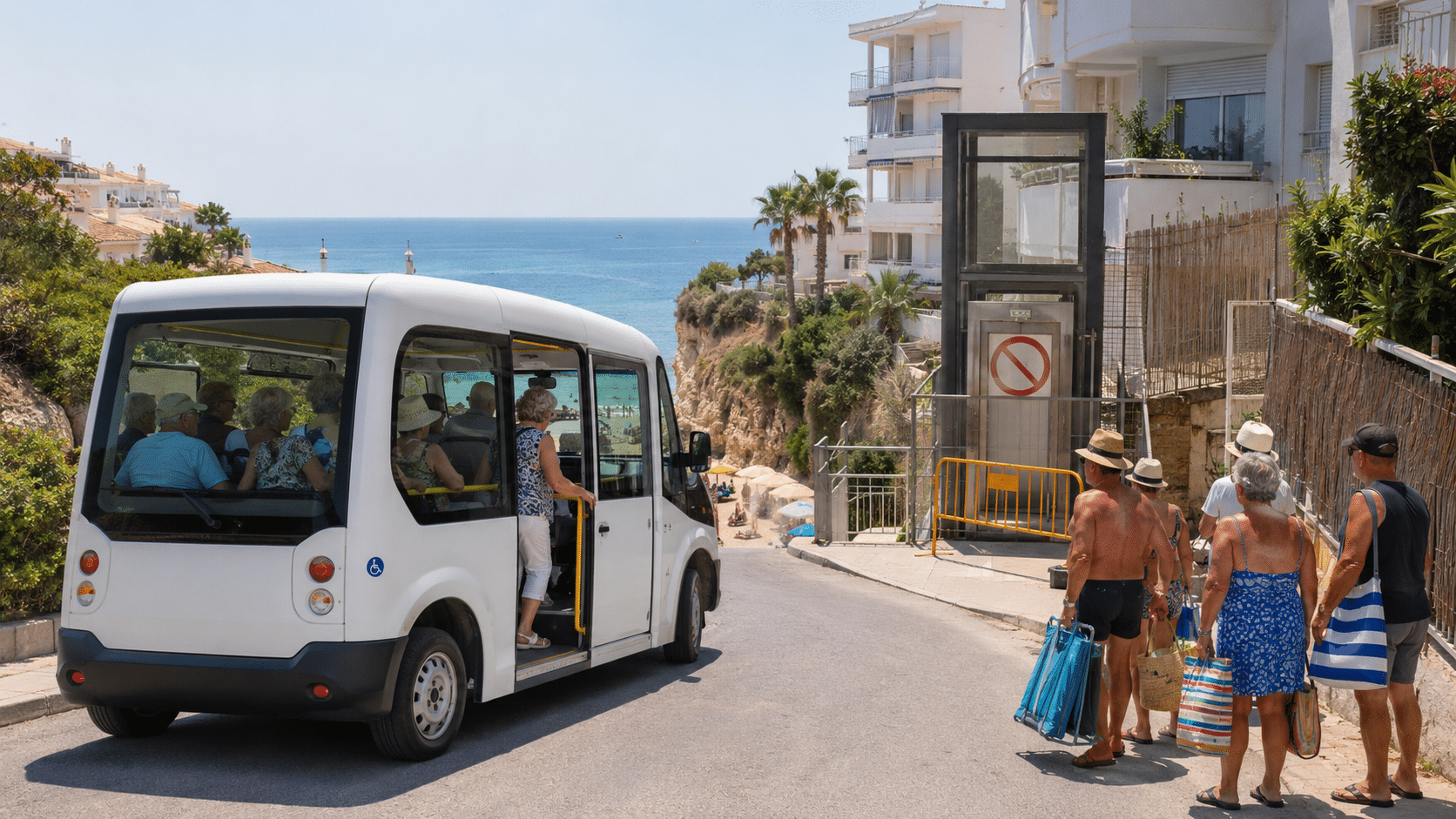
Orihuela City Council is funding a free shuttle service to carry beachgoers between Campoamor and Barranco Rubio beach after the municipal lift that once provided access to the coastline remained out of service for more than four years.
The van will operate throughout the remainder of August and for the first half of September, covering the approximately 360 metres between Calle Calderón de la Barca and Calle Lope de Vega. Although the distance is relatively short, the steep incline makes the journey difficult for elderly residents, people with disabilities and others with reduced mobility.
The service will provide at least 16 journeys each day between 10am and 3pm, with passengers able to travel free of charge.
The contract was originally valued at €25,198, although the final amount will be reduced because the service did not begin on the planned date and several operating days in July and August have already been lost. The contract was awarded to the most expensive bidder because the company proposed using a zero-emission vehicle.
The unusual arrangement has become necessary because of a long-running dispute surrounding the lift at Barranco Rubio. Although the facility was installed and maintained using municipal resources, it is located inside a privately owned residential building.
The lift stopped working more than four years ago. Funding for repairs was reportedly available in 2024, but work could not proceed after the homeowners’ association demanded a formal agreement with the council covering the use of part of the building’s communal area.
No agreement has yet been reached, and the exact terms being requested by the property owners have not been made public. The City Council has also reportedly been unable to locate documentation clearly establishing ownership of the lift, despite having paid its maintenance costs for several years.
The situation has highlighted a major contradiction in the management of Barranco Rubio beach. The beach offers adapted bathing facilities and services specifically intended for people with disabilities, including an area equipped for visitors with reduced mobility. However, the council’s own technical report acknowledges that reaching those facilities can be extremely difficult without the lift.
This is not the first time municipal funds have been used to provide alternative transport. A shuttle covering the same short route was introduced during the summer of 2024. Two years later, the temporary solution is being repeated, with no clear indication of when—or whether—the lift will return to service.
The decision is likely to attract attention elsewhere in Orihuela Costa, where residents have repeatedly complained about inadequate or nonexistent municipal services. Spending thousands of euros on 16 daily journeys over a distance of just 360 metres may appear generous when compared with unresolved demands involving street cleaning, waste collection, road maintenance and public infrastructure in other coastal neighbourhoods.
Campoamor, however, occupies a distinctive place in the history of Orihuela Costa. It was the area’s first major residential development, with its initial phase approved in 1953 and a second in 1967. Dehesa de Campoamor became one of the flagship tourism projects of Spain’s development boom and was officially declared a Centre of Tourist Interest.
Originally conceived as a self-contained holiday resort, it included a supermarket, café, hotel, church, open-air cinema and yacht club. Despite later expansion, Campoamor has retained its reputation as a prestigious summer destination, particularly among residents of Murcia and Orihuela.
For beachgoers, the shuttle offers welcome assistance. For the council, however, it remains an expensive temporary answer to a four-year-old problem that has still not been resolved.