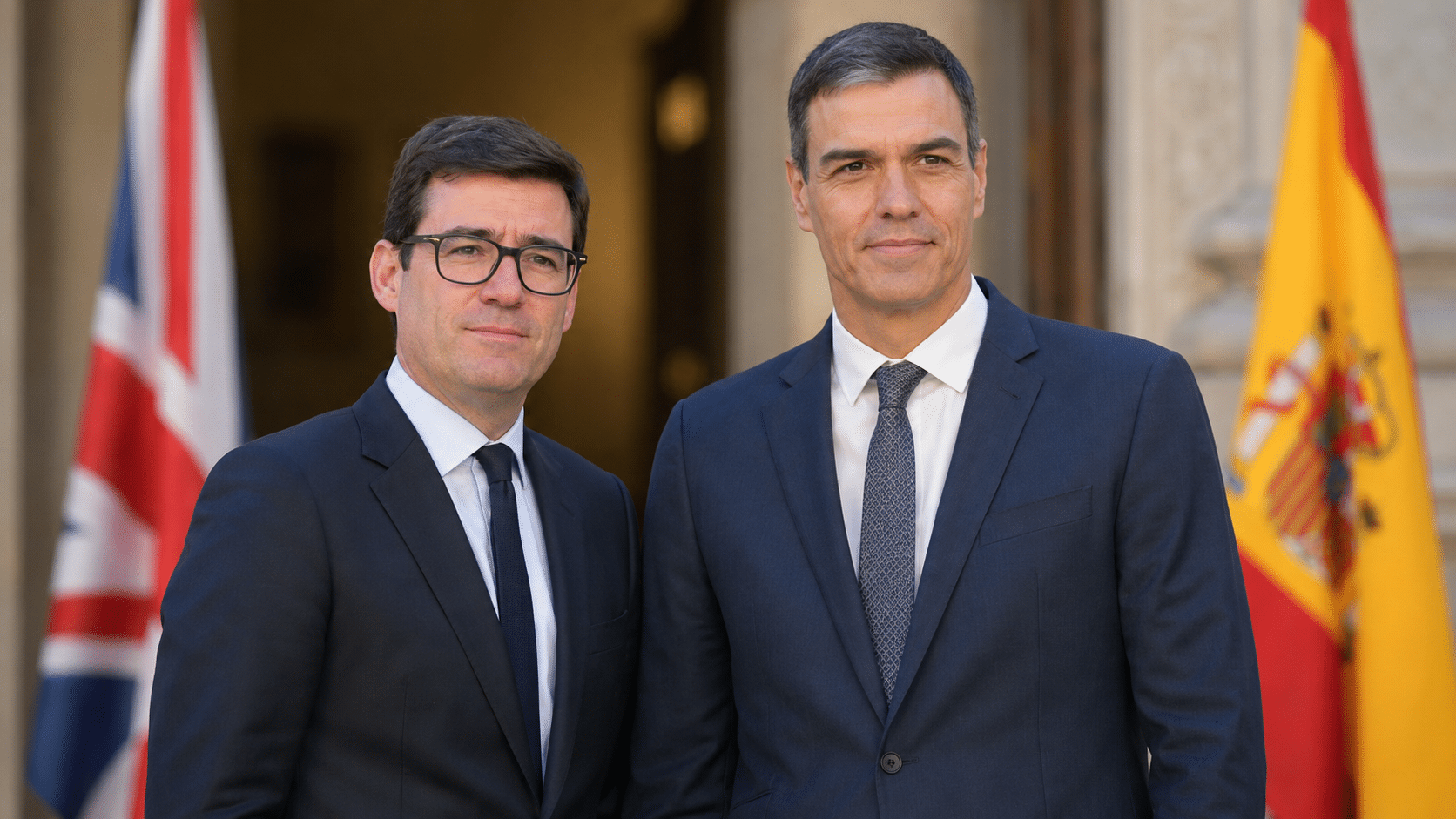
Pedro Sánchez has survived where many other European centre-left leaders have failed. Spain’s prime minister has held office since 2018, delivered an ambitious programme of social reforms and established himself as one of Europe’s most prominent progressive voices.
His political journey could offer valuable lessons for British Prime Minister Andy Burnham, whose own reinvention bears similarities to that of the Spanish leader.
Both men suffered setbacks before reaching the top. Burnham lost two Labour leadership contests before rebuilding his reputation as mayor of Greater Manchester. Sánchez was forced to resign as leader of the Spanish Socialist Workers’ Party (PSOE) in 2016 following disappointing election results and a bitter internal revolt.
Sánchez responded by travelling around Spain to reconnect with party members and left-wing voters. Presenting himself as an outsider challenging the PSOE establishment, he regained the leadership in 2017 and became prime minister the following year.
His success has been driven less by rigid ideology than political pragmatism. Sánchez recognised that the PSOE could govern most effectively by anchoring itself on the left and leading a broader progressive alliance.
His governments have substantially increased Spain’s minimum wage, invested heavily in renewable energy, extended abortion rights, restricted conversion practices, capped rent increases and raised taxes on the wealthiest while reducing pressure on lower earners.
This record proved important during the 2023 general election. Facing likely defeat by the conservative People’s Party and the prospect of the far-right Vox entering government, Sánchez framed the contest as a choice between his progressive coalition and the reversal of hard-won social protections.
The strategy worked because voters could identify policies they stood to lose. Simply warning about the right is rarely enough; centre-left parties must first demonstrate that they have improved people’s everyday lives.
Sánchez’s position is nevertheless far from secure. Investigations and allegations involving members of his family, former party figures and political associates have damaged his administration. His minority government has struggled to pass legislation, Spain has not approved a new national budget since 2023, and the PSOE has suffered electoral setbacks.
With domestic difficulties mounting, Sánchez has adopted an increasingly prominent international role. He has strongly criticised Israel’s military campaign in Gaza, defended Palestinian statehood and challenged US foreign policy. This has strengthened his standing among progressives, although it has not produced a dramatic recovery in domestic polling.
For Burnham, the central lesson is the value of combining progressive rhetoric with tangible results. Sánchez has generally refused to retreat when challenged over immigration or climate policy. His government has supported the regularisation of undocumented migrants and committed billions of euros to the green transition.
By occupying this ground, Sánchez has also weakened parties further to his left. Podemos, once polling at approximately 26%, has fallen to around three per cent.
Burnham faces a similar opportunity. Labour has lost substantial support to the Greens, suggesting that attacking or ignoring the left could be more damaging than attempting to imitate the right.
Sánchez’s experience shows that progressive politics can remain electorally viable—but only when bold positioning is supported by policies that materially improve voters’ lives. Burnham must now decide whether to follow that example or allow his political reinvention to become little more than an appealing story.