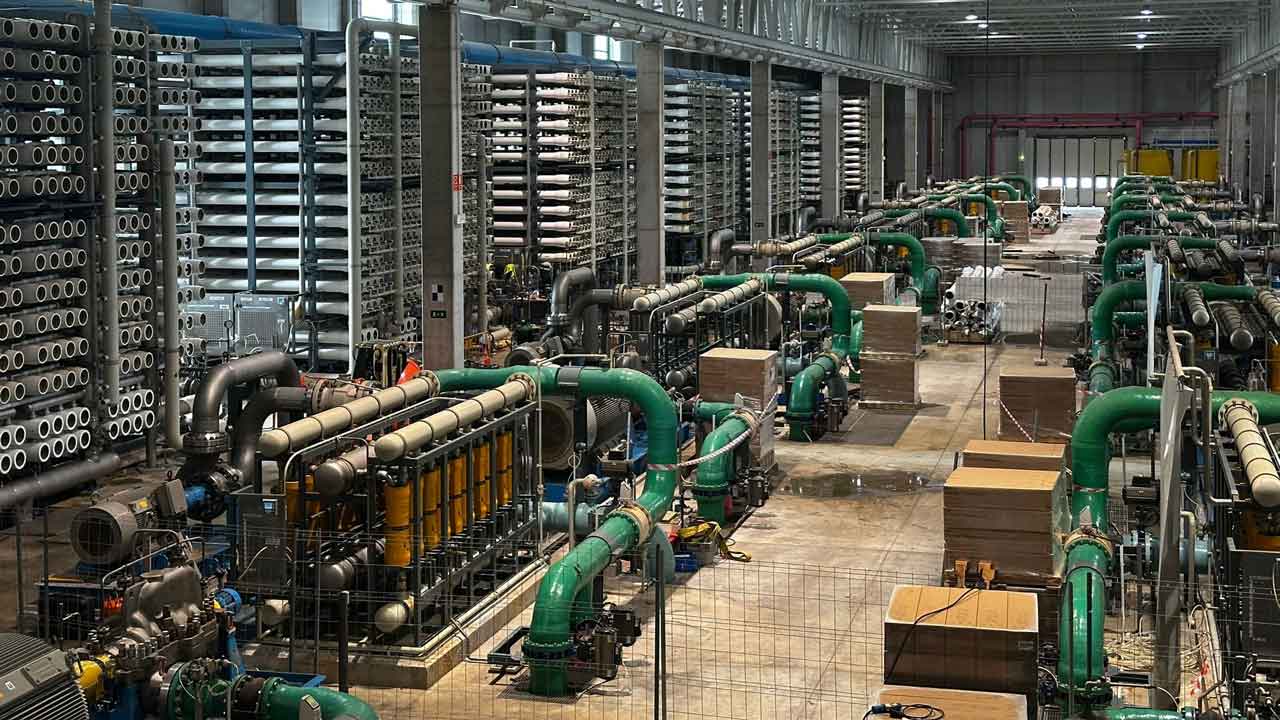
The expansion of Europe’s largest desalination plant is now expected to be operational in early 2027, with costs rising and major supporting infrastructure still unresolved.
The Torrevieja plant’s capacity will increase from 80 to 120 cubic hectometres of water annually. However, the project cost has risen from €89.49 million to €98.23 million following four contract modifications—an increase of €8.74 million.
Construction began in mid-2024 and was originally due to finish by mid-2026. After an initial seven-month extension, state water company Acuamed has acknowledged that a further delay will now be necessary.
The development includes greater seawater intake and pumping capacity, a new 4,000-square-metre building containing reverse-osmosis equipment, additional brine outlets and improvements to the delivery system at La Pedrera reservoir.
Agriculture will receive approximately 100 of the plant’s planned 120 cubic hectometres, with the remaining 20 reserved for urban supplies. Most of the irrigation water will go to Murcia’s Campo de Cartagena, while less than 20% will reach the Alicante province.
Energy consumption remains a major concern. Acuamed expects the plant to use 378 GWh of electricity in 2027, costing €48.61 million. A large solar installation announced by Prime Minister Pedro Sánchez in 2024 will not be ready when expanded production begins. It remains at the preliminary planning stage and could occupy about 140 hectares across San Miguel de Salinas, Los Montesinos, Almoradí and Orihuela. The proposal has faced strong opposition in each of those municipalities over the potential loss of valuable farmland.
There are also serious concerns about distribution. More than 20,000 hectares served by Riegos de Levante and other irrigation communities have water concessions but no direct connection to the plant.
The missing pipeline network is estimated to cost around €290 million. Until it is built, many farmers will remain dependent on water exchanges involving the increasingly restricted Tagus–Segura transfer.
The expansion therefore faces 2027 with a larger budget, soaring electricity needs and an unfinished distribution system.