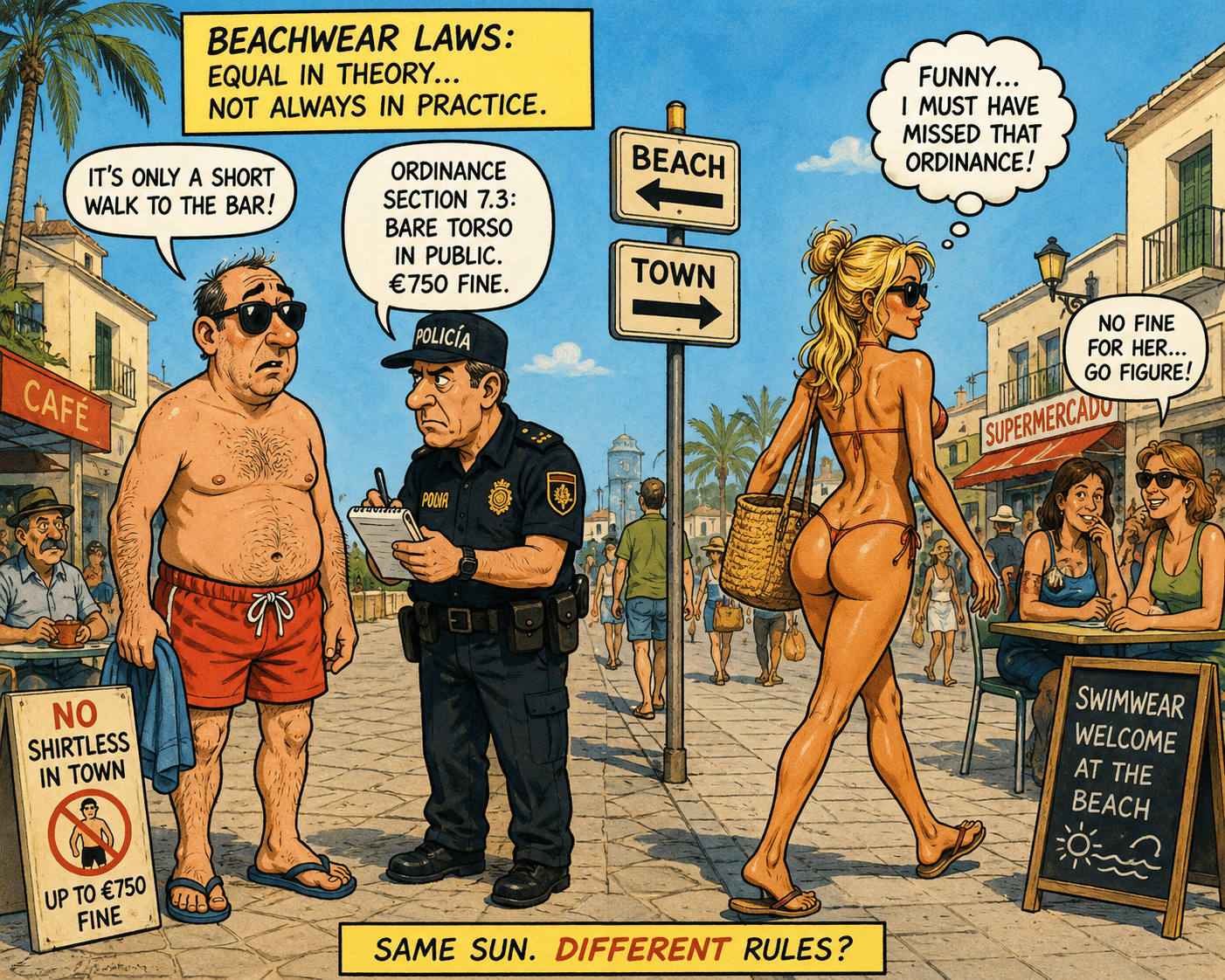

Every summer, as reliably as sunburn and €5 bottles of water, the same question returns to Spain’s coastal towns: why do shirtless men risk fines for wandering through the streets, while women in tiny bikinis often seem to pass untroubled?
It is one of those great Mediterranean mysteries, somewhere between “why is the parking machine out of order again?” and “how can a beach bar charge that much for calamari?”
The answer, inconveniently, is not quite as simple as men versus women. Across Spain there is no single national law banning bare chests, bikinis or the confident public display of holiday flesh. Instead, these rules are usually set by local councils through civic-behaviour ordinances. In other words, the law changes depending on which town you are in, how the by-law is worded, and how enthusiastic the local police are feeling that particular day.
Many coastal councils draw a distinction between the beach and everywhere else. Swimwear is acceptable on the sand, beside the pool, and often along the seafront. But once someone marches into a supermarket, bank, restaurant, shopping centre or town hall dressed as though they have just lost an argument with a towel, the mood changes.
In some municipalities, the rule refers specifically to people walking around with a bare torso. That makes enforcement fairly straightforward for men. A shirtless man is, by definition, shirtless. There is very little room for legal philosophy there. If the ordinance says no bare torso away from the beach, the man strolling past the chemist with his sunburnt chest on display is not exactly a difficult case.
Women in bikinis, however, occupy a more awkward legal grey area. A bikini top, however optimistic in its engineering, is technically clothing. It may not be much clothing. It may be fighting a heroic battle against physics. But it is not the same as being bare-chested.
That is where the apparent unfairness begins. A man with no shirt may clearly break a “bare torso” rule, while a woman in a very small bikini may not, unless the ordinance specifically bans swimwear in streets and public premises. Where the rule does mention swimwear, it can apply to bikinis, swimming costumes, trunks and anything else more suited to a sunbed than a bakery queue.
Enforcement also depends heavily on context. Someone walking twenty metres from the beach to a nearby bar may be treated differently from someone wandering through a town centre, supermarket aisle or municipal office dressed for a lilo. Police may issue a warning. Businesses may simply refuse entry. And residents may quietly mutter dark things into their coffee.
The real issue is not prudery. It is the clash between holiday behaviour and normal public life. Tourists often feel that, in a beach town, beachwear should be acceptable everywhere. Many residents disagree, especially when “everywhere” includes pharmacies, restaurants and food shops.
So yes, the rules can appear uneven. Men are easier to spot, easier to classify and easier to fine. Women in bikinis often fall into a more ambiguous category unless the wording is clear.
The safest rule is wonderfully old-fashioned: when leaving the beach, put something on. A shirt, a dress, a cover-up — almost anything will do. Spain may welcome tourism, but even paradise occasionally asks people to get dressed before buying tomatoes.