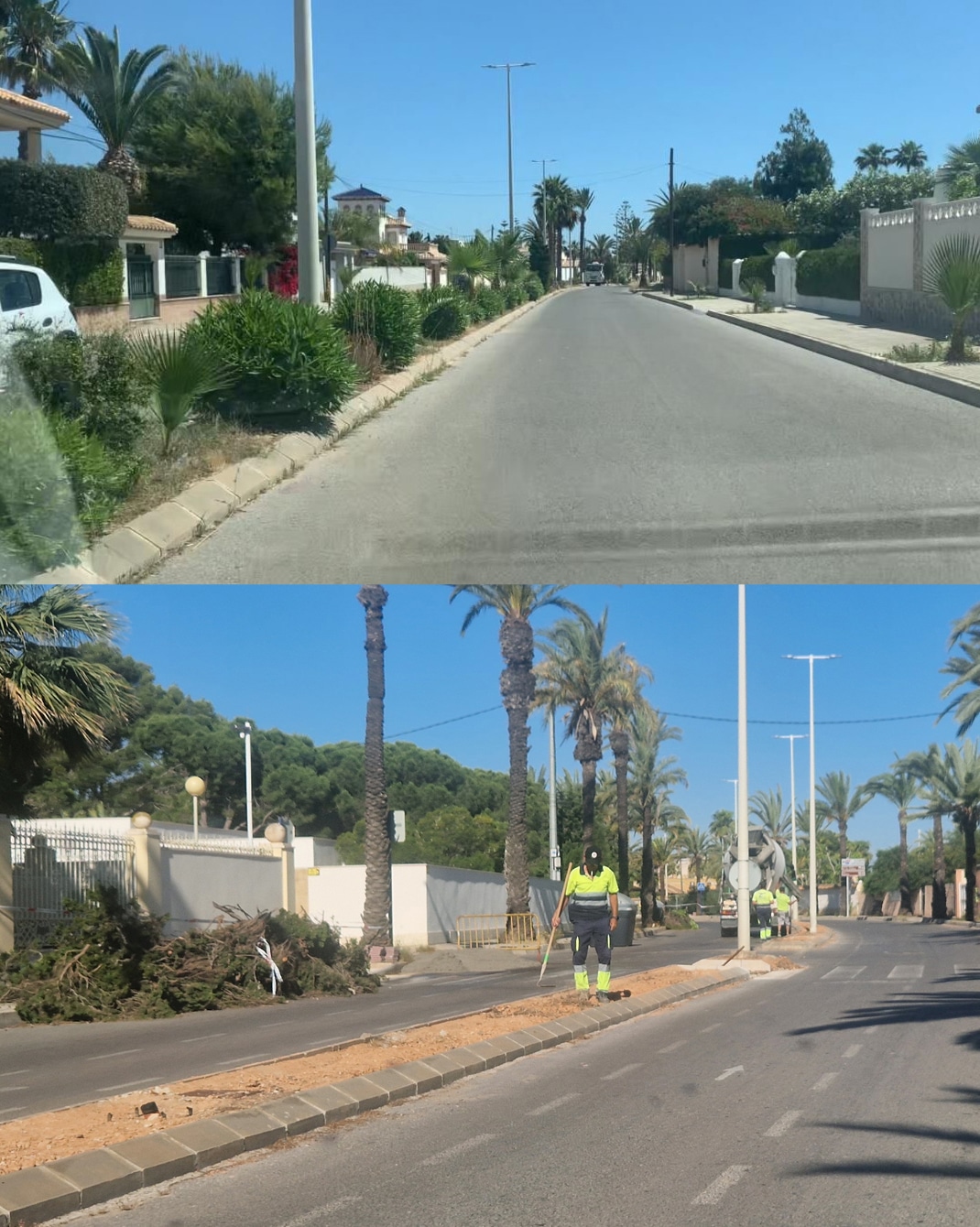
Residents’ associations have called on Orihuela City Council to halt the removal of vegetation from the central reservations of Cabo Roig’s main avenue, where a €200,000 improvement project is under way.
Residents in Cabo Roig, Orihuela Costa, have voiced anger and disbelief over improvement works being carried out on the urbanisation’s main avenue, after large areas of established vegetation were removed from central medians and landscaped areas.
The Cabo Roig Residents’ Association and the La Zenia Surfing Association have strongly criticised the works, claiming that a project presented as road maintenance and urban improvement has, in practice, led to the removal of most of the vegetation from the avenue’s medians.
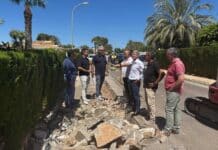
According to residents, between 2,500 and 3,000 square metres of vegetation have already been cleared, with the apparent intention of paving over the area, leaving only the palm trees in place.
“While cities across Europe are investing millions in creating more shade, trees and green infrastructure to combat heatwaves, in Orihuela Costa the exact opposite is happening,” the associations said. They warned that the works are replacing established greenery with concrete, damaging the character of Cabo Roig and removing habitat used by local wildlife, including protected bird species.
Where cypresses, pines, mature oleanders, dwarf palms, jacarandas, agaves and Mediterranean shrubs once stood, residents say the medians are now largely bare. They claim the plan is to cover the areas with concrete and paint them green.
Decades-old trees removed
Several residents have contacted the Environment Councillor, Noelia Grao, to express concern over the loss of vegetation they say has formed part of the area’s landscape and identity for decades.
They argue that many of the trees and plants removed were more than 30 years old, healthy and free from pests. Beyond their visual value, residents say they provided shade, cooler temperatures and environmental benefits in an area increasingly affected by extreme summer heat.
They described the decision to replace established vegetation with cement and hard surfaces as “incomprehensible” and said it represented a serious setback for the environment, the image of Cabo Roig and the quality of life of both residents and visitors.
“They are going to cover it with cement to save on maintenance,” residents warned.
The associations have asked the council to clarify what environmental criteria were used to approve the project, and whether any technical report or environmental impact assessment was carried out before the removal of long-established trees and plants began.
They are also calling for the works to be reconsidered, for the affected areas to be restored, and for solutions that preserve existing green spaces to be prioritised.
Climate concerns
Residents argue that the removal of shade and vegetation runs counter to current European urban planning priorities, particularly as Mediterranean municipalities face hotter summers, record temperatures and increasingly severe urban heatwaves.
They say EU-backed policies increasingly promote urban rewilding, more tree cover and additional shade along roads and in towns, helping to reduce temperatures, absorb vehicle pollution, improve biodiversity and enhance quality of life.
Instead, they warn, the works in Cabo Roig could increase ambient temperatures and encourage illegal parking on the newly cemented medians. They also point to unresolved traffic problems in the area, including long queues between Cabo Roig and the N-332 caused by a lack of parking and inadequate access.
Council says works will improve safety and accessibility
Orihuela City Council put the Cabo Roig Avenue improvement works out to tender in October for €209,344. The stated aim of the project is to improve accessibility, road safety and the condition of urban infrastructure affected by age and the coastal environment.
Infrastructure Councillor Víctor Valverde said at the time that the project responded to one of the most frequent demands from Cabo Roig residents.
“With this project, we are addressing one of the most frequent requests from the residents of Cabo Roig,” he said, describing it as a comprehensive intervention that would improve not only the appearance of the avenue but also the safety and functionality of one of Orihuela Costa’s main roads.
However, residents say they were not aware the works would involve removing much of the greenery that has long characterised the area.
The project documentation refers to the demolition of sections of pavements and medians to create accessibility ramps and improve the central reservation. It also includes the removal of “invasive shrubs and trees”, the concreting and painting of kerbs and medians, changes to vertical signage, repainting of road markings, installation of pedestrian crossings with solar-powered markers, tactile paving and non-slip surfaces.
The council has also cited problems with invasive planting lifting the road surface and reducing visibility on bends.
Further works include repairs to pavements and tarmac, improvements to street lighting and signage, and the removal of architectural barriers to ensure universal accessibility. The council has said the area currently suffers from poor accessibility, outdated and damaged road signage, inefficient lighting and deteriorated road surfaces.
The works, which have a planned completion period of three months, began in March. Just last week, the City Council reported that the project was progressing well.