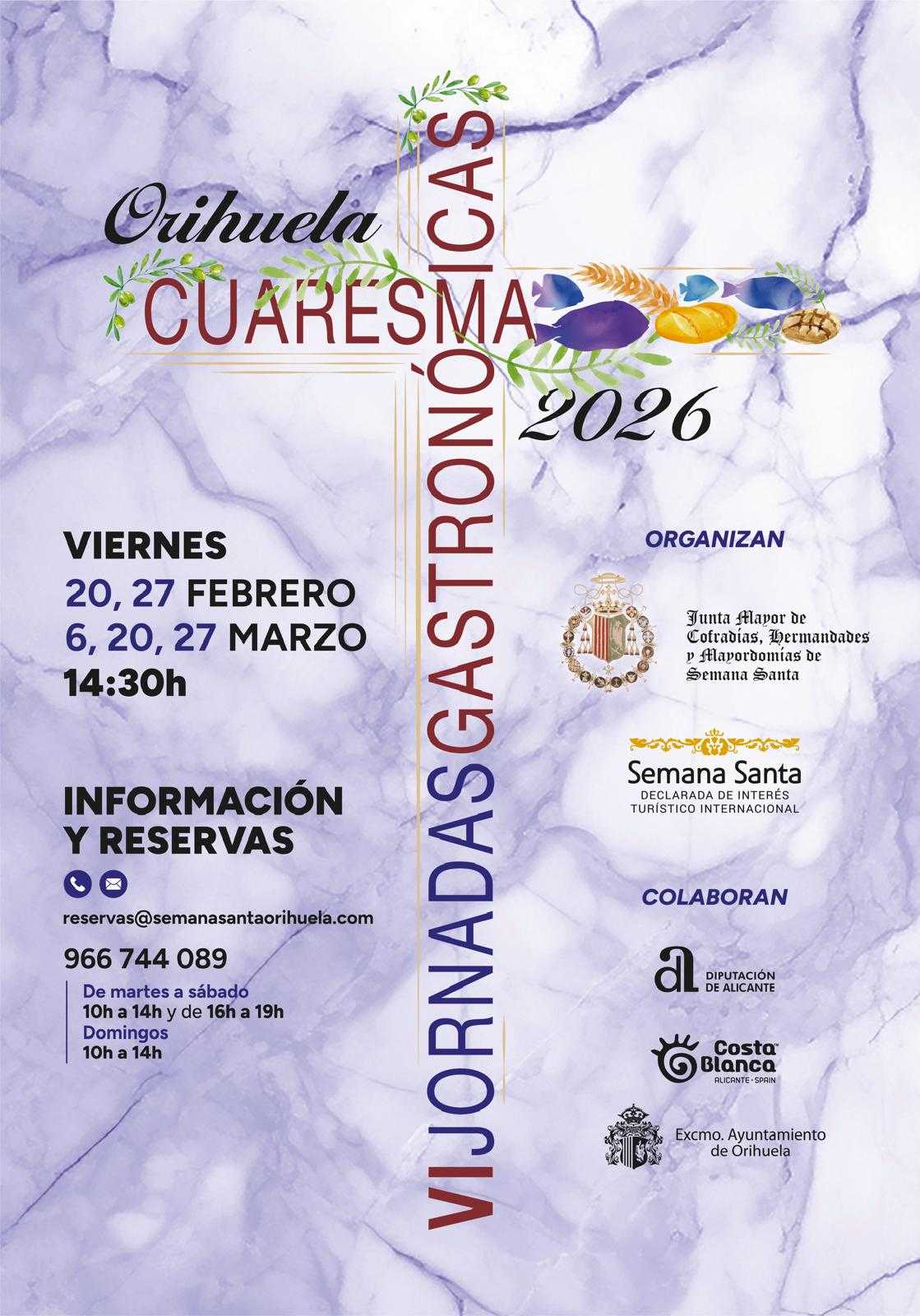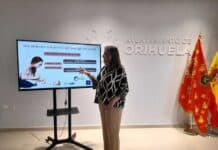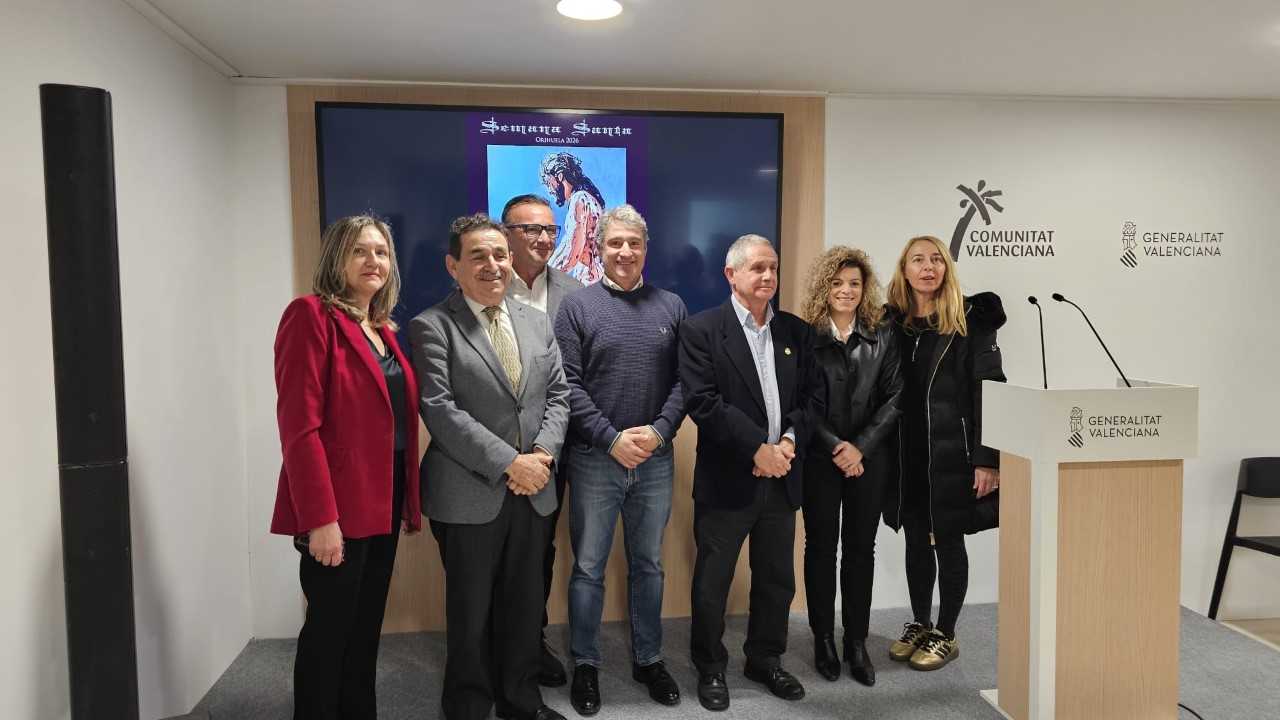
ORIOLA (Orihuela), January 22, 2026 — The city of Orihuela has presented the official poster for Holy Week 2026 at the International Tourism Fair (FITUR), held at IFEMA Madrid, alongside the Lenten Gastronomic Events (Jornadas Gastronómicas de Cuaresma), an initiative that has become one of the most distinctive highlights of the city’s pre–Holy Week calendar.
Orihuela’s Holy Week, which holds the designation of a Festival of International Tourist Interest, was showcased as part of the city’s broader strategy to strengthen its national and international profile as a cultural, religious and heritage destination.
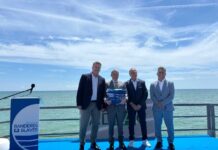
The presentation was attended by Orihuela Mayor Pepe Vegara; Councillor for Festivities Rocío Ortuño; President of the Holy Week Brotherhoods and Confraternities Council, José Sáez Sironi; and representatives of the Ecce Homo Brotherhood, including its Deputy Treasurer Pedro Meseguer and Vice President María Dolores Ferrando.
A Poster Rooted in Mediterranean Tradition
The official poster for Holy Week 2026 is the work of Orihuela-born painter Roberto Ferrández Gil and features an oil-on-canvas depiction of Christ of the Ecce Homo.
During the presentation, Pedro Meseguer explained the artistic and symbolic intent behind the work, noting that the objective was to create an image clearly identifying the symbols of the Passion, including the scourged back, bound hands, the reed, the railing and the crown of thorns.
Meseguer highlighted that the artist drew inspiration from the original 1777 sculpture by Francisco Salzillo, emphasizing its Mediterranean roots. “This is a style of religious imagery in which suffering is expressed with restraint, distancing itself from the more extreme dramatism found in other traditions,” he said. He also praised the sculptural realism of the composition and the symbolic use of colour and iconographic elements.
José Sáez Sironi congratulated both the artist and the featured brotherhood, describing the poster as “a magnificent work that announces Holy Week and invites society as a whole to participate and experience this deeply meaningful time for Orihuela.”
Mayor Pepe Vegara underlined the importance of Holy Week to the city’s identity, stating that “Orihuela’s Holy Week is one of the city’s defining symbols and a key element of our cultural heritage. Its presence at FITUR helps to strengthen its tourism profile and international recognition.”
Lenten Gastronomic Events: Tradition, Heritage and Experience
The presentation also highlighted the Lenten Gastronomic Events, a programme that has gained strong traction in recent years and has become one of the most distinctive features of Orihuela’s Lenten season.
These events are characterised by their commitment to traditional Lenten menus, based on historic recipes deeply rooted in Orihuela’s culinary heritage, and by their setting in architecturally and historically significant spaces that are often closed to the general public.
Venues include former schools, convents, monasteries and emblematic buildings such as the Santo Domingo Diocesan College, the Carmen Convent, San José Obrero Diocesan School, the Diocesan Seminary, the Episcopal Palace, the Salesas Monastery and the Convent of San Francisco, among others.
Each gastronomic event is complemented by cultural activities such as concerts, talks, artistic performances or historical explanations related to the host venue, offering visitors an experience that goes beyond cuisine and connects them with Orihuela’s heritage, spirituality and history.
By presenting both the Holy Week 2026 poster and the Lenten Gastronomic Events at FITUR, Orihuela reinforces a tourism promotion strategy rooted in authenticity, uniqueness and the preservation of tradition, consolidating its position as a leading cultural destination.