Most of the local education community has backed an indefinite strike amid growing anger over conditions in public schools
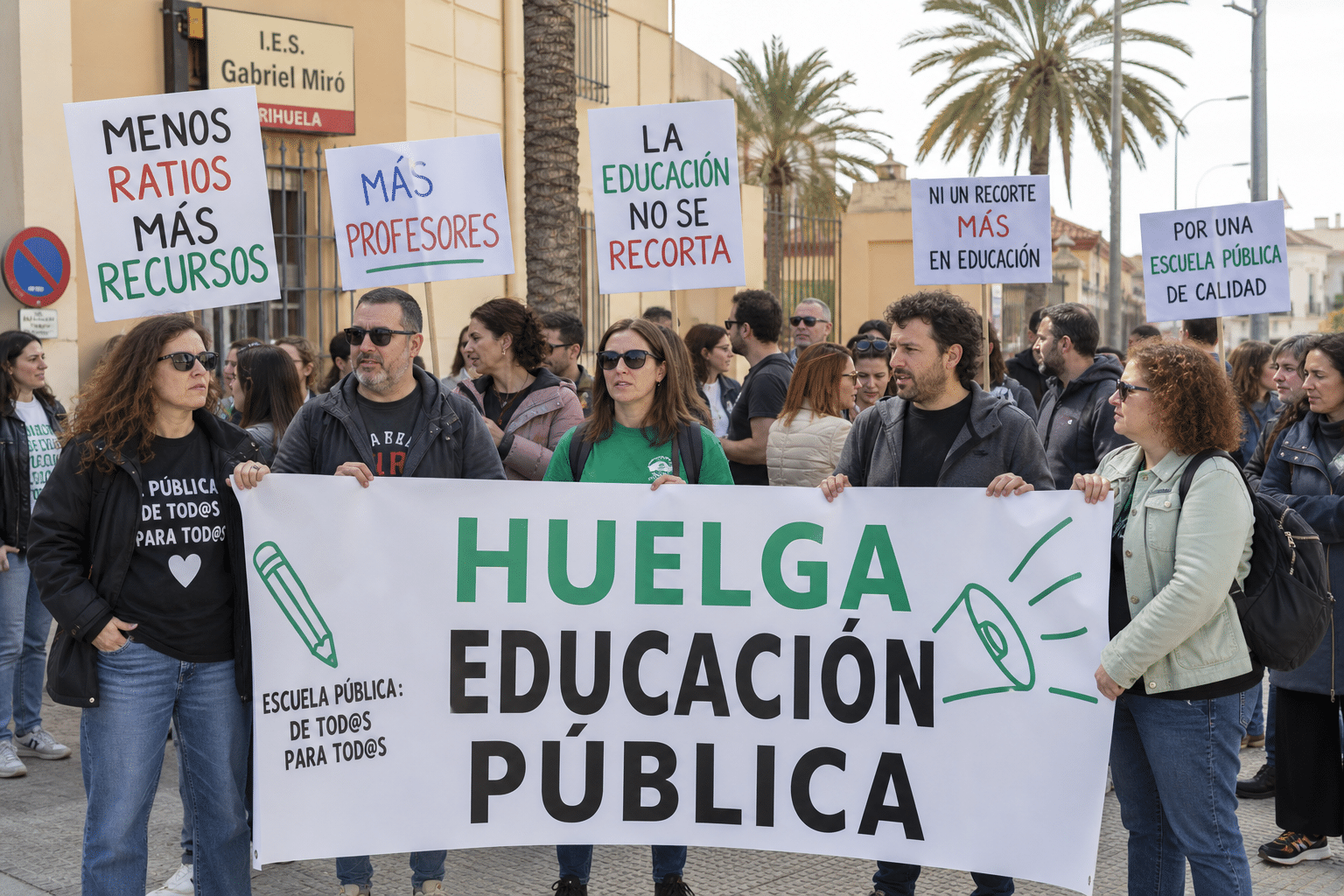
Teachers across Orihuela and the wider Vega Baja have joined an indefinite education strike that began on Monday, following days of protests calling for urgent improvements in public schools.
According to the Vega Baja Teachers’ Assembly, teaching staff across the district are expressing mounting frustration over the lack of progress on key issues including class sizes, working conditions and the resources needed to properly support pupils.
In Orihuela, the strike has received strong backing, especially on the coast, where schools are reportedly operating with 20% fewer staff than last year while class sizes continue to rise.
At CEIP Los Dolses, the entire teaching staff — more than 70 teachers — joined the strike.
“Support for the strike among teachers is overwhelming because we are suffering a great deal,” one teacher said, describing a situation in which fewer staff are expected to teach and support more pupils.
Teachers say class sizes that previously stood at around 20 pupils have now risen to 25 in Infant Education and 27 in Primary. They also warn that there is no dedicated teacher to help newly arrived pupils learn Spanish, despite the area having a high percentage of foreign students.
They also point to a lack of support teachers for children who need extra help, while special education UECO classrooms are above the recommended ratio of eight pupils.
Staff insist the strike is not mainly about pay.
“Salary is one of the issues, but it is not the fundamental one,” teachers said. They argue the central problem is the conditions in which they are expected to work and the level of care and attention they can provide to children.
They also compared the situation with healthcare, warning that public education is being pushed towards a model that could favour privatisation.
Teachers in the Vega Baja say the dispute is not primarily about Valencian language policy either.
“We know the reality of this district, and that is not the main issue here,” they said. “What we do see are the children’s faces, because we are in the playground every day.”
According to teaching staff, many educators have reached breaking point.
“The strike is really because people are exhausted from enduring, fighting and dealing with groups that are impossible to manage in these conditions,” they said.
Families are also said to be increasingly concerned as they see schools operating with fewer resources. At Los Dolses, only around 100 pupils attended school on Monday, which teachers described as “a response never seen before”.
The strike was also widely followed at other Orihuela schools. At CEIP Miguel Hernández, 36 teachers joined the strike. At IES Gabriel Miró, around 60 out of 100 teachers took part, with very few students attending classes. At IES Tháder, more than half the staff joined the walkout, with 38 of 60 teachers on strike.
Criticism of the Regional Education Department
The political group Cambiemos has expressed support for the indefinite education strike and criticised the regional Education Minister’s response.
The party described as “deeply irresponsible” the minister’s statement that “no student can be held hostage by a union conflict”, made in a letter sent to families through official institutional channels.
Cambiemos called the use of public communication tools in this way “very serious”, accusing the regional department of singling out teachers, intervening in a labour dispute and presenting families with “a biased account” instead of accepting responsibility for the deterioration of public education in the Valencian Community.
Councillor Quique Montero said the strike is “the direct consequence of the abandonment and systematic deterioration of public education by the Consell”.
He described it as “a legitimate response by teachers and education workers to a policy based on cuts, improvisation, overcrowded classrooms, lack of resources and contempt for the education community”.
Montero added that “the people who turn pupils into hostages are not those defending decent conditions for teaching and learning, with sufficient resources, but those who damage public services while trying to discredit the people who keep them running every day”.
Cambiemos has called for “a real and firm commitment to public education”, with greater investment and dignified working conditions, instead of what it described as “a strategy of confrontation and blame” by a regional education department more focused on attacking teachers than solving problems in classrooms.