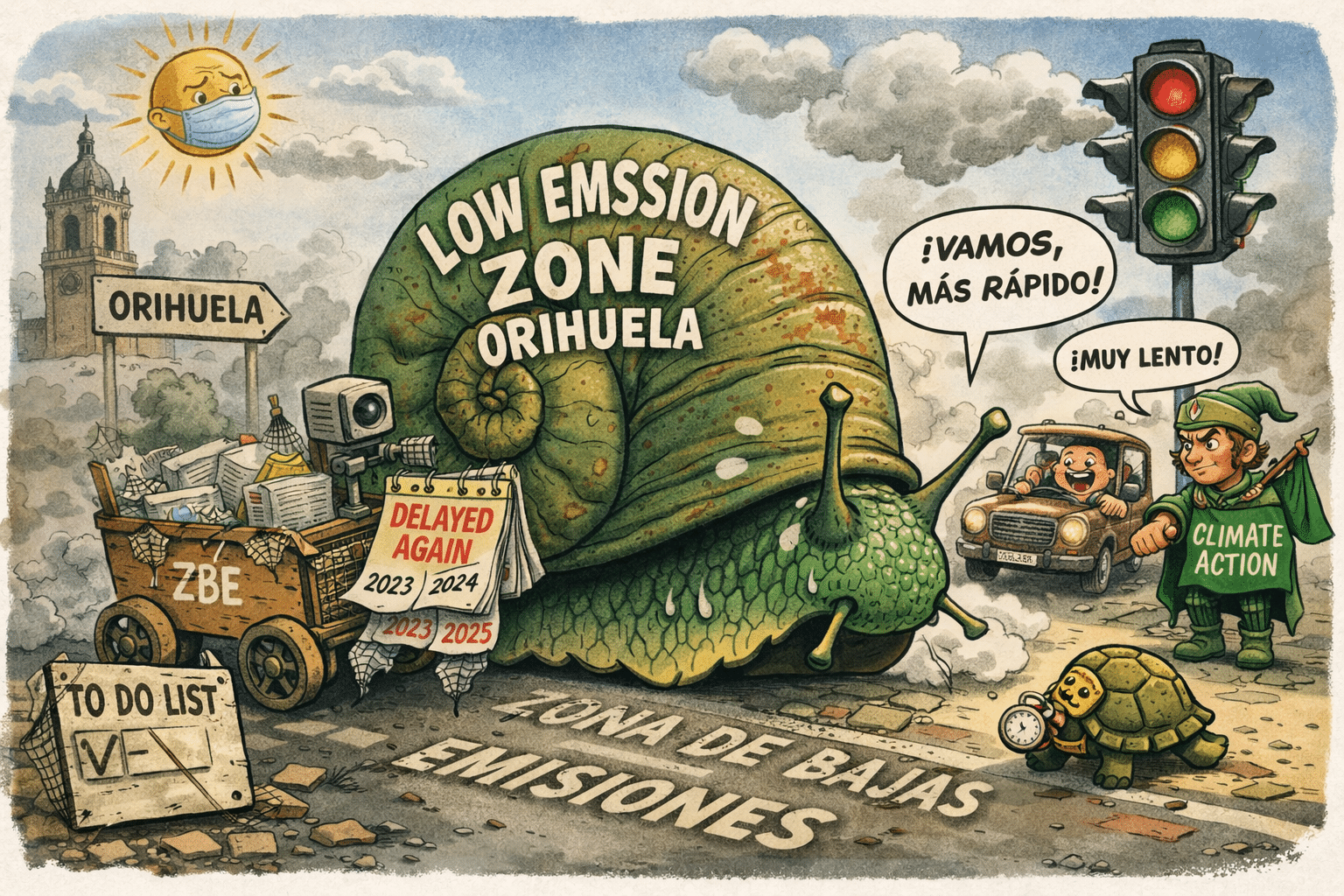
Orihuela is one of 20 Spanish municipalities that have yet to formally process a Low Emission Zone (LEZ), despite the legal obligation being in force since January 2023. According to data from the Ministry for Ecological Transition (MITECO), Spain ended 2025 with 58 LEZs implemented, 91 in progress and 20 still pending, showing only limited progress in recent months.
Torrevieja’s Low Emission Zone (LEZ) has been approved and planned for implementation in 2026, but like many others the rollout has been slow and is years behind legal deadlines. The city has tendered contracts and awarded the work to install infrastructure, yet no fines will be enforced until January 1, 2027, with full operational restrictions delayed while public awareness and systems are prepared. Critics say progress has been late and planning limited
Low Emission Zones are regulated by the 2021 Climate Change Law and a 2022 royal decree, and are mandatory for municipalities with more than 50,000 inhabitants, those with over 20,000 residents that exceed pollution limits, and all island territories. Although the original deadline was January 2023, implementation has been repeatedly delayed, with the government now allowing extensions until the end of 2026.
Recent developments highlight the uneven rollout nationwide. Pamplona has just activated its LEZ in the historic centre, Seville has softened its sanctions, Valencia has rejected a state-compliant model, Torrelavega temporarily suspended restrictions over Christmas, and Vitoria began issuing fines in mid-December. Legal challenges have also been frequent, though courts have not always sided with opponents.
In March, the Spanish Ombudsman issued recommendations to 33 municipalities over their delays. Nine months later, eight of those councils remain non-compliant, including Orihuela. The Orihuela City Council has acknowledged that it lacks sufficient internal resources and recently commissioned a technical study costing €18,142 to meet national requirements. Nevertheless, the project is still listed as pending by MITECO.
Most outstanding cases are in island territories, which require coordinated plans between local authorities and regional environmental bodies due to their environmental vulnerability. While some island cities have already complied or are close to doing so, many islands remain without approved LEZs.
Access to Low Emission Zones is regulated using the DGT environmental labels (0, ECO, C and B), which classify vehicles based on emissions standards rather than actual pollution levels. This system has been criticised, and although a reform was proposed under the Sustainable Mobility Law, it was ultimately removed during parliamentary negotiations. Meanwhile, Madrid has extended its moratorium on restrictions for residents’ vehicles without labels until 2026, and Barcelona will restrict access for B-label vehicles during high-pollution episodes from January 2026.
Overall, the rollout of Low Emission Zones in Spain continues to be slow, fragmented and politically contested, with Orihuela remaining among the municipalities yet to fully comply.