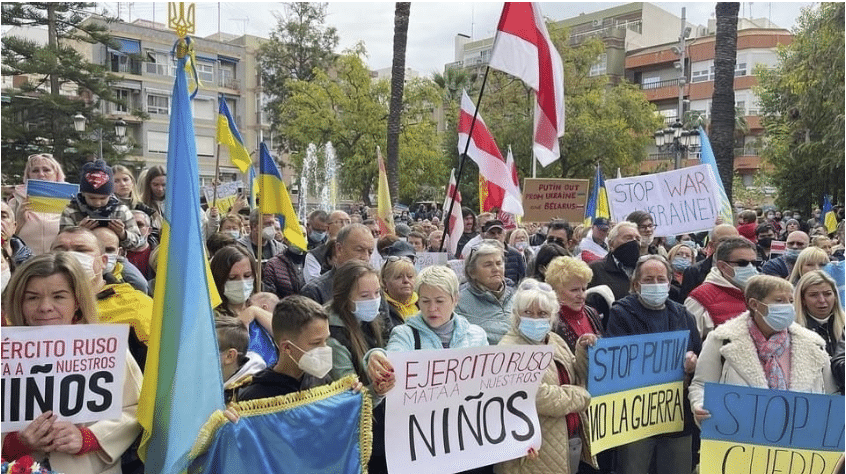
More than 400 people marched through the centre of Torrevieja on Saturday to mark the fourth anniversary of Russia’s full-scale invasion of Ukraine, which began on 24 February 2022 and was described by Russian President Vladimir Putin as a “special military operation”.
The demonstration, awash with Ukrainian flags and led by a large national banner, brought together members of Torrevieja’s sizeable Ukrainian community—now the city’s largest foreign group, with more than 10,500 registered residents. Despite the war slipping from media headlines at times, organisers said the conflict continues with undiminished intensity.
Chants of “Putin is a murderer!”, “Ukraine wants peace!”, “Thank you Spain, thank you Torrevieja!” and “Slava Ukraini, Heroyam slava!” (“Glory to Ukraine, glory to the heroes!”) rang out as participants sang the Ukrainian national anthem.
Torrevieja hosts one of Spain’s four Ukrainian refugee reception centres established at the outset of the war, now operating as the House of Ukraine in Spain from the Social Security Treasury building. Before 2014, when fighting began in Donbas, Ukrainian and Russian residents in the municipality were closely interconnected. The 2022 invasion, however, triggered a new wave of displacement, with many Ukrainians finding refuge with family and friends already living in the city or securing housing and work through established community networks.
Ukrainian nationals now form the largest foreign student group in several local schools, including IES Mediterráneo and public schools 14 and 15, where integration support is a priority. As the conflict shows no sign of a swift resolution, many families have put down roots, opening businesses—from hair and beauty salons to cafés, flower shops and 24-hour supermarkets—that serve both compatriots and the wider population. Alongside the February commemorations, Independence Day is marked each year on 24 August with rallies and cultural events.
Russian community
Over the same period, the public profile of Torrevieja’s Russian community—present since the early 1990s following the collapse of the Soviet Union and numbering around 5,000 registered residents—has steadily diminished. Russian flags that once adorned businesses have largely disappeared, and discretion now prevails.
A Russian film festival supported by the city council was rebranded to remove any overt association with a major local Russian organisation. While sanctions have chiefly limited high-value property purchases in the Vega Baja, they have done little to deter Russians from choosing Torrevieja, Orihuela Costa, Guardamar or Pilar de la Horadada as seasonal destinations.
The city is home to more than 15,000 registered residents of Ukrainian and Russian nationality combined, in addition to temporary visitors. Tensions between the communities remain largely subdued, with no serious incidents reported in recent years beyond an isolated assault in a bar. Even so, the strain of a prolonged war continues to cast a shadow over two groups bound by deep historical and cultural ties.