The Council of Statistics, which is managed by María del Carmen Portugal (Vox), has removed 324 non-EU foreigners from Orihuela’s municipal register due to the absence of permanent residency and their failure to complete periodic renewal.
The measure, executed through an edict issued by Mayor Pepe Vegara, has been officially published on the City Council’s electronic platform.
This action is based on the revised Article 16 of Law 7/1985 of April 2, which regulates the foundations of local governance. The amendment, introduced by Organic Law 14/2003 of November 20, modifies the provisions of Organic Law 4/2000 of January 11 concerning the rights and freedoms of foreigners in Spain and their social integration.
The de registrations in question pertain to the period between January and July 2023. Municipal sources explain that the process is time-consuming and meticulous, requiring extensive data verification. The same sources indicate that work is ongoing to address pending de registrations from August to December of the same year.
Previous Removals and European Citizens
In May 2023, the mayor issued two additional instructions that removed 503 European citizens from the register. These individuals were found to be non-residents in Orihuela between July and December 2023, as determined by investigations conducted by the Department of Statistics.
According to the official statement, these ex officio removals were carried out at the request of the National Institute of Statistics (INE) following its annual review of residency confirmations. The request was made in accordance with Article 72 of the Regulations on Population and Territorial Demarcation of Local Entities, which mandates the removal of individuals who do not meet registration requirements.
The INE’s request is significant, as municipal register figures influence key factors such as state funding allocations and the number of councillors in local government.
For years, discrepancies have existed between the municipal register and the official INE census, which typically reports lower population figures. This discrepancy prompted the INE to initiate a data-cleansing process after identifying cases where foreign residents were recorded without subsequent verification of their continued residence.
A notable correction took place in 2016, when tourist-driven municipalities like Orihuela, San Fulgencio, Rojales, and Torrevieja saw a sharp decline in their registered population figures.
Population Trends and Demographics
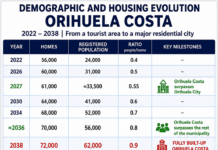
As of early 2024, Orihuela’s population has grown by 1.9% compared to the previous year, reaching 85,674 residents, an increase from 84,054 in 2023. The highest growth occurred in Orihuela Costa, where the population rose by 5%, while the city centre saw minimal growth of 0.1%, and the surrounding rural districts increased by 0.9%.
The official INE census, however, reports a slightly lower figure of 83,720 residents as of January 1, 2024, reflecting the annual verification process.
Spanish nationals remain in the majority, with 53,512 residents—an increase of 1.1% after a decline of 1.35% in the previous year.
Meanwhile, international migration continues to shape the municipality’s demographics, growing by 3.3% in 2024 compared to 1.34% in 2023. Foreigners now comprise 32% of Orihuela’s population, covering 121 nationalities. Notably, the number of Ukrainian residents has surged by 58%, while the Venezuelan population has increased by 48%.
The largest foreign communities in Orihuela are:
United Kingdom: 9,681, Morocco: 2,974, Ukraine: 2,356, Russia: 2,205, Colombia: 1,525
Algeria: 1,013
Despite overall growth, the British population has declined by 7% compared to the previous year, potentially due to Brexit-related factors or a return to the UK.
The largest numerical increases in population compared to 2023 are:
Ukraine: +865, Spain: +596, Colombia: +562, Belgium: +349, Morocco: +225
The most significant population growth has been concentrated in Orihuela Costa, where an additional 1,333 residents have been recorded, bringing the total to 27,929.
In contrast, the city centre has remained relatively stable, with only 57 new residents, totalling 32,879. Notably, water consumption data suggests a larger residential population in Orihuela Costa than that reflected in official statistics, indicating that many individuals remain unregistered.