The battle over Orihuela’s identity is back — but critics are asking why 30,000 coastal residents have not been consulted.
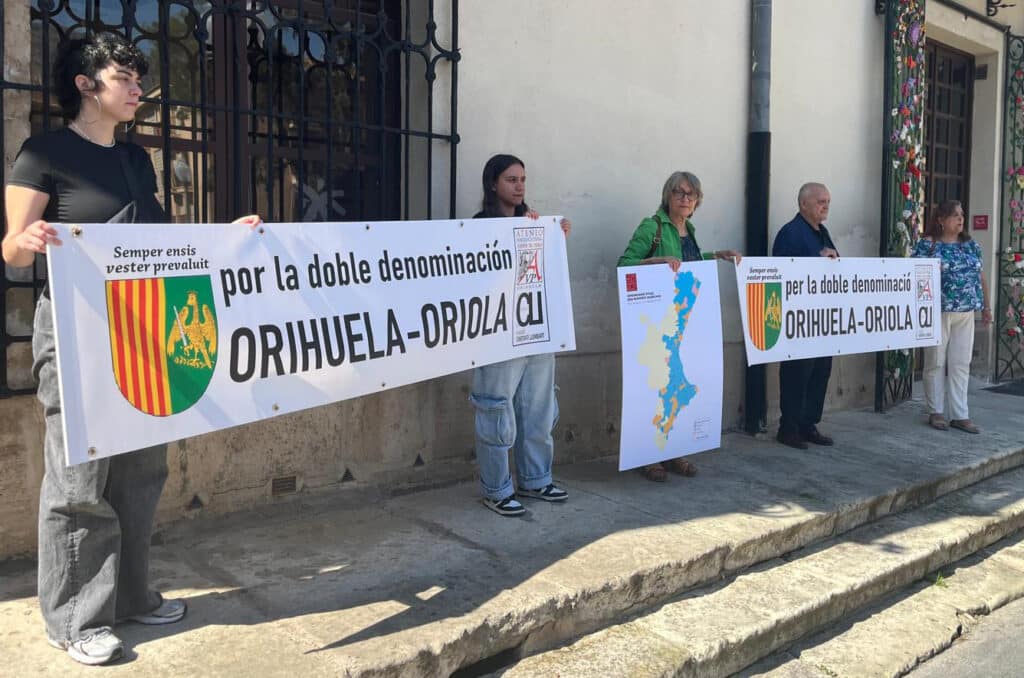
A fresh petition calling for the municipality to adopt the dual name Orihuela–Oriola has reignited debate at Orihuela Town Hall. The initiative, led by two right wing organisations, the Constantí Llombart Foundation and the Ateneo Viento del Pueblo, was formally resubmitted to councillors during Thursday’s plenary session and promoted publicly during a heritage demonstration linked to the legacy of poet Miguel Hernández.
Campaigners gathered in the square outside the town hall to collect signatures and rally support for the proposal, which was first officially registered on May 27, 2025. Their objective is clear: to push the council into launching the administrative process required to recognise “Oriola” — the city’s historical Valencian name — alongside Orihuela as part of a dual official designation.
Following the session, representatives of the Constantí Llombart Foundation met with the governing team. In a subsequent statement, they said Mayor José Vegara (PP) and councillor Manuel Mestre (Vox) were receptive and listened carefully to their arguments.
Supporters argue that reinstating the medieval name “Oriola” would reinforce the city’s cultural weight within the Valencian Community, enhance its historic profile as the southern gateway to the former Kingdom of Valencia, and support broader territorial cohesion. They also point to the prominence of Caja Rural Central de Orihuela as evidence of the municipality’s economic relevance.
However, the proposal has raised an increasingly vocal question: what about the approximately 30,000 residents living along the Orihuela Costa? Detractors say such a symbolic but significant change should not proceed without wider consultation, particularly among coastal communities who often feel sidelined in municipal decision-making.
For now, the dual-name proposal returns to the municipal agenda. If approved politically, it would still need to navigate a complex administrative pathway, including plenary approval and validation by higher authorities, before any official change could take effect.