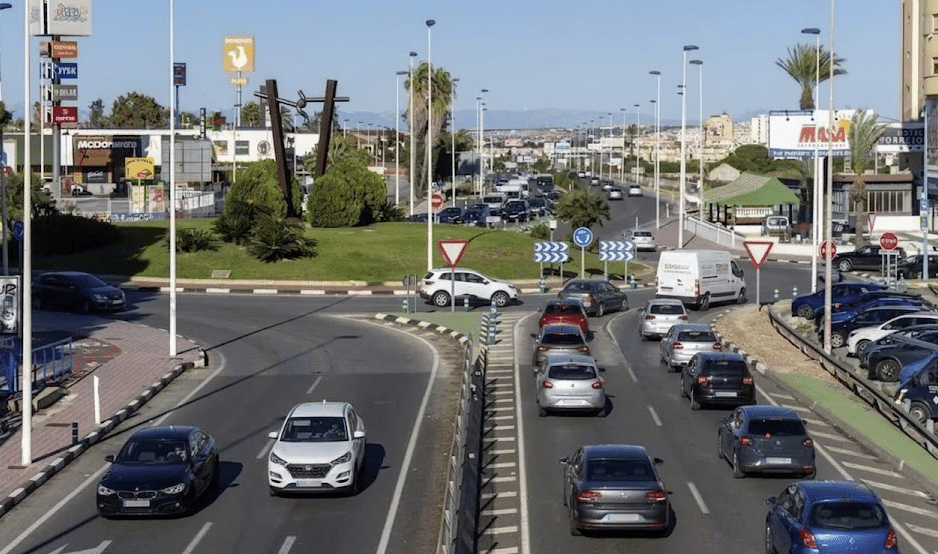
Spain’s first artificial intelligence-controlled roundabout has been launched on the N-332 between Torrevieja and Orihuela Costa, but its first days of operation have been marked by confusion, traffic jams and frustrated drivers.
Traffic congestion has become the main issue following the launch of the new smart traffic light system at the Punta Prima roundabout in Torrevieja, one of the busiest junctions on the southern Costa Blanca.
The Ministry of Transport and Sustainable Mobility has completed the installation of a pioneering artificial intelligence-based traffic control system at the roundabout, located at kilometre 52.8 of the N-332, on the stretch between Torrevieja and Orihuela Costa.
The project is being treated as an experimental scheme, as it is understood to be the first roundabout in Spain to use this type of technology.
Funded through European money from the Recovery, Transformation and Resilience Plan, the final cost of the project was €357,534, slightly below the initially estimated figure of €409,000.
The works have included the installation of traffic light poles at the main access points, including both directions of the N-332 and the junctions with Avenida de Las Olas and Calle Escorpiones. Detection cameras and traffic data collection devices have also been installed at each entrance to the roundabout.
The system is designed to use artificial intelligence to automatically regulate traffic light cycles according to real-time traffic intensity.
According to the ministry, the aim is not only to improve traffic flow at the roundabout, but also to test the use of intelligent systems in the management of the State Road Network, placing road users at the centre of decision-making.
That is the theory.
In practice, however, the first days of operation have brought confusion and chaos, with many drivers seemingly unsure how to react to traffic lights on a roundabout. The result has been significant queues at peak times in all directions, particularly on Avenida de Las Olas and Calle Escorpiones.
Some motorists have also been seen ignoring the red lights altogether, apparently out of frustration after long waits.
The system appears to prioritise traffic on the N-332, where tailbacks can already stretch for hundreds of metres, especially in the direction of Torrevieja. This has left drivers approaching from Los Altos and Rocío del Mar in a difficult position.
At times, when the lights turn amber, there is no real opportunity to enter the roundabout. Yet when the lights are red, gaps sometimes appear in the traffic flow. After waiting in long queues, some drivers have chosen to take their chances and pass through regardless.
The early problems have led many road users to question whether the “smart” traffic lights are really smart enough for such a complex junction. Others are asking whether a more traditional traffic light system would have been sufficient, or whether another solution should have been found for a roundabout that handles an average of around 45,000 vehicles per day.
There is also growing concern about what will happen during the height of the summer season, when traffic volumes increase sharply with the arrival of tourists and second-home owners. The roundabout is already a key access point for residents of Rocío del Mar and Señorío de Punta Prima, areas that have seen significant construction in recent years, with more development still underway.
For now, the system may need time to settle. The technology is designed to learn from real-time use, collecting data and adjusting traffic light regulation through machine learning and reinforcement learning techniques.
The monitoring and management system combines neural networks, big data, traffic modelling and traditional traffic engineering methods to analyse the operation of the roundabout and select what it considers the most efficient solution for all users.
Whether that will eventually ease congestion remains to be seen. For the moment, the launch of Spain’s first AI-controlled roundabout has produced more queues than confidence.