Minimum wages continue to differ sharply across Europe, leaving millions of workers closely watching pay decisions in 2026. An estimated 12.8 million people across 22 EU countries earn the minimum wage or less, according to calculations based on Eurostat data.
Yet for many, the year has brought little change. Around one in three minimum-wage workers saw no increase between July 2025 and January 2026, while four countries recorded no rise at all over the past year.
Big Gaps in Nominal Pay
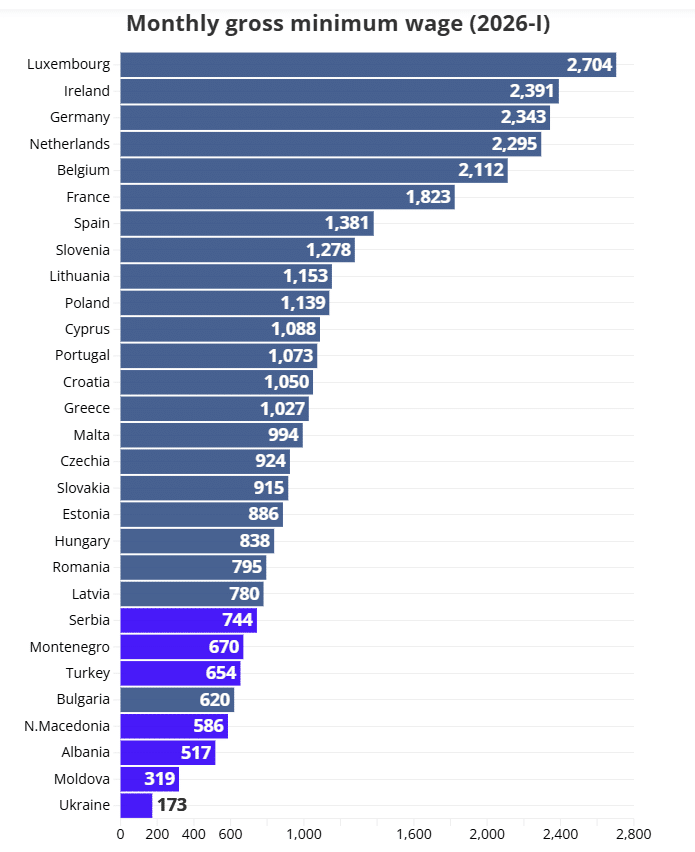
As of January 2026, monthly gross minimum wages among EU member states range from just €620 in Bulgaria to €2,704 in Luxembourg. When EU candidate countries are included, the gap widens further, with Ukraine emerging as a clear outlier at €173, followed by Moldova at €319.
Only five countries currently offer minimum wages above €2,000 per month:
Luxembourg, Ireland (€2,391), Germany (€2,343), the Netherlands (€2,295) and Belgium (€2,112).
Below this top tier, France stands at €1,823, while Spain’s minimum wage drops to €1,381, underlining the striking differences even between neighbouring countries.
Eurostat groups minimum wages into three broad bands:
- Above €1,500
- Between €1,000 and €1,500
- Below €1,000
Spain sits in the middle category alongside Slovenia, Lithuania, Poland, Cyprus, Portugal, Croatia and Greece, where wage levels differ but remain relatively close.
Below €1,000 in Half of Europe
Among 29 European countries — including EU members and candidates — 15 have minimum wages below €1,000 per month. All EU candidate countries fall into this lowest bracket, along with several eastern EU states.
Examples include Czechia (€924), Hungary (€838), Romania (€795), Turkey (€654) and Albania (€517). Notably, three candidate countries now surpass Bulgaria, the lowest-paying EU member state.
Purchasing Power Tells a Different Story
Nominal figures, however, do not reflect differences in living costs. When minimum wages are adjusted using Purchasing Power Standards (PPS) — which measure what wages can actually buy — the disparities narrow significantly.
Under this measure, minimum wages across the 22 EU countries range from 886 PPS in Estonia to 2,157 PPS in Germany. While some rankings shift, the top nine countries remain unchanged when compared with euro values.
Several EU candidate countries perform notably better once purchasing power is considered, surpassing some EU members. Romania shows the biggest improvement, rising from 20th place in nominal terms to 12th in PPS. North Macedonia also climbs sharply, while Serbia and Turkey gain several positions.
By contrast, Czechia and Estonia experience the steepest falls, each dropping eight places once purchasing power is factored in.
Countries Without a Legal Minimum Wage
Not all European nations set statutory minimum wages. Italy, Austria, and the Nordic countries Sweden, Denmark and Finland rely instead on collective bargaining agreements to determine pay floors.
Where Pay Has Stagnated — and Where It Rose
Between July 2025 and January 2026, minimum wages remained unchanged in Belgium, Estonia, Greece, Spain, Luxembourg and Slovenia.
The strongest increases were recorded in Bulgaria, Hungary, Lithuania and Slovakia, each posting rises of more than 11%. Over the full year, wages also stagnated in Estonia, Spain and Slovenia, while Romania’s minimum wage, though unchanged in national currency, fell slightly when measured in euros.
Why the Differences Persist
According to experts at the European Trade Union Institute (ETUI), sustainably higher wages are closely linked to productivity. Countries with strong industrial bases, advanced financial sectors and high-tech industries tend to generate greater economic output — and higher pay.
Collective bargaining strength also plays a decisive role, with better-organised workforces more able to secure wage increases.
As Europe enters 2026, the figures highlight a familiar reality: while minimum wages are rising in parts of the continent, where you live still largely determines how far your pay will go.
United Kingdom Comparison
In the UK, there is no officially defined monthly minimum wage, as pay is set hourly. However, based on the National Living Wage of £11.44 an hour (for workers aged 21 and over), a full-time employee typically earns around £1,850–£1,980 per month (€2,150–€2,300) before tax, depending on whether they work a 37.5- or 40-hour week. While this places the UK among the higher-paying European countries in nominal terms, rising housing and living costs mean that real purchasing power varies widely across the country.