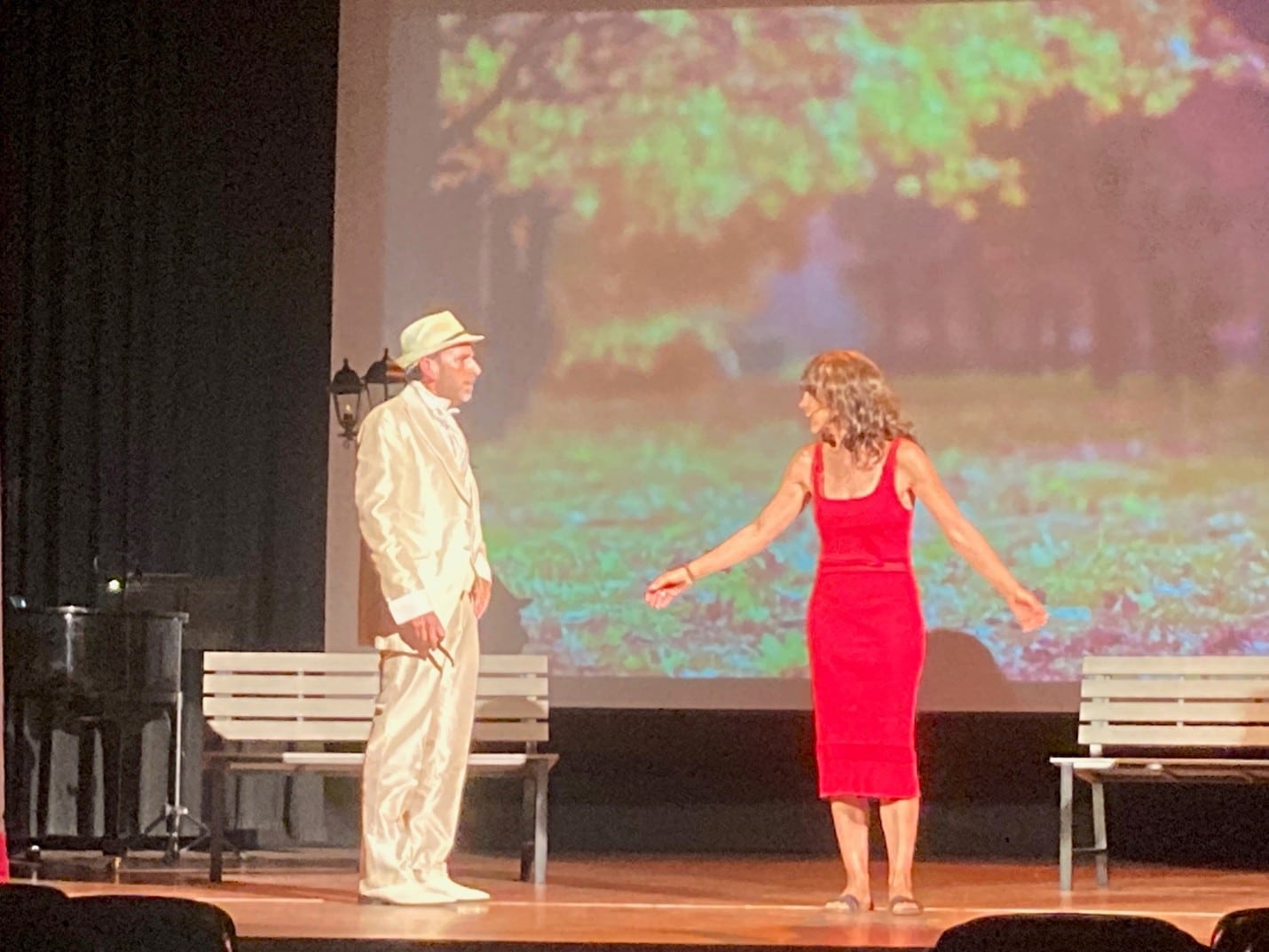
Crescendo International Choir sang in a Spanish play El hombre del banco (The man on the bench) Saturday evening 25 April before a packed auditorium at Los Montesinos School of Music and Culture. Crescendo International Choir, led by Music Director Irene Oliva, provided live music for the performance, accompanied by violinist Josep Andreu Martínez.
A first-of-its-kind event for Crescendo, the choir performed “Humming Chorus” from the famous Madame Butterfly opera as well as the beautiful song “Deep Peace,” by Canadian composer and musician Bill Douglas. Douglas said his inspiration for this piece was drawn from British Isles folk music tradition and Renaissance choral music.
Thirdly, the choir performed a song that combined the popular song “I Believe” by Elvis Presley, song by the male singers, with the Latin hymn “Ave Maria Gratia Plena,” sung by the women. The choir also performed part of the song, “Play for Me a Simple Melody,” composed by Irving Berlin. All four songs were incorporated into the performance of this unique play.
The Man on the Bench was written by Lorenzo Segura and performed by actors Isabel Verdejo and Salva Monleón. Judging from audience response, the play was very well received.
As you can see by this article, Crescendo Choir sings a wide variety of musical selections. If you are interested in singing with Crescendo, you are invited to come to one of their rehearsals. They are held at Rincon de Miguel restaurant in Los Montesinos every Monday from 17:30 to 20:00 until further notice. All singers are welcome.
For more details, see its web site at crescendo-choir.com. You can also follow the group on Facebook at Crescendo Choir. If you have questions, email info@crescendo-choir.com.
The choir would be delighted to welcome new singers. The current choir includes people from England, Scotland, Wales, the US, the Netherlands, Germany, and Scandinavia, among other nationalities. Its music director, Irene Oliva, and pianist Carlos Almela, are both accomplished Spanish musicians.
Photo – Diego van der Hak