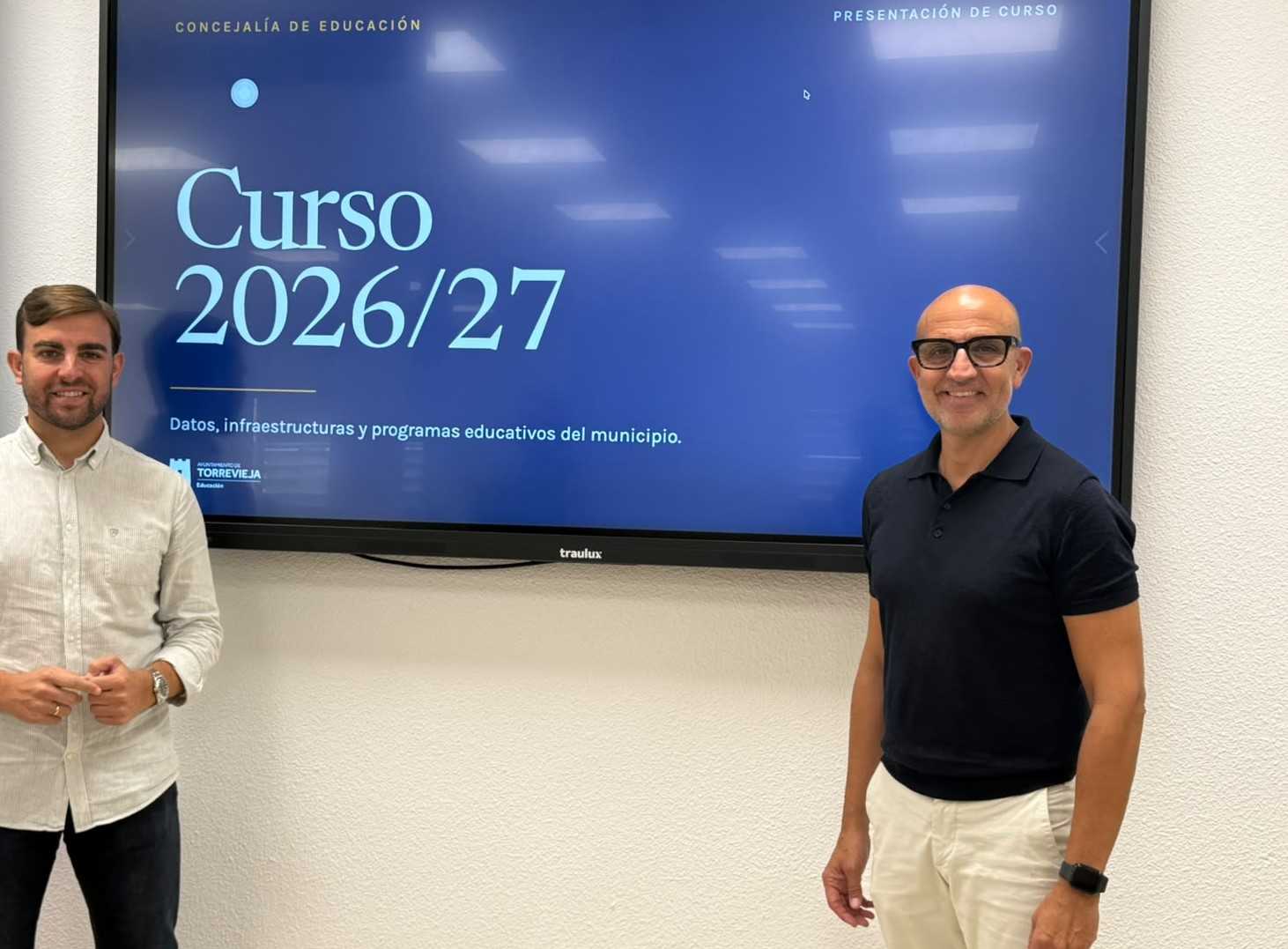
Torrevieja will begin the 2026/27 academic year on Wednesday, September 9, with 17,002 students enrolled across the municipality and ten council-supported educational programmes planned for local schools.
Classes will end on June 18, 2027, for pupils in infant, primary and secondary education, as well as those studying for the Bachillerato and vocational qualifications. The three local non-teaching days will be December 7, February 8 and May 3.
The student population includes 107 two-year-olds, 2,107 children aged three to five, 5,904 primary pupils and 4,151 students in compulsory secondary education. A further 1,068 are enrolled in Bachillerato courses and 1,010 in vocational training.
Adult education has attracted 862 students, while 1,535 are registered with the Official School of Languages and 258 with the municipal conservatory.
Education councillor Ricardo Recuero said the figures reflected the continuing rapid growth of Torrevieja’s school-age population and reinforced the need for additional facilities and resources.
During August alone, the Education Department processed 303 late applications from families arriving or applying outside the standard enrolment period. Of these, 201 involved infant and primary pupils and 102 related to secondary education.
Late enrolment has become one of the most significant challenges facing the local education system as the municipality’s population continues to expand.
Several major infrastructure projects are progressing. The tendering process for the refurbishment of CEIP Virgen del Carmen is under way, while plans are being drawn up for the comprehensive renovation of IES Las Lagunas.
The council also expects to receive delegated authority for the proposed Maestro Lafuente school within the coming weeks, allowing the project to move to its next administrative stage.
Ten municipal programmes will operate during the academic year, covering pupils’ academic, social and emotional needs. These include initiatives addressing school absenteeism, bullying and mental health, alongside coordinated support for vulnerable children and their families.
The “No te calles” anti-bullying campaign will help pupils identify and report harassment, while offering schools guidance on prevention and early intervention.
Fourth-year pupils will again be able to participate in sports and nautical activities through the “El Cole en el Mar” programme. Meanwhile, the Mastral Project will provide workshops on meteorology, astronomy and sustainable development.
Environmental activities developed with water company Agamed will promote sustainable resource management and the principles of the United Nations’ 2030 Agenda.
The council will also continue its Academic Excellence Awards and hold another Reinventing Education Congress on March 6, 2027. A Family School programme will provide parents with training and advice on education, family relationships and children’s development.
Other projects include introducing more vegetation into school grounds, creating shaded playground areas and developing safer walking routes. These measures are intended to make schools greener, improve protection from extreme temperatures and provide safer, more sustainable journeys.
Four types of financial assistance will remain available during the year. These will support university students studying outside Torrevieja, pupils receiving academic excellence awards, families facing school transport costs and those purchasing books and classroom materials.
School transport links have also been strengthened through Torrevieja’s new urban bus service. Six routes now connect neighbourhoods with the municipality’s seven secondary schools, with morning services departing between 7am and 7.58am to coincide with the start of lessons.
The council says the improved connections will give families a practical public transport alternative while making pupils’ daily journeys safer and more sustainable.